Honk, Honk; Gone Away!
Every sport has its downside. Consider some of the older, retired NFL players—hobbling about in a fog of multiple concussions. What about foxhunters? Most of us have had our share of concussions and fractures, too. Now comes this hunt report from a retired Master of Foxhounds. Is this what we have to look forward to? He claims his story is tongue-in-cheek. Whatever. But I wouldn’t believe a word of it. -ED
The pack / Alastair Strachan photo
This season’s armadillo hunting has started with a bang. There’s plenty of quarry as the local pack of coyotes has moved away. Lots of rabbits on the golf course is another sign that the coyotes have taken a hike. However, in the wee hours of the night a week ago, I did hear a strange howl out there on the fourth fairway of the golf course.
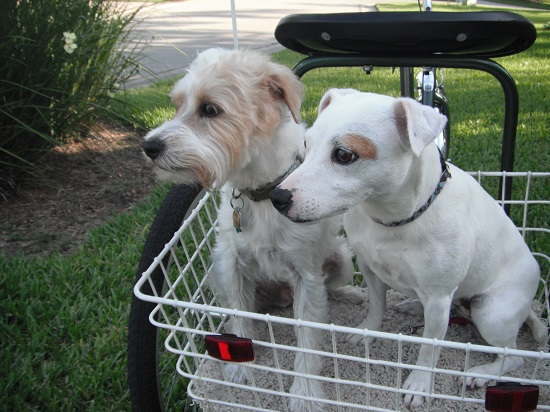
The local radio has been reporting that Florida panthers (no, not the sports team) have moved north of the Caloosahatchee River for the first time. Perhaps it is a coincidence, but a black Labrador and a house cat have been reported missing—another good reason to walk out our pack of Jack Russells in daylight hours.
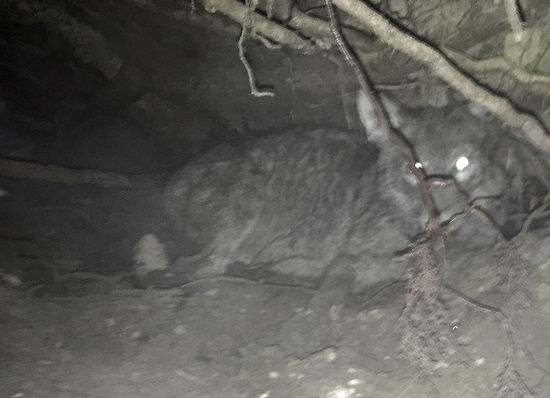
Coyote In the Tunnel
We enjoy publishing hunt reports. The emphasis may be on humor, a unique hunting country, the horse, or the substance of venery, but rarely all that in one package. Epp’s report covers every base, especially substance. In the course of one exciting hunt, the reader is there as the huntsman conjures the best place for the first draw; reads his hounds as individuals; reaps the fruits of hot summer work in the country; assists the Field Master; uses his road whips to advantage when chasing the wide-ranging coyote; makes quick but necessary decisions—right or wrong—to maintain the pace of his hunt and the safety of his hounds; all the while, tuned to the problems of his mount.
Day’s end. / Ed Maxwell photo
The drought in the U.S. Southeast made September, October and November hunting in Georgia some of the most challenging we and the hounds have had in many years. Dust everywhere. Most of the streams long dried up. In others, just pockets of water.
It has been so dry and dusty that the puppies and even some of last year’s entry were tempted to run deer and pigs. Long, boring days where hounds cannot find a coyote to run tempt all but the most deer-broke dogs. We had two days that scent was so bad they could not run a freshly viewed coyote—even when we got them to the view in less than a minute.
The Kilkenny Foxhounds at Mount Juliet
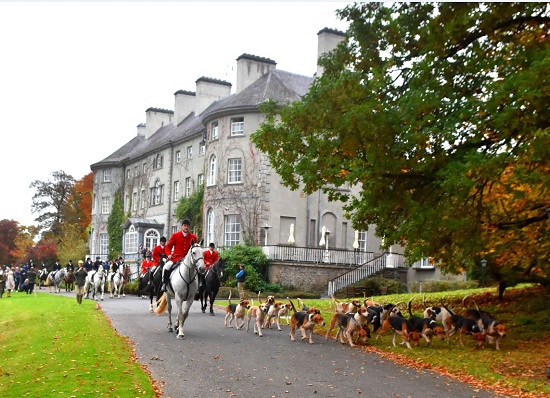
Kilkenny huntsman Peter Cahill and foxhounds move off from Mount Juliet, the spiritual home of the Kilkenny. / Noel Mullins photo
The Kilkenny Foxhounds were founded by John Power in 1797, and the founder was succeeded by his son Sir John Power in 1844. Hounds have been kennelled since 1921 at Mount Juliet when Major Dermot McCalmont, MFH built the kennels. His son Major Victor McCalmont (Master from 1949-1993) continued the hunting tradition until he passed away while in office.
Stepping into the kennels one can feel the sense of history. Although I have reported on the Kilkenny Foxhounds many times in the past, it has been more than thirty years since I attended a meet at Mount Juliet—the spiritual home of the Kilkennys. At the time, Major Victor McCalmont who hunted the pack for thirty-four seasons was Master. Peter Thomas was hunting hounds and Paddy McDonald was whipping-in. I recall the second horsemen dressed in charcoal grey livery and grey bowler hats arriving to exchange horses with Major Victor and the huntsman in the early afternoon.
The Kilkenny, by the way, is seeking new Joint-Masters.
Fort Leavenworth Opening Meet Attracts Foxhunters From Coast to Coast
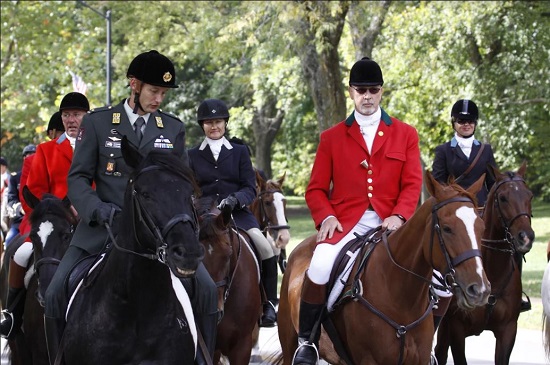
As a part of Opening Meet Weekend 2016, Riders in formal attire participate in a tribute at the Buffalo Soldiers monument. Front, l-r: Infantry Major Jeroen van Rantwijk of the Royal Netherlands Army, who is attending the Command and General Staff College, and Honorary huntsman Dr. Steven Thomas.
The Fort Leavenworth Hunt (KS) put together an Opening Meet Weekend attracting foxhunters from ten states and featuring the hunt’s unique place in our nation’s history. One hundred mounted riders and fifty car-toppers participated in a three-day program that included a historic ride on the 5,600-acre post, Opening Meet, Military Hunt Ball, wreath laying ceremony at the Buffalo Soldiers monument, and guided tours. The events were led by both military and civilian personnel, as appropriate.
Attending guests included current Masters from Bijou Springs Hunt (CO), Bridlespur Hunt (MO), North Hills Hunt (NE) as well as members from other hunts hailing from Alabama, California, Colorado, Kansas, Kentucky, Missouri, Nebraska, Iowa, South Carolina, and Virginia.
Built in 1827, Fort Leavenworth is the oldest active United States Army post west of Washington, D.C. The fort is also the oldest permanent settlement in Kansas. Historically, Fort Leavenworth has been known as the Army’s intellectual center. During the country’s westward expansion, Fort Leavenworth was a forward destination for thousands of soldiers, surveyors, immigrants, American Indians, preachers and settlers who passed through. The fort was the eastern terminus of the Santa Fe and Oregon Trails, and the weekend events were aimed at exposing visitors to much of the post’s history.
The Best Day…On the Planet…Ever
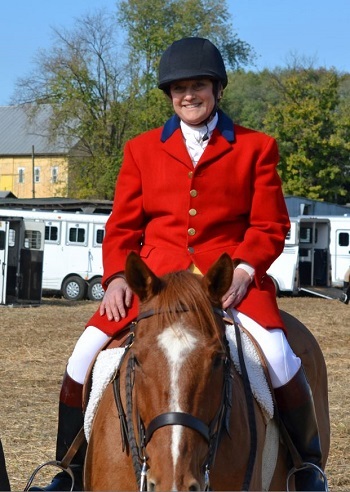
Jackets excused, we started out on this warm early autumn day by hacking left out of the drive and down Lees Mill Road. Passing behind one of the houses a man was bent over a small back door garden while an elderly man watched from the adjacent deck. Although he looked our way the elderly man did not respond to our waves, standing with his arms slack at his sides. The younger man pointed at us and, barely audible, I heard him say we were “looking for the fox.” Closing in on the one year anniversary of the death of my father-in-law, it was a bittersweet scene. Much more sweet than bitter to witness this quiet exchange between what I imagined to be an adult son and his father.
Approaching the creek crossing we heard a whipper-in’s view halloa ahead of us. Shortly after that we heard third field’s view; they had crossed the creek the usual way by the machine shed. The run lasted roughly an hour-and-a-half. At one point there were simultaneous views on opposite sides of the strip of corn running alongside Doss Garland Drive. There were views being called all over the place. Hearing them ahead of me I rushed up only to miss them. Second Field was viewing behind me, and I missed those, too.
Toronto and North York Hunt: From Fort York to Creemore
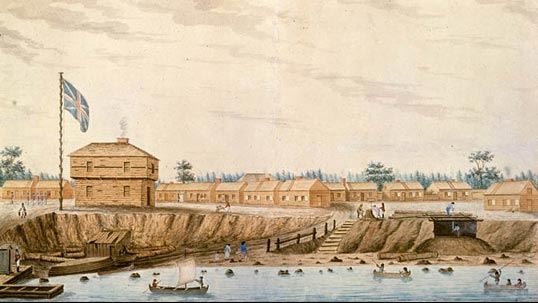
Fort York on Toronto Harbor, early nineteenth century
The Toronto and North York Hunt is proud of the long history of its pack of English foxhounds. Early in the nineteenth century, British military men, fond of sport, shipped hounds across the Atlantic to Fort York, which guarded Toronto Harbour on Lake Ontario. Not long after the City of Toronto was incorporated in 1834, we find mention of the Toronto Hunt. Between 1843 and 1869, eight of the hunt’s nine Masters were army officers.
Grosvenor’s Hill
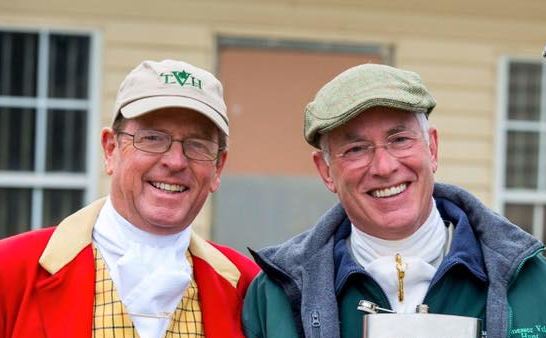
Epp Wilson, MFH, Belle Meade Hunt and Grosvenor Merle-Smith, MFH, Tennessee Valley Hunt are two men who create sport wherever they go. / Allison Howell photo
In January of 2010, Tennessee Valley Hunt had a three-day joint meet with the Belle Meade Hunt down in Georgia. Belle Meade’s MFH and Huntsman, Epp Wilson, had last hunted with TVH’s MFH Grosvenor Merle-Smith when Gro was huntsman for the Bull Run Hunt in Virginia several years earlier. They had what Epp described as an “epic” hunt chasing fox. The two huntsmen had finally organized a recap of that memorable hunt, and the expectations of both men were very high for the weekend.
Twelve of us Tennesseans trekked south to Georgia just west of Augusta. Included were Grosvenor, his wife Rosie Merle-Smith, MFH, and our TVH huntsman Beth Blackwell who brought about eleven couple of Penn-Marydels.
Foxhunting in the “Garden of Ireland”
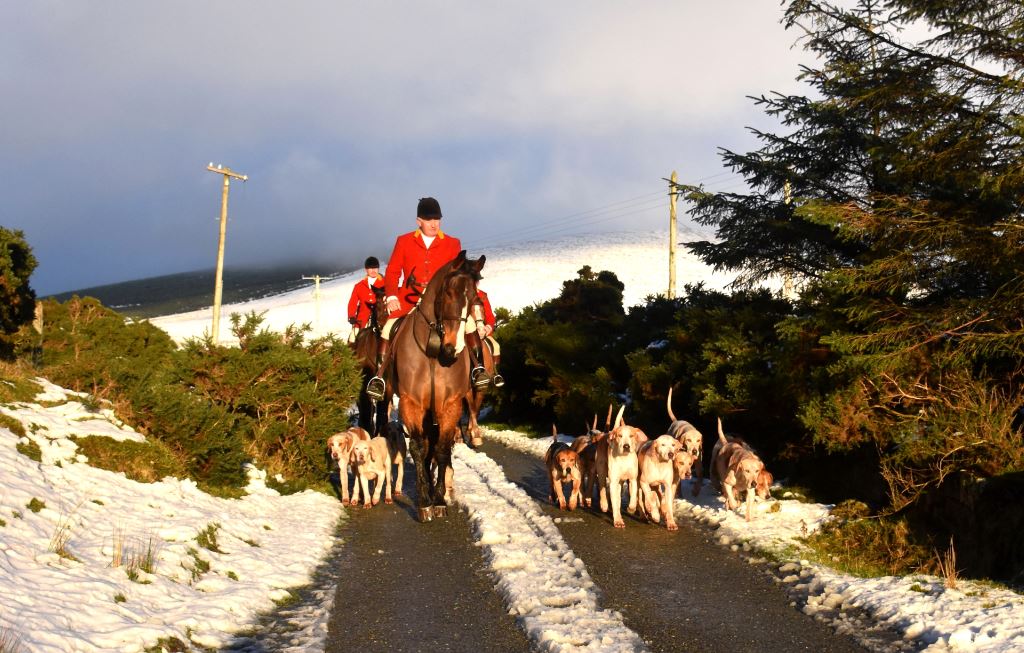
West Wicklow Senior Master and huntsman Rupert Macauley takes hounds to covert. / Noel Mullins photo
Well-known hunting author Willie Poole once said, “There is no landscape in the world that can’t be enhanced by a pack of hounds.” County Wicklow, known colloquially as the Garden of Ireland, has a reputation for beauty quite on its own. Add the foxhounds to a landscape of blue skies, sheep grazing in green fields, extensive plantations, and snow-capped hills, and the image describes perfectly my day with hounds from Pat Kavanagh’s Hampton Lodge Equestrian Centre at Brittas.
Old North Bridge Hounds in the Footprints of History II
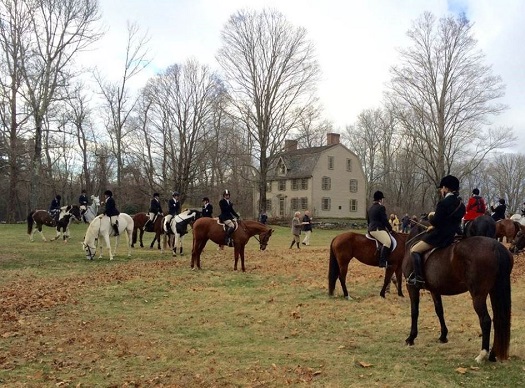
The Old North Bridge Hounds meet at The Old Manse, home of Ralph Waldo Emerson and his forebears, adjacent to the North Bridge, their namesake. / Elizabeth Goldsmith photo
In an earlier story, we read of the Old North Bridge Hounds (MA) meeting at historic Longfellow’s Wayside Inn in nearby Sudbury. This drag pack, established in 1969 and recognized by the MFHA in 1973, boasts connections back to Colonial days, and hounds hunt routinely across some of our nation’s most hallowed ground.
The hunt was organized in Concord, Massachusetts, the town that inhospitably hosted several companies of British regulars on the 19th of April, 1775. On that fateful day, the first British casualties of the War of Independence were shot and killed at the Old North Bridge spanning the Concord River. The redcoats were driven back to Cambridge by scores of Minute Men from surrounding towns who had assembled there, having been rousted by Paul Revere the night before.
Country Closed? Woodbrook Takes ’em to the Beach!
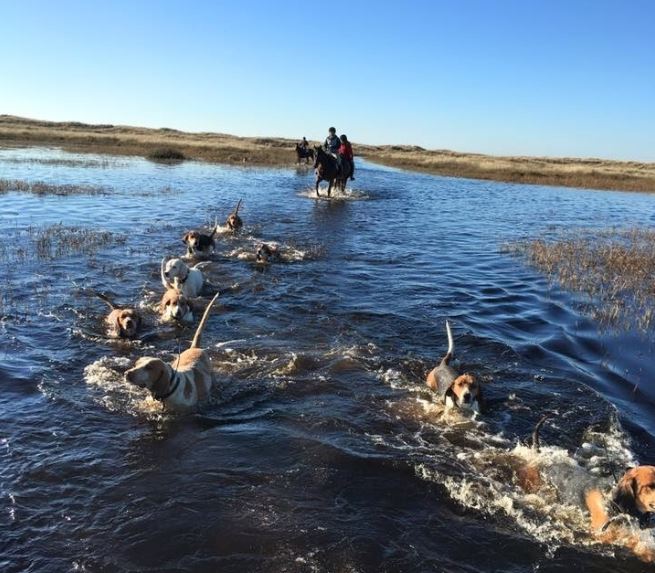
Woodbrook Hunt (WA) takes hounds for a new adventure — a day at the beach. / Emily Rang photo
The temperature was seventeen degrees when we rose at 5:30 to begin our day with horses and hounds. The promise of the day’s adventure outweighed the desire to stay warm in bed. The pack could feel it even in the dark. They bugled excitedly as horses were fed, stalls cleaned, and ice chipped away in the buckets.
The pack always knows when they are going somewhere. Even when the routine is the same in the morning, their hive mind senses the excitement of something different. On this inky black, frozen winter morning typical of the Pacific Northwest, they felt an adventure coming on and sang out a beautiful song to the entire neighborhood: rise up, gather your hunting kit and your best horse, and join us for some fun! Not all appreciate the early, noisy invitation, but the jongleurs, undiscouraged, serenade the neighborhood anyway, hoping to be loaded and on their way as soon as possible.
The Woodbrook Hunt Club (WA) is fortunate to have our hunting country located literally out of our kennel door. The kennels are on a military installation, part of Joint Base Lewis Mcord (JBLM). We have a lot of access, but we must acquire a permit, or the area must be open to recreation. This weekend we had neither permits for the area, as it was Thanksgiving weekend, and the ground was so frozen and slick, it would be galling on our steeds. Our clever huntsman, Jennifer Hansen, who never misses an opportunity for hound action, planned a trip to the ocean with our pack where the weather could be cold, windy, and rainy, but surely not frozen. And we were permitted to ride to our hearts content.