
Every sport has its downside. Consider some of the older, retired NFL players—hobbling about in a fog of multiple concussions. What about foxhunters? Most of us have had our share of concussions and fractures, too. Now comes this hunt report from a retired Master of Foxhounds. Is this what we have to look forward to? He claims his story is tongue-in-cheek. Whatever. But I wouldn’t believe a word of it. -ED
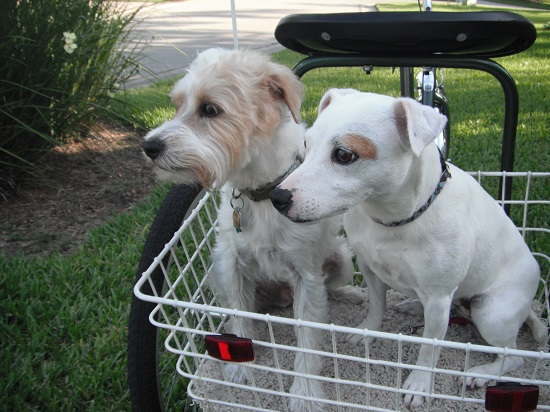 The pack / Alastair Strachan photo
This season’s armadillo hunting has started with a bang. There’s plenty of quarry as the local pack of coyotes has moved away. Lots of rabbits on the golf course is another sign that the coyotes have taken a hike. However, in the wee hours of the night a week ago, I did hear a strange howl out there on the fourth fairway of the golf course.
The local radio has been reporting that Florida panthers (no, not the sports team) have moved north of the Caloosahatchee River for the first time. Perhaps it is a coincidence, but a black Labrador and a house cat have been reported missing—another good reason to walk out our pack of Jack Russells in daylight hours.
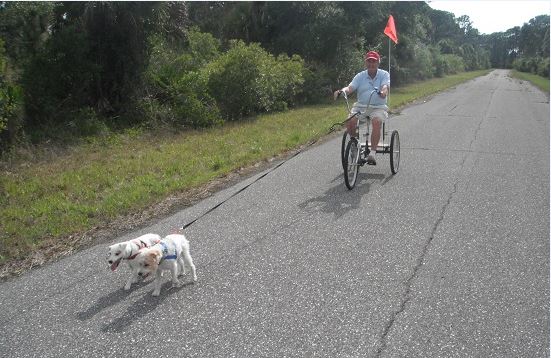 Derek French, mounted, with pack
We continue to hunt with both our dog pack (Simon) and the bitch pack (Sally). The average age of the pack is now ten years, so we are scheduling a few more checks to allow them to catch their breath in the hot weather. But the sight or scent of an armadillo is enough to get them back up to speed. Now that we are in hunting season, I have increased the proportion of flesh (canned liver) in their diet to give them more drive.
We are scheduling meets three days a week. We vary the location but our favourite meet is at the junction of Lyric and Bellweather roads where we often find an old tortoise waiting for us. The Jacks have yet to figure out how to attack through the armour plating. So long as the tortoise keeps his nose and stubby little legs under cover, he is safe. Our pack just gives him a quick sniff and a ‘how are you’ and then goes in search of less heavily armoured quarry. I have managed to convince Simon that it is rude and unsporting of him to cock his leg and give the old gentleman a quick squirt before moving on. He insists it is simply a friendly gesture.
Our hunt country runs in straight lines as we go up and down the back roads which have been installed well in advance of any house building. A few ‘for sale’ signs have appeared recently but no ‘sold’ signs as yet. That’s kind of surprising as prices are really low; one full acre lot is listed at just $5,200. Just as in Caledon. If it gets too built up we will have to move north where there is plenty of good hunt country.
Our equipment remains the same. The Master’s mount is an adult tricycle with a wire basket behind the seat for transporting the pack to the meet and home again. Instead of a hunting horn, we ring the bicycle bell to encourage the pack to enter covert. A new addition this year is a ‘honker.’ This is a horn with a rubber bulb which you squeeze to produce a resounding honk. This is blown only when an armadillo is viewed and simulates the ‘Gone Away’ cry of a regular hunting horn. It definitely adds to the excitement of the chase.
Our hounds are equipped with shoulder harnesses attached to a 12-foot lead line which slips over the handle bars of the trike. The only other piece of equipment is the hand brake on the trike. An essential tool, I hasten to add, as it is the only stopping method when hounds go from a dog trot of about five mph to twenty or more when an armadillo is flushed. The wear and tear on this little rubber brake pad is considerable, and this year, for the second time, we had to get it replaced at the local bike shop.
Followers of our sport realize that the purpose of armadillo hunting is to keep hounds and armadillos well exercised, so that all participants can sleep soundly at night. We have special terms for the different stages of the hunt. The sighting of an armadillo is known as a rumble and is accompanied by much horn-honking and cries of encouragement (or is it fear?) as the speed goes from five mph to twenty in three seconds. A successful conclusion of the hunt is known as a tumble. That is when the hounds meet up with their quarry and roll him over, after which the Master saves the animal’s life and a messy clean up by applying the brake. On occasion, this has resulted in a tumble of a different sort for the rider when the angle of the restraining leash is ninety degrees or more.
Hounds have been out seven times this season. Only one hunt proved to be blank, possibly because we had advanced the meet time from 4:30 pm to 3:30 pm as the Master’s presence was required at a cocktail party at 6:00 pm. We can usually count on two or three rumbles each hunt and perhaps one tumble. There was one occasion when we achieved two tumbles just five minutes apart. Such was the excitement on this day that we retired the hunt early. Hounds received an extra ration of chopped liver and the Master poured himself a double scotch and soda.
Posted January 2, 2017
The author is ex-Master of the Eglinton and Caledon Hunt (ON), though that relationship might be strenuously denied in Ontario.