
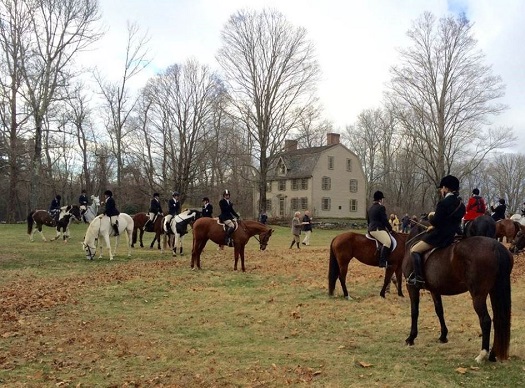
 The Old North Bridge Hounds meet at The Old Manse, home of Ralph Waldo Emerson and his forebears, adjacent to the North Bridge, their namesake. / Elizabeth Goldsmith photo
In an earlier story, we read of the Old North Bridge Hounds (MA) meeting at historic Longfellow’s Wayside Inn in nearby Sudbury. This drag pack, established in 1969 and recognized by the MFHA in 1973, boasts connections back to Colonial days, and hounds hunt routinely across some of our nation’s most hallowed ground.
The hunt was organized in Concord, Massachusetts, the town that inhospitably hosted several companies of British regulars on the 19th of April, 1775. On that fateful day, the first British casualties of the War of Independence were shot and killed at the Old North Bridge spanning the Concord River. The redcoats were driven back to Cambridge by scores of Minute Men from surrounding towns who had assembled there, having been rousted by Paul Revere the night before.
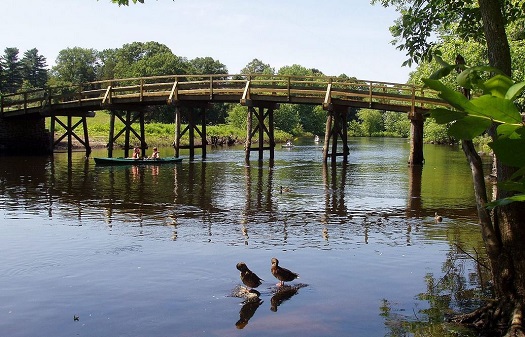 Replica of the Old North Bridge, Concord, Massachusetts, site of the first battle of the Revolutionary War
The Old Manse
In our lead image, hounds are meeting at The Old Manse, built in 1770 just adjacent to the Old North Bridge. Ralph Waldo Emerson’s grandfather built the house and watched the battle from his field. His wife and children observed the fight from an upstairs window.
Ralph Waldo Emerson, having moved to The Old Manse in 1834, wrote the famous poem about “the rude bridge that arched the flood” where was “fired the shot heard round the world.”
A disproportionate concentration of America’s literary luminaries populated the town of Concord in the nineteenth century. Louisa Mae Alcott (Little Women) and her family—Louisa’s father was Superintendent of Schools—lived just beyond the town center on the Lexington road.
Nathaniel Hawthorne (House of Seven Gables) and his new wife Sophia Peabody lived at The Old Manse for three years. Before the couple moved in, Henry David Thoreau (Walden) created a vegetable garden there to welcome them. An upstairs window still bears an inscription written by both Hawthornes and etched into the glass by Nathaniel with Sophia’s diamond.
The Old Manse was conveyed to the Trustees of Reservations by the Emerson family in 1939 with all its furnishings. The house opens seasonally for guided tours and contains a remarkable collection of furniture, books, and homey items, as well as original wallpaper, woodwork, windows, and architectural features.
Across the bridge to the west side of the Concord River and within sight of The Old Manse, stands the Buttrick House. Major John Buttrick, leading the Colonials that day in 1775 saw two of his men leading the militia fall at the first volley from the British regulars.
“Fire, for God’s sake, fellow soldiers, fire!” he yelled, and the Revolutionary War was ignited.
Nearly two hundred years after Major Buttrick uttered his battle cry, Mrs. John Buttrick, one of the organizers of the Old North Bridge Hounds, gave the hunt their name. Former Concordian and well-known Virginia Master and huntsman Sherry Buttrick—MB, Farmington Beagles and ex-MFH, Farmington Hunt—is a direct descendant of Major Buttrick.
Old North Bridge Hounds
Anne Kaiser relates that “A. Henry Higginson (from the town of Lincoln, Massachusetts abutting Concord to the southeast) in his classic book The Hunts of the United States and Canada (1908) speaks of the Millwood Hunt: ‘As early as 1866, Mr. E. F. Bowditch settled in Framingham [MA], and his small private pack, which was kenneled at “Millwood,” his country-seat, has always been kept up by his sons.’
“Millwood became the first organized hunt club in New England, although of course, individuals had maintained hounds for hunting on foot since the founding of the Massachusetts colony. The Millwood Hunt provided great sport for 103 years. When it at last disbanded in 1969, a nucleus of its members, mostly from Concord, MA, pooled their enthusiasm, experience, and resources with other interested people in the area and formed the Old North Bridge Hounds.
“The group was appropriately named by Mrs. John Buttrick, a long-time Concord resident. Clearly these folks did not share the opinion of one of Concord’s residents in Bowditch’s time who was quoted as saying that he considered hunting ‘a godless custom’ and that he regretted the ‘bringing back of the red coats, which were driven out of Concord in 1775.’”
Since its earliest years, the Old North Bridge Hounds hunted country on both sides of Monument Street north of the Old North Bridge along picturesque wooded trails and across small fields, often alongside the well-sheltered Concord River, weaving its way placidly northward where it drains into the Merrimack River.
Anne Kaiser, again: “Hunt territory has been centered in Concord, Acton, and Carlisle, plus areas in Framingham, and Stow. Since 2000, ONBH has developed exciting new country in Pepperell, Groton, and Hollis, New Hampshire. The terrain is mostly wooded with some open fields and water crossings, and stone wall, fallen tree, chicken coop, and logpile jumps abound. ONBH hunt country is made up of suburban and rural territories. To avoid back yards and busy roads, the hounds follow a drag made up of anise and vegetable oils, expertly laid by the “Mama Fox,” Kathy Wright, and her intrepid crew. Safety of the hounds is assured, and the field has an exhilarating run over a variety of jumps, plus the opportunity to watch and hear hounds work.
“The pack of American and Crossbred foxhounds is hunted by Ginny Zukatynski, who shares the Mastership with Marjorie Franko.”
For History Buffs
A touching bronze plaque in memory of the fallen British soldiers sits by the pathway to the Old North Bridge. It reads:
Grave of British Soldiers
They came three thousand miles and died,
to keep the past upon its throne:
Unheard, beyond the ocean tide,
their English Mother made her moan.
April 19, 1775
Finally, this article would be incomplete without a word about the Minute Man statue—a magnificent bronze representing an armed patriot striding boldly forward for his country, one hand lingering on the plow he leaves behind. The statue was erected at the Old North Bridge in 1875 to commemorate the Centennial of the action at Concord. The town fathers reached out to a young local artist from Concord, Daniel Chester French. They awarded him his first professional commission and paid him about $24.00 which just about covered the cost of his materials. While countless visitors have admired his resolute Minute Man, surely many, many more from around the globe have gazed in admiration at his later works, one of which is the seated figure of a contemplative Abraham Lincoln at the Lincoln Memorial in Washington, D.C.
Posted January 28, 2016
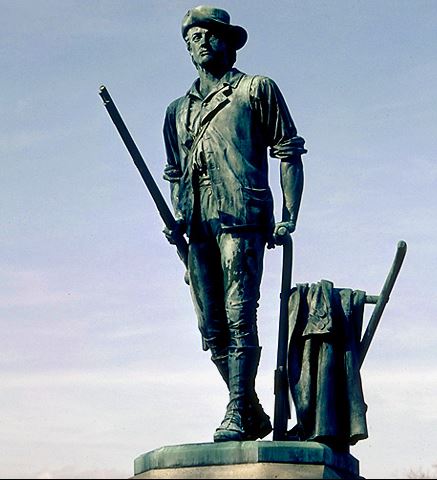 The Minute Man statue by Daniel Chester French stands by the Old North Bridge in Concord, Massachsetts.