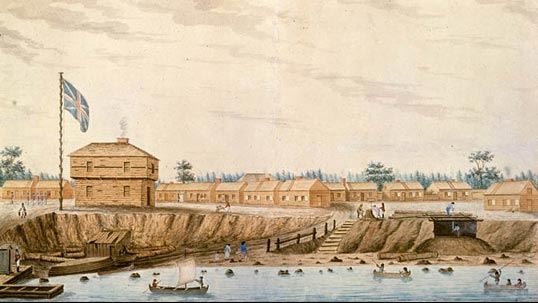
 Fort York on Toronto Harbor, early nineteenth century
The Toronto and North York Hunt is proud of the long history of its pack of English foxhounds. Early in the nineteenth century, British military men, fond of sport, shipped hounds across the Atlantic to Fort York, which guarded Toronto Harbour on Lake Ontario. Not long after the City of Toronto was incorporated in 1834, we find mention of the Toronto Hunt. Between 1843 and 1869, eight of the hunt’s nine Masters were army officers.
In the 1860s a group of businessmen reformed the hunt as a club, complete with rules and a president, and the “garrison hounds” were merged with other private packs. In the 1870s hounds were kenneled in the city, on Clinton Street near Bloor. Hotel owner M. Augustus Thomas was amateur huntsman, often following a dragged scent to guarantee a run. The pack was in the care of Irishman Jack Halligan from 1843 until his death in 1885. Dr. Andrew Smith, MFH from 1883 to 1893, founded the Ontario Veterinary College and kept hounds there, on Temperance Street, near Yonge Street south of Queen (the college still thrives but has moved to Guelph).
Radical change came with Smith’s successor, George W. Beardmore, MFH, a man of substantial inherited wealth and vast ambition. Incorporated as the Country and Hunt Club of Toronto in 1893, for the first time the hunt was not actually based downtown. Land in Scarborough overlooking Lake Ontario was purchased, where a golf course, polo field, tennis court, and grand clubhouse were installed as well as kennels, stables, and a house for a professional huntsman. Beardmore imported hounds from the Fitzwilliam, Grafton, and Oakley hunts in England as well as the Tipperary in Ireland.
In 1922 he hired outstanding English huntsman Charles Morris. By then urban sprawl had ruined hunting near the clubhouse, so Beardmore bought a farm, which he named Beverley, forty-three kilometers (twenty-seven miles) further north, on Yonge Street in Aurora. Morris befriended the neighbours and increased the pack from fifteen couple to thirty-two. The fixture card announced meets in Aurora, Newmarket, and King as “Toronto Hunt – North York.”
When the 1929 stock market crash destroyed Beardmore, D’Alton Lally McCarthy was elected club president and MFH. Under his tactful leadership the horsey folk and golfers separated. With Lady Eaton’s money, McCarthy bought Beverley Farm, and in 1933 the Toronto and North York Hunt was incorporated. Aurora was home to the hunt for the next fifty years. In 1948 huntsman Fred Pickford arrived from England and imported hounds from the Cattistock, Avon Vale, Fitzwilliam, Dulverton, Four Burrow, and the Duke of Beaufort’s hunts. Encouraged by Col. Clifford Sifton, MFH, Pickford not only developed the pack but assisted other Canadian hunts. In 1971 the horn passed to Pickford’s local protégé Robert Oliver. During Oliver’s twenty years of service, the Masters of Toronto and North York included John Elder, Tom Gayford, Lew Scott, and Walter Pady as well as Col. Sifton and his son Michael.
Giving up the Beverley establishment to move further north, first to Newmarket and then to Creemore, was a complex process begun in the early 1980s and not completed until 2005. Along with the decision to continue live hunting came the decision to look to England for a new huntsman. John Harrison was hired in 1991, succeeded five years later by Mark Powell and then Antony Gaylard. These three professionals, each with a different style, improved the pack with carefully selected new blood. With special support from Wolf von Teichman, MFH, they took hounds to shows in the USA as well as Canada, including some foxhound performance trials, and always came back laden with honours. Harrison returned to Toronto and North York as huntsman in 2014.
MFHs Laurel Byrne and Andy Bite, joined recently in the Mastership with the appointment of Carl Feairs, have continued to encourage the showing of Toronto and North York hounds. Today Harrison is making sure that members and guests enjoy the same pleasure experienced by sporting men and women of long ago: hearing and watching first-class foxhounds at work.
Posted September 12, 2016