
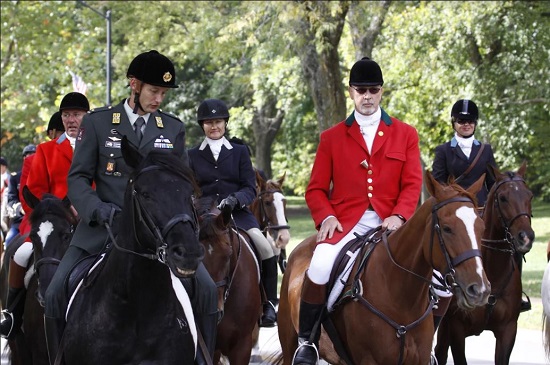
 As a part of Opening Meet Weekend 2016, Riders in formal attire participate in a tribute at the Buffalo Soldiers monument. Front, l-r: Infantry Major Jeroen van Rantwijk of the Royal Netherlands Army, who is attending the Command and General Staff College, and Honorary huntsman Dr. Steven Thomas.
The Fort Leavenworth Hunt (KS) put together an Opening Meet Weekend attracting foxhunters from ten states and featuring the hunt’s unique place in our nation’s history. One hundred mounted riders and fifty car-toppers participated in a three-day program that included a historic ride on the 5,600-acre post, Opening Meet, Military Hunt Ball, wreath laying ceremony at the Buffalo Soldiers monument, and guided tours. The events were led by both military and civilian personnel, as appropriate.
Attending guests included current Masters from Bijou Springs Hunt (CO), Bridlespur Hunt (MO), North Hills Hunt (NE) as well as members from other hunts hailing from Alabama, California, Colorado, Kansas, Kentucky, Missouri, Nebraska, Iowa, South Carolina, and Virginia.
Built in 1827, Fort Leavenworth is the oldest active United States Army post west of Washington, D.C. The fort is also the oldest permanent settlement in Kansas. Historically, Fort Leavenworth has been known as the Army’s intellectual center. During the country’s westward expansion, Fort Leavenworth was a forward destination for thousands of soldiers, surveyors, immigrants, American Indians, preachers and settlers who passed through. The fort was the eastern terminus of the Santa Fe and Oregon Trails, and the weekend events were aimed at exposing visitors to much of the post’s history.
Historical Ride
The first organized event of the Opening Meet Weekend took place on Friday, October 7, as riders in casual attire and two hay wagons full of guests were guided in small groups on a tour of many historical sites on the post.
Beside the airfield can still be seen visible evidence of where, nearly two hundred years ago, wagon trains crossed the Missouri River to pass by Fort Leavenworth and begin their journeys along the Santa Fe Trail, the Oregon Trail, California, and the Smoky Hill Trail to the gold fields in Colorado. One can still see the ruts carved by the wheels and imagine hearing the sounds of wagons full of supplies and belongings of the early settlers being pulled up from the river’s landing. Missouri River steamboats also tied up to unload adventurers, settlers, gold seekers, soldiers, merchandise, and livestock at what was known as the Gateway to the West.
Visitors were also shown the remains of the old Disciplinary Barracks first built in the late 1800s as an afterthought to one of Congress’s more baffling decisions. The Congress had originally authorized the Military Prison to be constructed at the Rock Island Arsenal. At some point, someone must have posed the question, “Why would we want to house prisoners on a site where we are manufacturing weapons of war?” The question didn’t require an answer. Congress amended the original act, and directed that the prison be established at Fort Leavenworth instead!
Visitors stopped to view the Disciplinary Barracks Cemetery where more than 240 souls were interred, including thirteen German POWs executed for the murder of three fellow Germans whom they caught collaborating with their American keepers.
Other historical sites on the tour included Memorial Chapel, built in 1878, where interior tablets memorialize deceased officers, including those killed with Custer at the Little Big Horn. It is believed to be the oldest active chapel in the U.S. Military. Participants stopped at the campground where Chief Joseph and nearly four hundred of his Nez Perce tribe were interred for nine months after their capture in Montana, Otis Hall where Major Dwight D. Eisenhower lived with his family while attending school, and other points of historical interest.
Later in the afternoon, a Welcome Reception was held for members and guests at the Frontier Army Museum. More of the Fort Leavenworth story was told as guests enjoyed heavy hors d’oeuvres and drinks.
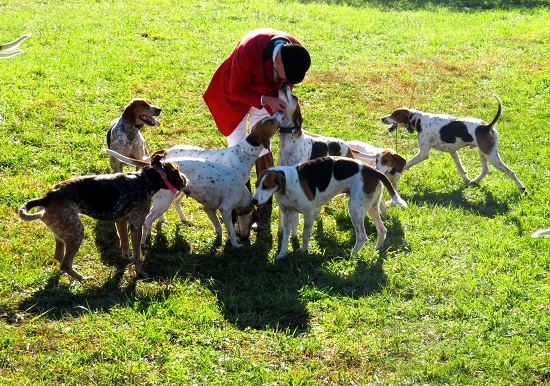 Huntsman Steven Thomas discusses the day’s hunting strategy with hounds.
Opening Meet
Opening Meet was scheduled for 10:00 am on Saturday, October 8. Riders were encouraged to carry a ten-dollar bill in their pockets should they happen to involuntarily join the Croppers Club. We have no report on that club, but Dr. Steven Thomas, an oral surgeon, making his formal debut as huntsman for the Leavenworth pack—his first season hunting a pack of foxhounds—reported that hounds hunted well, despite the warm temperatures.
“Nine-and-a-half couple of Crossbred hounds went out on a beautiful October morning, followed by a hundred riders and nearly half that many in cars,” Thomas writes. “Hounds settled nicely and pushed a pair of coyotes steadily through the first covert until staff saw them break into a bean field and split. Whipper-in Mel Sadler turned one of them back into the hunted country, and I put hounds on. They ran for about thirty minutes through much of the center of the fixture, losing very nearly where they first found. It was a warm day so hounds were taken to the pond, then hacked to the creek for a second water break while the field was treated to the first of two ‘whoopee wagons.’ The next cast took hounds through the Little Green Valley to Trader’s where they found a big red coyote viewed by whipper-in Lucy Hirsch, made a large circle around the Two Ponds with him, and then chased him across the bean field to Brush Creek Valley were they lost in the corn. Hounds got a break at the creek while the field enjoyed a second ‘whoopee wagon.’ Given the heat and two solid runs, hounds were then hunted in close to the huntsman with frequent water stops. It was a beautiful day with excellent hound work and cooperative game.”
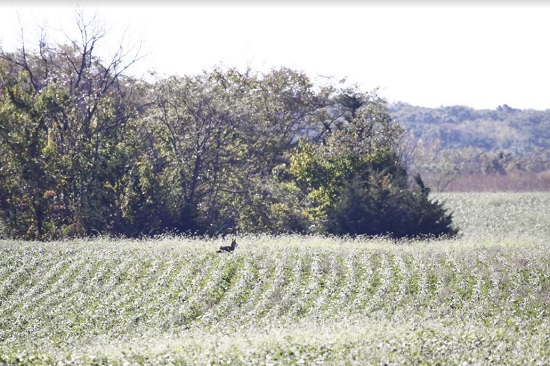 Coyote in the bean field
Hunt Ball
On Saturday evening a Military Hunt Ball was held in historic downtown Leavenworth. Attire was formal with men attending in scarlet, black tie, or mess dress military uniform and women in evening gowns or mess dress military uniform. The evening followed a formal military “dining out” sequence, the rules having been printed out for guests. The sequence included the cocktail hour, dinner, special events—including the keynote speech delivered by hunt member Brigadier General Tom Graves—with each phase of the formal portion of the evening appropriately announced by horn at the precise hour, and concluding with the Retiring of the Colors at 2045 hours (8:45 pm). That final ceremony, closing the evening’s formal “dining out” sequence, kicked off the informal part of the ball—music, dancing, and mingling with new friends made during the morning’s hunt.
Buffalo Soldiers Ceremony
On Sunday morning, riders in formal attire assembled for a final ride and wreath laying ceremony in tribute to the 10th Cavalry (Buffalo Soldiers). Fort Leavenworth was the base of African-American soldiers of the U.S. 10th Cavalry Regiment of the United States Army. Formed on 21 September 1866 at Fort Leavenworth, Kansas, they became known as Buffalo Soldiers, nicknamed by the Native American tribes whom they fought. This term eventually was applied to all of the African-American regiments formed in 1866. The Buffalo Soldiers were also an integral part of the Leavenworth Hunt during the hunt’s formative years from 1931 to 1941. The 10th Cavalry provide the hunt staff, including kennel huntsmen and whippers-in. With the Buffalo Soldiers celebrating their 150th anniversary this year, the hunt wished to honor their service at the Buffalo Soldiers’ monument.
After the ceremony, riders continued on a mounted tour, while non-riders were offered a guided tour of the Louis and Clark Building, home of the Command and General Staff College, hallmark of the U.S. Army Military Officer Education System.
Final Farewells
A Farewell Luncheon, more typically a hunt breakfast, was laid out for guests at the historic Hunt Lodge. After a few closing remarks and farewells, departing guests pointed their rigs at just about every point of the compass for their homeward journeys.
Posted October 26, 2016
With credit and appreciation to photographers Julie Honsinger and Larry Stava.