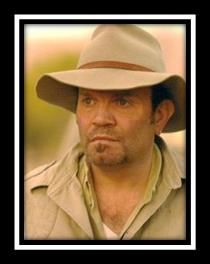
Huntsman Chip Anderson lay terminally ill on the morning of December 7, 2013 as the Santa Ynez Valley Hounds met for their Opening Meet at Master Steve Lyons' KickOn Ranch in Santa Barbara, California. Before hounds moved off, word came quietly to the Masters that Chip had died. Lyons chose to withhold the sad news until after the meet, when, along with the announcement, he dedicated the day to Chip.
I got to know Chip when I was editor of Covertside magazine. He submitted a hunting story to me for publication, and I was riveted. I published a number of his hunting stories and loved every one; they were full of adventure, suspense, danger, and exotic locales.
Chip was mad-keen to hunt. Whatever the game; wherever the habitat; he devoured the experience. He hunted wild boar with foxhounds in California, with Ariegeois hounds in Italy, with the Aidi dogs of the Berber tribes in Morocco, and with the Dogo Argentino on the South American pampas—sometimes with guns, sometimes with short swords, and sometimes with daggers in close combat. He was, for a time, a professional guide for dove and pigeon shoots in South America, and he wrote a fingernail-biter about shooting a cattle-killing jaguar that he tracked with a pack of dogs, one of which was a foxhound from the Tryon Hunt in North Carolina that he had bred while huntsman there.
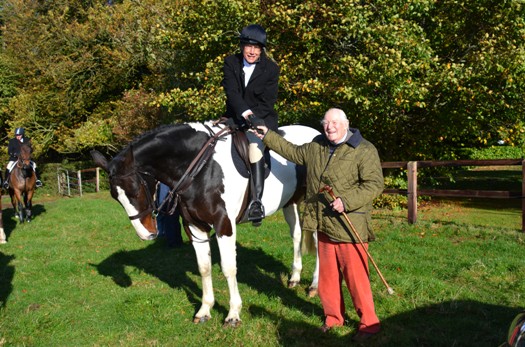
George Briscoe, MH of the Tara Harriers for 71 years, greets Charlie Noell of Ardbraccan House, County Meath, and the Elkridge-Harford Hunt (MD). / Noel Mullins photo
If there were a title of Grand Master of Hounds in our hunting world, George Briscoe would certainly fit the bill. This season George Briscoe hosted his seventy-fifth consecutive opening lawn meet of his beloved Tara Harriers at Craystown, County Meath. The occasion marked his seventy-first season as Joint-Master, making his period as Master and for a time huntsman a world record. Especially when you consider that the majority of the hunt followers were not even born when he succeeded his father in the Mastership in 1942 at age twenty-one.
George is one of nature’s gentlemen, with a broad welcoming smile, a kind word for everybody, and unbounded passions for hunting, the farming community, and the Tara Harriers. He never misses an opportunity to remind followers of the illustrious history of the Tara Harriers. His sitting-room window looks out onto the Hill of Tara, the royal seat of the High Kings of Ireland—probably the most important ancient site in Ireland, the history of which goes back as early as 5,000 BC. George has penned two books on the life of a country gentleman which is a record of life around the big house, hunting, shooting, and fishing, as well as a few racy references just for good measure!
George was a great friend of Betty Bird and her husband Charlie, who was Joint-Master of the Meath Foxhounds from 1956-59 when George was hunt chairman. Later he hunted with the Bird’s home pack, Mr. Stewart’s Cheshire Foxhounds in Pennsylvania, USA. Interestingly one of George’s neighbours, Anne Kelly, left Ireland to work with Betty Bird producing horses for showing and hunting and settled in Pennsylvania. She married racehorse trainer Michael Moran whose mother Betty owned the Aintree Grand National winner, Papillion. Anne is now a Joint-Master of Mr. Stewart’s Cheshire Foxhounds.
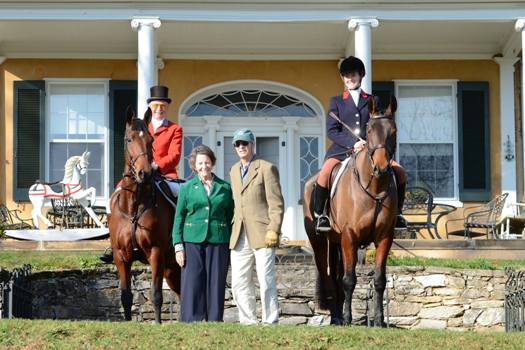
l-r: Organizer Peter Cook, Blue Ridge Hunt; hosts Hettie Mackay-Smith Abeles and Dr. Matthew Mackay-Smith; Denya Dee Leake, honorary whipper-in, Old Dominion Hounds, step-granddaughter of Alexander Mackay-Smith / Liz Callar photo,
It's been nearly seventy-five years since Alexander Mackay-Smith's Farnley Farm in White Post, Virginia was home to a herd of some fifty Cleveland Bays. In his travels, Mackay-Smith had discovered the ancient breed of coach horse in the northeast of England and became convinced they would make ideal field hunters. He imported breeding stock, encouraged Tom and Marilyn Webster of the Idle Hour Stud to buy and stand Rambler’s Renown (who was to become North America’s leading sire of Cleveland Bays), and re-introduced the endangered breed to a new generation of horsemen and women in this country.
Farnley was once again in its bay glory on Saturday, November 16, 2013 as a record number of twenty-one Cleveland Bays (seven purebreds and fourteen part-breds) gathered at the invitation of Mackay-Smith’s children, Hetty Mackay-Smith Abeles and Dr. Matthew Mackay-Smith; Cleveland Bay breeder Peter Cook; and the Masters of the Blue Ridge Hunt for a celebration of the legacy that Farnley has left to the Cleveland Bay breed in North America.
Hetty Abeles and Dr. Matthew Mackay-Smith greeted the Cleveland Bay delegation and welcomed them back to Farnley as they assembled for a photograph in front of the house. Blue Ridge Joint-Master Anne McIntosh gave the official welcome on behalf of Joint-Masters Linda Armbrust and Brian Ferrell, after which participants divided into three flights and trotted up the lane to the first covert.
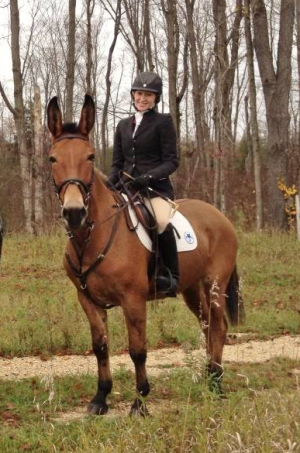
It’s the ears, of course. At a walk, the long, warm-brown ears swing with metronomic precision forward and back, forward and back, to her hoof beats. At the trot, they stiffen forward, and at a check they go into neutral, except when something catches her attention. Then she points with them, head up.
Macy the foxhunting mule is an eight-year-old, 15.2-hand molly (or mare) with zebra markings on her hocks and knees, a dorsal stripe, and a cross on her withers. Her coarse dun hair and sparse tail are more similar to her donkey father than to her quarter horse mother.
She is owned by Suzanne Dow of Dundalk, Ontario, honorary whipper in of the Eglinton and Caledon Hunt and MFH of the Bethany Hills-Frontenac Hunt from 1998 to 2004. Suzanne kindly offered to let me ride Macy for a Monday hunt recently, and I took her up on the offer. A landowner issue caused the hunt to be cancelled, but we did go out for a trail ride so I could sample the virtues of a mule. There are many.
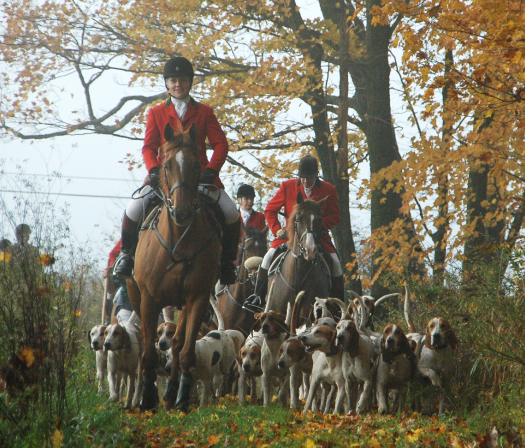
Booli Selmayr, professional whipper-in, Millbrook Hunt (NY): “A good day whipping-in is not having to be told, but instead, allowing natural instinct to guide me: listening to the horn and hounds, reading the terrain, and quickly distinguishing whether fox or coyote.” / Kirsten Edlund-Tunkel photo
Professional or Honorary
The world of whipping-in is split into two camps—professional and honorary. The professional whipper-in often fills the position to gain experience and recognition on his or her road to becoming a huntsman. As the title suggests, it is a paid position. The honorary whipper-in is not paid, is generally recruited from the ranks of the hunt membership, and generally does not aspire to become a huntsman. He or she may be a riding member or one of the Masters.
Professional hunt staff in England go through a structured period of apprenticeship. Years there are spent just doing kennel work before even being allowed to walk hounds out on exercise and before even being allowed on a horse. If recommended, they will finally be taken on as second whipper-in to a hunt. After a few moves, they may be recommended to fill an opening for a first whipper-in somewhere else. Under the system, they purposely move every few years from one hunt to another, gaining experience and exposure to different huntsmen and different methods before finally being offered a huntsman’s post. Clearly a strong foundation is laid through such a rigorous system.
This article was first published in 2013. With an archive of thousands of articles available on our website, we hope you will agree that at least a few are worth republishing!
Booli Selmayr, professional whipper-in, Millbrook Hunt (NY): “A good day whipping-in is not having to be told, but instead, allowing natural instinct to guide me: listening to the horn and hounds, reading the terrain, and quickly distinguishing whether fox or coyote.” / Kirsten Edlund-Tunkel photoTo the uninitiated, the term whipper-in might conjure images of a callous fellow laying his whip across the backs of hounds for every infraction. In fact, the whip is used primarily for its loud crack as an attention-getter. The explosive noise breaks the concentration of hounds from whatever they are doing that the whipper-in wants to stop.
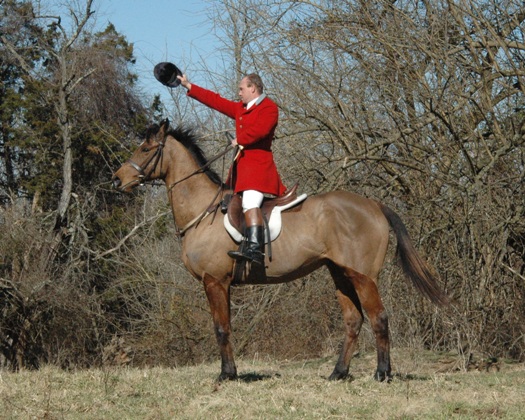
Neil Amatt, professional whipper-in, Piedmont Fox Hounds (VA): “Anticipation, punctuality, how you present yourself—all these things are drilled into you in the English system. You start in the kennels, and you have to really want it before you’re even allowed on a horse.” / Nancy Kleck photo
With the start of a new season just around the corner, we bring back this article, first published in 2013, not only for the benefit of all new and aspiring whippers-in, but also for those field members who wish to appreciate all that happens in the hunting field.
Last season, after forty-five years of hunting, I witnessed a simple act of sophisticated whipping-in that left me shaking my head in admiration. For a huntsman or an experienced whipper-in, it was perhaps no big deal.
My hunt fielded an all-new professional staff last season—huntsman and whipper-in—both of whom were learning the country on the fly. Hounds had checked in a thick covert, and we in the field could see them, heads down, trying to recover the line. The whipper-in came galloping by headed for the end of the covert.
“Over here,” called the Field Master, pointing to a concealed trail. “You can get in over here.”
The whipper-in came back, talked urgently to the Field Master, then turned his horse and continued in the direction he was originally going.
After the meet I asked him what that exchange was all about.
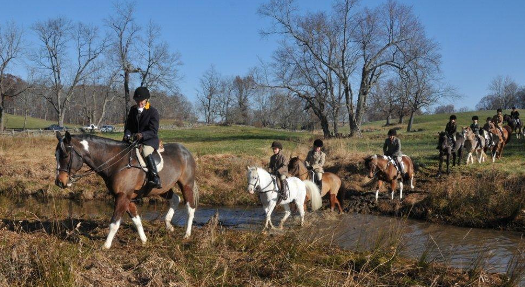
Nancy Dillon has taught children to ride and hunt for nearly half a century. / Liz Callar photo
Nancy Dillon is a living, legendary treasure of the Piedmont Fox Hounds in Virginia. She is the longest subscribing member of the hunt, having started hunting at age eight in 1943. For nearly a half century she has taught and led more children into the hunting field than anyone can count. Her truck and trailer pulling into the meet have been likened to the car at the circus where the clowns just keep coming out.
On Friday, November 8, 2013, the hunt threw a party at Buchanan Hall in Upperville to screen a specially-produced documentary—Lessons in the Piedmont—in tribute to Nancy. Throughout this beautifully-produced and heart-warming film, children (some grown, others still growing), Masters, hunt members, and citizens of the community expressed their love for this woman and their heart-felt appreciation for what she has done to instill a love of the sport, respect for the land, and personal values to generations of children.
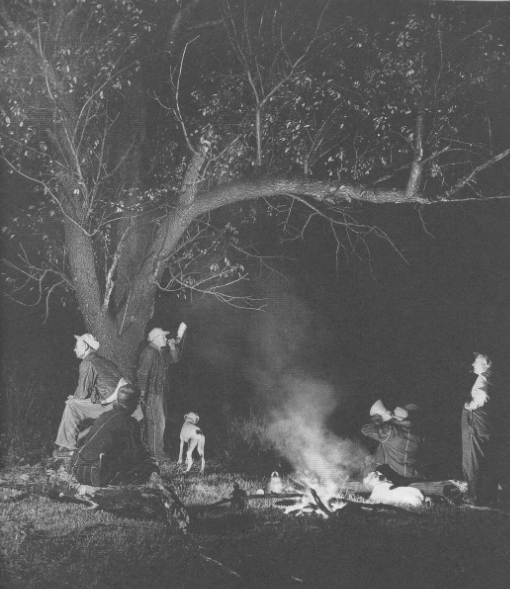
This is a true story as best as I can recollect. I was about six or seven years old that night, but as you can imagine this was a story told and retold around many a local foxhunter’s fire for many years thereafter.
Dad often took me foxhunting with him when I was little. I don’t have many memories of those hunts other than falling asleep in the back of whatever old car dad had at the time. The foxhunting that dad and his friends participated in did not involve horses or fancy scarlet coats. Their steeds were Ford and Chevy, GM and Oldsmobile; the uniforms worn were usually whatever work clothes they had been wearing that morning.
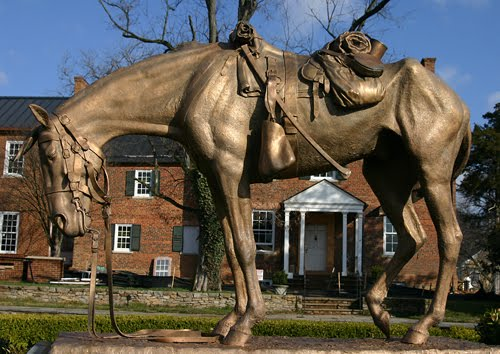
Appalled as we are by the human death and casualty figures resulting from the Civil War, less known is the fact that well over a million horses died in service during that conflict. Many of those horses, belonging to officers and cavalrymen of both sides, must have carried their riders after foxhounds in happier days.
The late Paul Mellon believed that these animals deserved to be remembered, and he determined to create an authentic memorial for them. The result, a product of artistic genius coupled with painstaking research, is an exceedingly moving piece of sculpture. Any foxhunter or horse lover will be well-rewarded by a visit to the National Sporting Library and Museum in Middleburg, Virginia or to the U.S. Cavaly Museum at Fort Riley, Kansas to see either of the two castings from the original mold. (-Ed.)
The sculpture of the war-weary Civil War horse in the courtyard of the National Sporting Library had its origin in the mind of the late Paul Mellon.
In 1994 Mr. Mellon received a book for his eighty-seventh birthday titled The Cavalry Battles of Aldie, Middleburg and Upperville, June 10-27, 1863 by Robert F. O'Neill, Jr. O'Neill had conducted an enormous amount of research through books and newspapers of the period and letters and diaries of the participants that vividly brings those seventeen days to life. Reading of battles and bloodshed of human and horse right in this community had a profound effect on Mellon.