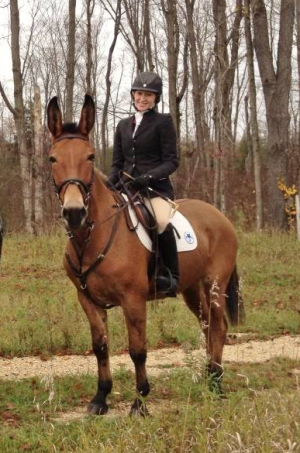
 It’s the ears, of course. At a walk, the long, warm-brown ears swing with metronomic precision forward and back, forward and back, to her hoof beats. At the trot, they stiffen forward, and at a check they go into neutral, except when something catches her attention. Then she points with them, head up.
Macy the foxhunting mule is an eight-year-old, 15.2-hand molly (or mare) with zebra markings on her hocks and knees, a dorsal stripe, and a cross on her withers. Her coarse dun hair and sparse tail are more similar to her donkey father than to her quarter horse mother.
She is owned by Suzanne Dow of Dundalk, Ontario, honorary whipper in of the Eglinton and Caledon Hunt and MFH of the Bethany Hills-Frontenac Hunt from 1998 to 2004. Suzanne kindly offered to let me ride Macy for a Monday hunt recently, and I took her up on the offer. A landowner issue caused the hunt to be cancelled, but we did go out for a trail ride so I could sample the virtues of a mule. There are many.
Narrow withered, straight backed, Macy is smooth, steady and light at the trot, effortless at the canter, and her small, hard, unshod hooves are nimble through brush, rocks and the country’s clear running stream beds. Her gallop can match that of a horse, Suzanne assures me. She neck reins, and even if her short neck doesn’t have the lovely collected arch of a horse, she has her own distinctive charm. I had the sensation of riding an animal that thought rather than reacted, that pondered things and was therefore calmer than the average horse.
“They are deep thinkers,” Suzanne agreed. “Mules are sensitive, they don’t bond easily, and they are tough. Yesterday we went on a ten-and-a-half-mile point on a coyote. You have to figure out how to handle her in a smarter way, not the traditional way like a horse. That means make it easier for her to do the right thing. If you correct a mule harshly, all they feel is fear, they try to get away, and you can’t stop them because they are super strong.”
Suzanne, whose favored mount is Roy, a blanket-hip appaloosa gelding with a dash of draft blood, also owns a white Highland pony gelding named Huckleberry, imported in utero. She’s a former employee of the Ontario Provincial Police and former court administrator. Her longest profession, however, has been that of horse dealer. She found and sold her first horse at a profit at age sixteen and since then has sold hundreds to buyers as far away as Bermuda.
“I love finding and fixing and finding good homes for them. I can sort of see what they can become and really like to help them get there. I’ve sold lots of horses for foxhunting, and even more jumper, eventer and all rounder types. Several MFHs have horses from me. I get a lot of pleasure out of seeing my good horses out hunting.”
The Eglinton and Caledon is the closest hunt to Toronto, and its country comprises Victorian brick farmhouses, herds of cattle, sheep, alpacas, and bay and black standardbreds grazing in pastures. (I also spotted the occasional camel.) There are thin gray lines from Mennonite buggy wheels on the side roads, small towns with big curling rinks (Shelburne), pastures and orchards bounded by zigzag cedar fences, wind turbines, and rock walls.
In hunt season, it’s a land of bright yellow tamarack, red dogwood, tall grasses, thick cedar groves, and forest trails carpeted with pine needles. As we rode down a converted rail bed and across fields, men in blaze orange stirred in the brush, the Grand River clattered with early ice, and sundogs bracketed a pale sun. Dundalk lies on the highest elevation of Ontario, a plateau that can claim the heaviest snowfall in the province, according to Suzanne. It’s a good country for horses and perhaps an even better country for their hardier mule cousins.
Suzanne purchased Macy earlier this fall from MaryAnn Parker, another Ontario foxhunter and horse dealer. From the first hunt, she found the young mule to be a thoughtful, surefooted, and hardy mount, which has contributed to her decision not to sell her.
“She knows where her feet are all the time. There’s no skittering around on her like on some horses. We went to a rock wall with barbed wire and trees all along it, and she just looked over, neatly popped down between the trees and over the wire between big rocks.”
And then there’s the easy-keeper aspect of mules: “I give her very little grain; she’s not like a horse. She would get too hot. She’s efficient.”
“People are fascinated by her, but they bring up mistaken cliches about mules, such as that they are stupid. Some mules are weak in the loins from their donkey side, but she’s jumped two-foot-nine and three feet. They may have some quirks: you cannot leave a mule alone, they need a buddy. Macy doesn’t like needles. And although some mules can be funny about dogs, she’s excellent with hounds.”
A scan of the Internet shows mules in several hunts including Tennessee Valley, Old Chatham, and Bull Run, but admittedly they are still far rarer, given their talents and suitability, than they could be.
“There are few mules in hunts for a couple of reasons, the first one being that most people have the misconception that mules are stubborn and slow,” said Suzanne. “And they do not present the ‘traditional picture’ of a big, beautiful hunt horse. Unfortunately, a few people who hunt are really hung up on appearances, but beauty is as beauty does in my book. I think mules are very beautiful, especially when properly turned out for hunting. And Macy is so good, I think I’ll try eventing her next year.”
Posted December 3, 2013