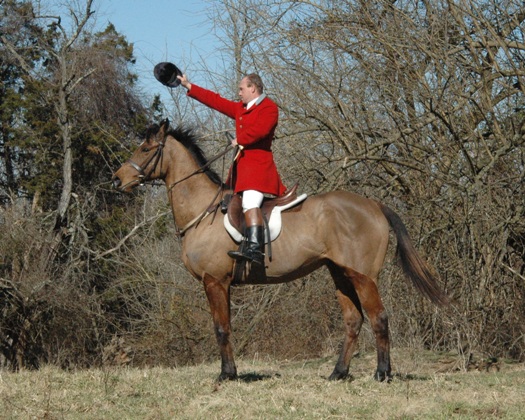
 Neil Amatt, professional whipper-in, Piedmont Fox Hounds (VA): “Anticipation, punctuality, how you present yourself—all these things are drilled into you in the English system. You start in the kennels, and you have to really want it before you’re even allowed on a horse.” / Nancy Kleck photo
With the start of a new season just around the corner, we bring back this article, first published in 2013, not only for the benefit of all new and aspiring whippers-in, but also for those field members who wish to appreciate all that happens in the hunting field.
Last season, after forty-five years of hunting, I witnessed a simple act of sophisticated whipping-in that left me shaking my head in admiration. For a huntsman or an experienced whipper-in, it was perhaps no big deal.
My hunt fielded an all-new professional staff last season—huntsman and whipper-in—both of whom were learning the country on the fly. Hounds had checked in a thick covert, and we in the field could see them, heads down, trying to recover the line. The whipper-in came galloping by headed for the end of the covert.
“Over here,” called the Field Master, pointing to a concealed trail. “You can get in over here.”
The whipper-in came back, talked urgently to the Field Master, then turned his horse and continued in the direction he was originally going.
After the meet I asked him what that exchange was all about.
“I had just been rating a few of the hounds,” he said, “and they were probably a bit apprehensive of me. I didn’t want to go into the covert where they were working, because I was afraid they’d worry and lift their heads.”
Simple but sophisticated! In fact, hounds recovered the line and went on. If the whipper-in had gone in among them and they had lifted their heads, that chase might have ended right there.
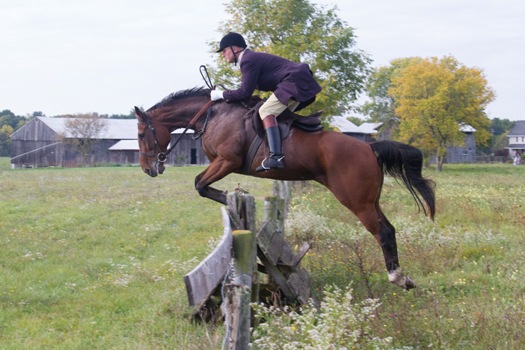 Travis Thorne, professional whipper-in, Genesee Valley Hunt (NY): “For those who whip-in to their spouse, as I do, always be mindful of the picture we present to the world around us and behave accordingly. It’s helpful to keep things in perspective and remember that hunting is a sport, and we do it for the fun of it.” / William Gamble photo
Loyal in Conflict
Peter Beckford, author of the eighteenth century classic, Thoughts on Hunting, considered the whipper-in as a second huntsman, yet added that he should be “obedient” and “attentive” to the huntsman. And, as most huntsmen will insist…loyal.
Philosophically, many professional whippers-in work under what a lawyer might describe as a “conflict of interest.” Although they aspire to be huntsmen, they must submerge their aspirations and work loyally for their huntsman to help him or her show sport.
So what do huntsmen expect from this virtuous sportsman—the whipper-in who is so often verbally abused by his huntsman when things go wrong in the field, yet must do his best to help the huntsman show good sport and garner all the credit?
John Gilbert, former huntsman of the Essex Fox Hounds (NJ) wants a whipper-in who will give him leave to “lose his noodle” on occasion. “The whipper-in needs a thick skin, but not too thick,” he says. “The staff is a team, and the huntsman is the team captain.”
Huntsman Tommy Lee Jones of the Casanova Hunt (VA) wants his whipper-in to possess the same qualities as his hounds: eager, honest, obedient, and no babbler. “The Master is in charge of the field, and the huntsman is in charge of the hounds,” he says. “I assist the hounds, and the whipper-in assists me.”
Huntsmen John Gray of the Hillsboro Hounds (TN) and Donald Philhower of the Millbrook Hounds (NY) agree that a whipper-in should be a good horseman. “The whipper-in doesn’t have to be a show rider or a pretty rider,” says Gray, “but he or she has to be good enough to stay on. If he falls off and spends the rest of the day looking for his horse, he’s no good to me!”
“Anticipation is the greatest trait a whipper-in can have,” says Jones. Corrections are more easily made with less stress to hounds before the problem erupts into a major incident and requires major corrections. That’s where dog sense comes in.
Gilbert wants a whipper-in with dog sense, and huntsman Sam Clifton of the Green Spring Valley Hounds (MD) believes that an effective voice is one of the best tools a whipper-in can have when communicating with hounds. “It should be stern when needed, but otherwise seductive…light and encouraging” he says. “A whipper-in with a nice tone—the words don’t really matter—can accomplish so much. This constant roaring away you hear from some staff members is not good.”
In the Field
“Job-one for the whipper-in is the safety of hounds,” says Jones. Indeed, Randy Waterman, when Master and huntsman of the Piedmont Fox Hounds (VA) was heard to say (hopefully, with tongue in cheek), “I would rather see a dead whipper-in on the road than a dead hound.”
Huntsmen deploy their whippers-in in various configurations depending on the quarry, the terrain, and their own preferences. Some use what in nautical terms can be described as station-keeping—a constant position relative to the huntsman no matter the direction taken. For example, four whippers-in might be deployed at 2:00 o’clock, 4:00, 10:00 and 8:00, with 12:00 o’clock being the direction the huntsman is headed. This may be fine for starters, but as in most military campaigns, once the fighting starts the plans go out the window. Likewise, once the fox is up and running, whippers-in must rely on instinct, good judgement, and their sense of venery.
Ivan Dowling, retired huntsman of Mr. Stewart’s Cheshire Foxhounds (PA) uses the wheel analogy for the placement of his staff. He is at the hub, the hounds may be anywhere on the spokes, and the whippers-in should remain on the rim.
One of the chief duties of a whipper-in in the field is to count hounds whenever in view of the pack and report the count to the huntsman. The huntsman wants to know how many hounds are missing, left behind, or off on their own. He wants to hunt with a full pack, and he is always concerned about hounds left loose in the country. The phrase he most wishes to hear from every whipper-in is, “All on, sir.”
When hounds are running, Dowling still wants his whippers-in counting hounds; he wants them to be aware always of where hounds are headed; and he wants them to be recalling how the fox ran the last time they were there. At a check, Dowling wants information on where hounds last spoke to the line and in which direction hounds were traveling. And keep counting!
In case of a split, the whipper-in must stop the hounds that split and bring them back to the main pack. Whether split or riot, “Get to their head,” says huntsman Geoff Hyde of the Elkridge-Harford Hunt (MD). Once the whipper-in has done that, there is little need for screaming or whip cracking. “Use the voice sparingly,” Hyde recommends.
Sometimes hounds must be stopped even when they’re right. This is something huntsmen hate to do, but if hounds are headed toward a busy road, or to where staff cannot follow, or into country where the hunt is not allowed, the huntsman has no choice. Tony Leahy, Master and huntsman of the Fox River Valley Hunt (IL) uses the term “bumping off.” He’ll get hounds stopped with the help of his whippers-in, then he’ll carry right on with them and lead them somewhere. He tries to make it a fluid movement, keeping their attention all the while so hounds don’t dwell on the question, “Why were we stopped if we were right?
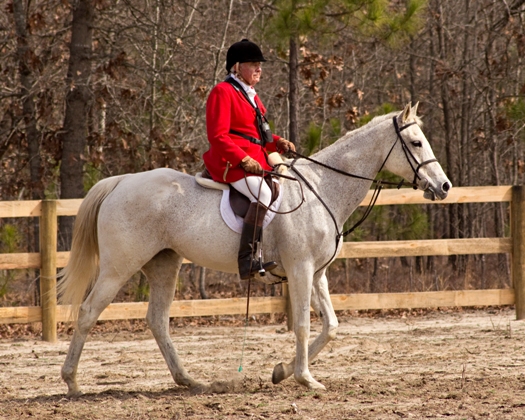 Larry Byers, MFH and honorary whipper-in, Aiken Hounds (SC) and former president, United States Pony Clubs: “Having whipped-in to four hunts and as many huntsmen, my top priorities to be effective as a whipper-in are (1) know the country, (2) know the hounds, and (3) think like the huntsman. / Catherine Davey photo
New-Age Whipping-In
The traditional responsibility of the whipper-in, as expressed by Beckford himself, has been to assist the huntsman in showing sport. A more recent responsibility, as we have noted—and as viewed by some huntsmen as the whipper-in’s principal duty—is the safety of hounds.
With both job requirements in mind, two developments in North American foxhunting—the introduction of the coyote and the increase in motor traffic on the roads—have led to the widespread use of two-way radio communication by many hunt staffs.
Before the electronic age, communication between huntsman and whipper-in was through voice and horn. There is a specific horn call a huntsman can use when he wants the whipper-in to come to him. Other than that specific request, the whipper-in used his eyes, ears, experience, and instinct to tell him what to do.
However, the coyote with its explosive speed and greater range has significantly shortened the reaction time for whippers-in to make those decisions. Loss of open space and increased road traffic have created a more dangerous environment for hounds. While two-way radios have become an important tool in facilitating communications in both situations, huntsmen decry that radios have too easily become a crutch for new whippers-in and actually prevent them from more fully developing their natural senses of country, woodlore, and venery.
Radios are not used at Elkridge-Harford, but for hunts that do use them, Hyde suggests that a first-year whipper-in not be given a radio. This would give the new staff member at least one season to watch and listen and develop his or her own senses of the natural world. Huntsman Gilbert at the Essex uses radios to receive feedback from his whippers-in, but he often finds himself receiving more feedback than he really needs or wants!
Another innovation, developed mainly as a response to the coyote, has been the use of wheel whips in many hunting countries today—motor vehicles in radio contact with huntsman and mounted staff. Wheel whips listen to the radio traffic and try to get ahead of hounds by road. Like their mounted counterparts, they have to learn the country and develop a sense of how the quarry runs. An effective wheel whip can be a tremendous safety asset to the hunt by stopping or slowing traffic on a road to which hounds are headed. It has to be a great relief to Masters and staff as they burst out of the woods onto a road, having caught up to hounds, to find the wheel whip already there with matters in hand.
“At first I resisted the radio,” says Dowling, “but in the Cheshire country with the roads and the traffic, it’s a safety issue.” Dowling uses wheel whips with a rotating caution light that can be clapped onto the roof as well. “I can tell you that the radio and the truck whip have saved hounds…and people.”
Midland Hounds (GA) huntsman Ken George was huntsman at the Moingona Hunt (OK) at the time this article was written. George hunts four days a week and uses both radios and wheel whips. “The radio is an aid; it helps make the pack and the sport better,” says George. “The coyote runs big, fast, and far. The radio is essential for communicating with the trucks.”
George generally has three or four trucks on the roads, not only for hound safety, but also to save the staff horses. Trucks can quickly get ahead of hounds by road and often view the quarry across the road. “Instead of having the whippers-in wear out their horses galloping every which way to keep up with hounds, we wait for word from the trucks.”
Conclusion
A whipper-in who knows the country and is capable of crossing it, who knows the hounds in the pack and which of them can be trusted, and who remembers how the foxes run, can exercise great influence on the outcome of any hunting day. With those tools in hand, innate animal sense and further experience lead to still greater sophistication and give the huntsman his greatest ally in the field.
Posted November 19, 2013
Re-posted September 17, 2016
A version of this article was previously published in The Chronicle of the Horse.