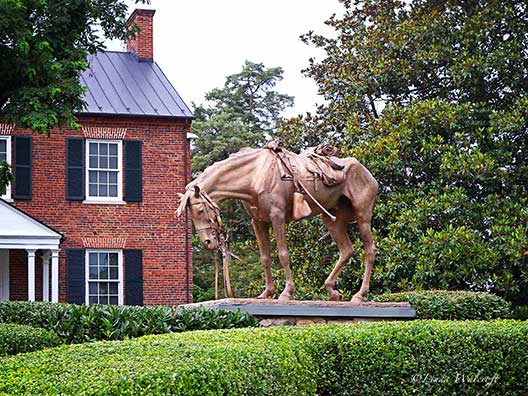
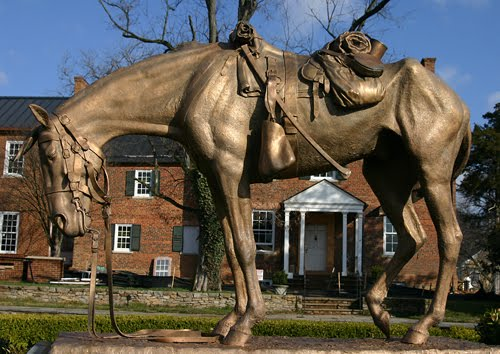
Appalled as we are by the human death and casualty figures resulting from the Civil War, less known is the fact that well over a million horses died in service during that conflict. Many of those horses, belonging to officers and cavalrymen of both sides, must have carried their riders after foxhounds in happier days.
The late Paul Mellon believed that these animals deserved to be remembered, and he determined to create an authentic memorial for them. The result, a product of artistic genius coupled with painstaking research, is an exceedingly moving piece of sculpture. Any foxhunter or horse lover will be well-rewarded by a visit to the National Sporting Library and Museum in Middleburg, Virginia or to the U.S. Cavaly Museum at Fort Riley, Kansas to see either of the two castings from the original mold. (-Ed.)
The sculpture of the war-weary Civil War horse in the courtyard of the National Sporting Library had its origin in the mind of the late Paul Mellon.
In 1994 Mr. Mellon received a book for his eighty-seventh birthday titled The Cavalry Battles of Aldie, Middleburg and Upperville, June 10-27, 1863 by Robert F. O’Neill, Jr. O’Neill had conducted an enormous amount of research through books and newspapers of the period and letters and diaries of the participants that vividly brings those seventeen days to life. Reading of battles and bloodshed of human and horse right in this community had a profound effect on Mellon.
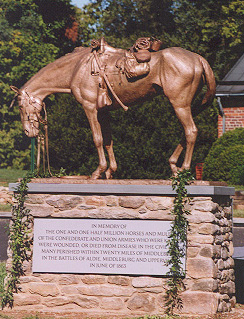 “Mr. Mellon wanted to do something for those horses, and certainly a lot of them died right here in this area,” said Peter Winants, NSL director emeritus. “He stopped by the Library one day and he was telling us he had just read that book. He thought a lot of this Library and the idea for the memorial came up in casual conversation.”
While thousands of monuments have been erected to honor soldiers of the Civil War, none existed to pay tribute to equine efforts and losses. To right this omission, Mellon envisioned an extraordinary bronze sculpture to honor all Civil War horses and mules, both Union and Confederate. To make his vision reality, he sought out the best hands and minds to render a true form.
“Mr. Mellon’s assistant contacted me to find a definitive number of horses and mules killed in the war, and they wanted to make the equipment as accurate as possible,” said O’Neill, a writer and recently retired policeman who was introduced to the three battlefields by Leesburg Civil War historian John Devine. “She wanted to know not just about the leather gear, but what soldiers were allowed to carry.”
The Library sent to Mellon numerous photocopies of saddles, bridles, and other cavalry equipment from books in the NSL’s collection. And they sent photocopies of horses from equestrian art books, including one by Frederick Remington titled “The American Tommy Atkins in a Montana Snowstorm.”
Mellon turned his idea over to sculptor Tessa Pullan of Rutland, England. In 1993, she had produced a three-quarter life-size bronze of Sea Hero, Mellon’s 1993 Kentucky Derby winner. This sculpture still stands at Mellon’s Rokeby Farm.
An outstanding contemporary sculptor, Pullan was apprenticed to artist John Skeaping, R.A. (1901-1980) for three years in the early 1970s. Mellon was well acquainted with Skeaping who had produced commissioned works for him.
“John Skeaping once told Mr. Mellon that Tessa was better than he ever hoped to be,” recalled a Mellon associate. When Skeaping died, all of the work he had yet to complete went to Pullan. Pullan’s work is publicly displayed in the collections of London’s National Portrait Gallery, the National Horse Museum in Newmarket and at the Yale Center for British Sporting Art in Connecticut.
To help Pullan see his vision of the Civil War horse, Mellon consulted many sources to ensure that the overall design was absolutely authentic. “He supplied the photographs which were of a horse used for battle reenactments. He also sent a couple of photocopies of prints or paintings to give me an idea of what he was after. One was a horse in a snow storm, which is the one I based the sculpture on,” said Pullan.
“Mr. Mellon wanted the horse’s stance to look exhausted, like he had no food,” said Mellon’s assistant Beverly Carter. “You’ll notice there’s no sword. The scabbard is empty to show the horse had lost its rider in a cavalry battle. And he’s standing with his back hoof bent, because Mr. Mellon said horses stand that way when they are tired.”
Carter set an appointment with Steve Taylor, a Civil War reenactor with the 4th Virginia Cavalry. She relates the day she and Mellon traveled to Taylor’s farm in Fauquier County: “Steve had his horse saddled and we took over 200 photographs from every angle possible.”
“I was very excited about it,” said Taylor. “I contacted several friends and some equipment was loaned to me for the project. The hardest part to figure out was how to make the horse look Union or Confederate. The difference is that Northern and Southern soldiers used Federal gear, but generally Northern soldiers used all Northern gear. The horse as outfitted came as close as we could get for a horse that may have been outfitted as Northern or Southern. The saddle for example is a McClellan, used by Northern soldiers, but captured or copied and used by Southern soldiers. All gear used for the project is original from the Civil War period.”
From the “horse in a snow storm” and photos of Taylor’s horse, Pullan produced a maquette, a small model of the intended work, which was cast in bronze and shown to a specialist in Civil War accouterments who approved it.
“Mr. Mellon was constantly in touch with comments and ideas about how the sculpture should proceed,” said Pullan. “He felt that my horse looked too well fed and clean. I contacted the R.S.P.C.A. and they provided me with cruelty photographs which were horrendous, but they helped give the effect of a horse whose rider was slain and was dying of exhaustion after a long battle.”
After spending two months to produce the maquette, Pullan then worked for six months to complete the three-quarter-size model. Once the final bronze was cast, a dark patina was applied to protect the finish.
The Civil War horse at the Library was the first to be cast in bronze,” says Pullan. “It was this cast that was shown at the Royal Academy Summer Exhibition.”
Following the show, the horse was shipped directly to Mellon’s home in Upperville. Andrew Baxter of Bronze et al Fine Art Conservation in Richmond first met Mellon when he was hired to repatinate the sculpture of Sea Hero by Pullan. Now he was asked to return to Rokeby to repatinate the Civil War horse because the original finish had deteriorated.
“Mr. Mellon’s first idea for the patina was a dark bay like Sea Hero,” said Baxter. He had just finished removing the old patina with a technique similar to sand blasting using glass beads when Mellon drove up for a look. The horse stood in the garden in his bare golden bronze skin. “Mr. Mellon declared, ‘That’s the finish I want!'” recalled Baxter.
For the inscription on the base, Mellon’s staff contacted Civil War historian Nick Nichols. “I have been collecting primary data on the cavalry of the Civil War for over thirty years,” Nichols said. “I have amassed data relating to equine mortality from dozens and dozens of primary sources, including regimental returns, contemporary correspondence (official and unofficial) and reports, purchasing statistics, data gathered from various equine infirmaries operated by both the Federal and Confederate authorities and more. It is my considered opinion that a reasonable estimate of the equine mortality rate, not including wounded equines, during the Civil War fall between 1,350,000 and 1,500,000. I’m glad that some visitors find this astronomical number unsettling; it certainly should be.” Dwight Young of the National Trust for Historic Preservation combed through the Library of Congress to gather information to confirm these numbers.
With the Library’s Civil War horse completed in 1997, the bronze waited in the Mellon garden at Rokeby until the new building was completed for the NSL. In the meantime, Mellon commissioned a second copy for the U.S. Cavalry Museum in Ft. Riley, Kansas. That horse carries the dark patina.
“The horse at Ft. Riley was the second copy from the same mold as the one for the Library,” said Pullan.
Mellon also wanted a third to be placed at the Virginia Historical Society in Richmond. When he visited the site, “He decided that the horse was too small for the outside of the Historical Society,” said Pullan. A company in England enlarged the mold to full size for the third and so far final bronze.
“The Civil War horse has become the most visited landmark in this area,” said former NSL President Kenneth Tomlinson. “What a legacy to the spirit of Paul Mellon and the horses he chose to honor.”
Lisa Campbell is Head Librarian of the National Sporting Library, Middleburg, Virginia
Posted November 8, 2013