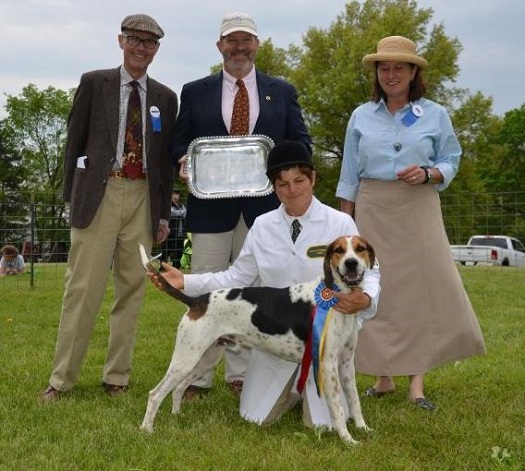
Fort Leavenworth Valor '13 begins his day at Central States by capturing the English/Crossbred Championship. North Hills Kid Rock, last year's Grand Champion of Show, was Reserve. Huntsman Stephanie Wilcox Carter, MFH shows Valor. Judge Cameron Sadler is standing (right). / Glen Carter photo
Fort Leavenworth Valor ‘13 was crowned Grand Champion Foxhound at both the Southwest Hound Show on April 18, 2015 and the Central States Hound Show on May 2, 2015.
Valor is a fitting name for Fort Leavenworth hounds, tied as the hunt is to that venerable military post in Kansas. Three Fort Leavenworth foxhounds have proudly carried the name, Valor, in the last thirty years!
Southwest Hound Show
Exhibiting hunts at the Southwest Hound Show included Brazos Valley Hounds (TX), Fort Leavenworth Hunt, and Independence Foxhounds (TX). Judges George and Jeanie Thomas, MFHs of the Why Worry Hunt (SC) were impressed by both Valor and the hound show. In a “joint communique” George and Jeanie write, “We like Valor a lot, and he showed the way a champion should. We found him to be a very nice hound with super conformation and correctness. He is a fluid mover and has a lot of power from his lovely hind end. Although he is not a big hound, he made up for it with his drive and verve. We are looking forward to seeing him in Virginia!”
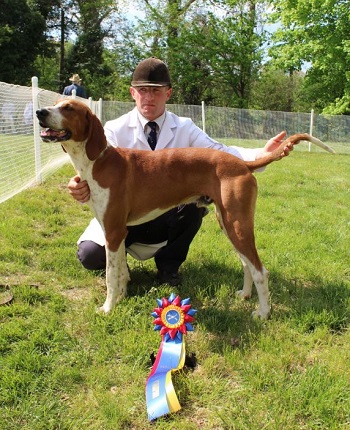
Champion American Foxhound: Orange County Kermit with huntsman Reg Spreadborough / Karen Kandra Wenzel photoFor forty consecutive years, foxhunters from the Mid-Atlantic have gathered on the day following the Kentucky Derby to give their unentered hounds an opportunity to learn what this “hound show thing” is all about. As a prelude to the major shows—Virginia and Bryn Mawr—later in the spring, this show is a bit lower key, but still a serious undertaking. Restricted to unentered hounds except for classes for Produce of Dam and Get of Sire, the emphasis is on teaching young hounds and young handlers what they can expect in a few weeks.
The show is held on a rotating basis among the MFHA-sanctioned hunts in Maryland, and this year the Marlborough Hunt in Prince Georges County served as host. On the banks of the Patuxent River on their lovely grounds for both clubhouse and kennels, the Marlborough folks, under the leadership of Masters Katherine Cawood, Patty Sasscer, and Christine Claggett, provided two spacious rings—one for foxhounds where Thomas H. Jackson, MFH, Mr. Jackson’s Flat Creek Hounds and former huntsman of the Mission Valley Hunt Club (KS) would judge the 101 foxhounds entered, and one for foothounds where Forbes R. Reback, MB and Charlotte D. Buttrick, MB, both from the Farmington Beagles (VA), would judge bassets and beagles.
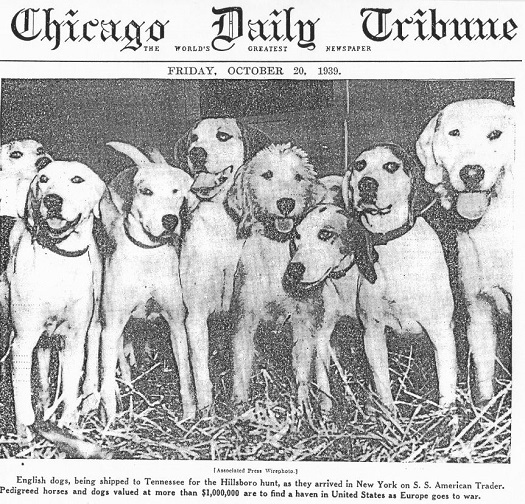
With the seventieth anniversary of V-E Day, May 8, 1945, just days away, we’re reminded of two sportsmen—one in America and one in England—who together tried to preserve the best bloodlines of the modern English foxhound as that type was developing and gaining acceptance over the heavy and ponderous English foxhounds of the so-called “Shorthorn Era.”
Mason Houghland, MFH of the Hillsboro Hounds (TN) and Major W.W.B. Scott, MFH of the North Cotswold Foxhounds (UK) were good friends. As Hitler invaded Poland (September, 1939), and war threatened to engulf Europe for the second time in the century, English foxhound breeders prepared yet again for their government’s mandate of destruction. (In World War I, thousands of foxhounds had been destroyed by the English authorities as a measure to conserve food and grain supplies.) Houghland received the following cablegram from Scott:
“Can you take seventeen couple of hounds for the duration of the war? Lend to friends those you have no room for. Please reply.”
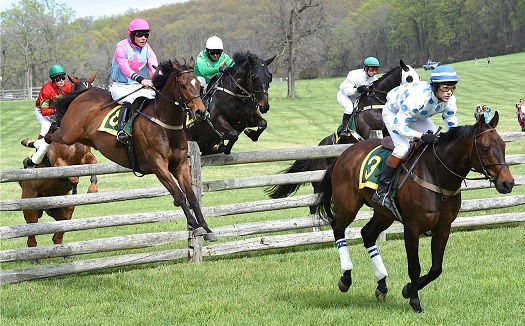
Fence 3: (l-r) Imperial Way (Bethany Baumgardner up) about to jump; Raven’s Choice (Mark Beecher up) 1st; Almarmooq (James Slater up); Guts For Garters (Jody Petty up) 2nd; Twill Do (James Stierhoff up) / Douglas Lees photo
Ten minutes after crossing the wire first, a half length in front of Raven’s Choice, Imperial Way was disqualified. His jockey Bethany Baumgardner failed to weigh out with all the weight she carried into the race. Somewhere, during the course of the race, a twenty-pound weight slipped out of her saddle pad—a first in the 119 runnings of the Maryland Hunt Cup.
It was a double disappointment for Imperial Way, who was beat by just a nose in last year’s race by Stewart Strawbridge’s Guts for Garters. The odds-on favorite this year, Guts for Garters was trying for his second consecutive win, but placed second to Raven's Choice by six lengths after the disqualification.
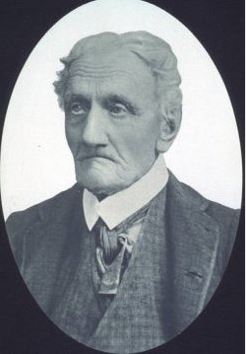
John Woodcock Graves (1795--1886)We’re all familiar with “John Peel,” surely the most well-known foxhunting song of all time. We’re perhaps less familiar with the songwriter, John Woodcock Graves, who turns out to be a most fascinating and unpredictable character—rogue some might say—in his own way. We owe this insight into Graves' life to our Cumbrian friend, Ron Black, who sent us excerpts from A Ramblers Notebook at the English Lakes (H. D Rawnsley, 1902).
In an earlier article, Foxhunting Life describes that night in 1829 when John Woodcock Graves sat in his parlor in Caldbeck, in England’s Lake District, with John Peel. Peel was a farmer, horse dealer, and foxhunter whose hounds were highly celebrated by the local sheep farmers. From the adjoining room, Graves overheard his son's granny singing an ancient Irish melody to the child. Graves took that old melody and wrote a new set of lyrics to honor his friend, John Peel.
"I sang it to poor Peel," Graves wrote, "who smiled through a stream of tears which fell down his manly cheeks, and I well remember saying to him in a joking style, ‘By Jove, Peel, you’ll be sung when we’re both run to earth!'’
Just a few years after that cozy night, however, Graves became embroiled in a violent altercation with an employee, the aftermath of which induced him to leave England forever. His adventures were just beginning.
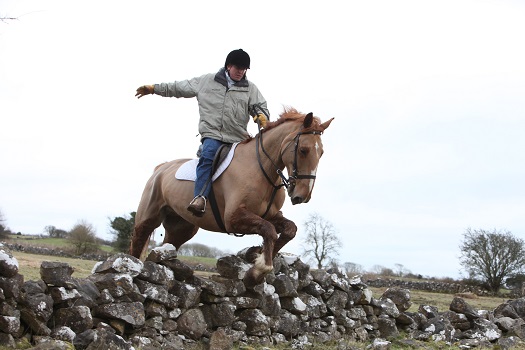
Kail Mantle from Montana: just like riding a bronc / Val Westover photo
Last year, while hunting with the Red Rock Hounds (NV), I met Renee and Kail Mantle from Big Sky Hounds in Three Forks, Montana. Kail gave us a bucking horse lesson one day before hunting. This Montana cowboy, who hunts in chaps and cowboy hat, had sat calmly to his horse bucking crazily above the sagebrush and had seriously impressed me.
When a group of these Western foxhunters invited me to accompany them to Ireland this year, I jumped at the chance. These were fun people---more than a little crazy, and I wondered if anyone had warned the Irish!
I also wondered if my companions knew what they were getting into. I had hunted the big Irish walls and hedges in 2000, and I came home with newfound respect for anyone who hunts regularly in Ireland. It is challenging country, and their version of foxhunting is an excuse to run and jump really big fences.
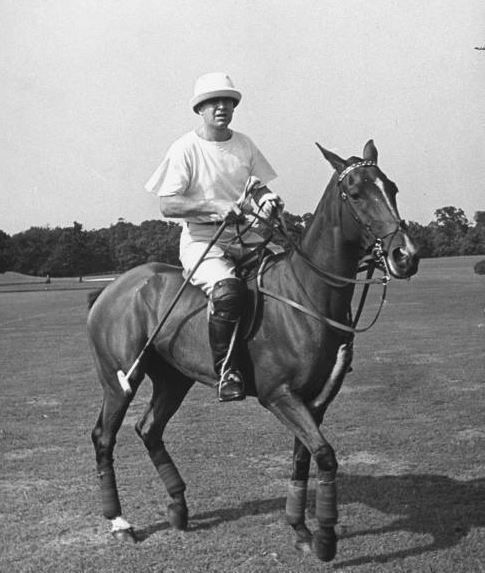
May 8, 2015 will mark the seventieth anniversary of V-E Day, Victory in Europe, the end of the Nazi menace. It’s a propitious time to remember a foxhunting sportsman named Tommy Hitchcock, Jr.
Most Foxhunting Life readers are familiar with his name. Born in Aiken, South Carolina, Hitchcock was an all-around sportsman, a foxhunter, and perhaps the greatest American polo player of all time. A ten-goal player by age twenty-two, Hitchcock led the U.S. team to their first victory in the 1921 International Polo Cup. He followed that feat by leading four teams to U.S. National Open Championships. In 1939, after the death of his mother, Louise Eustis Hitchcock, MFH of the Aiken Hounds, Tommy and his sister Helen founded what is know today as the Hitchcock Woods Foundation in Aiken—a magnificent gift to subsequent generations of horsemen and women from all across North America.
Perhaps less known, however, is the singular role that Hitchcock played in the winning of World War II. If not for Hitchcock, the date June 6, 1944 would most likely not be known to history as D-Day. The invasion of the European mainland would have necessarily been postponed. And if it hadn’t, thousands more Allied soldiers would have been slaughtered on the beaches by the German Air Force.
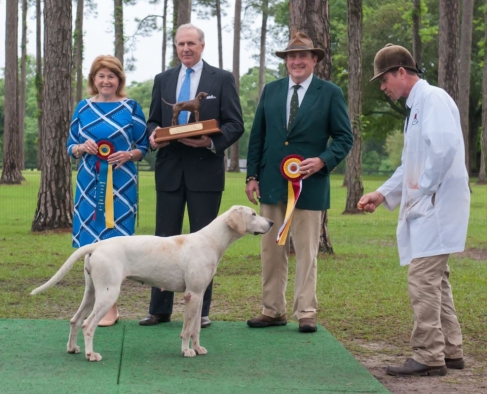
Live Oak Fanfare '10 is Grand Champion of the Southern Hound Show. (L-R): Daphne Wood, MFH, Live Oak Hounds; Michael Ledyard, Esq., MFH Mr. Stewart’s Cheshire Foxhounds; C. Martin Wood III, MFH, Live Oak Hounds; Dale Barnett, huntsman
Captain Ian W. Farquhar, MFH of the Duke of Beaufort (UK), who judged at this show seven years ago, was joined in the ring by John J. Carle II, ex-MFH of the Keswick Hunt (VA).
Ian Farquhar, huntsman for thirty-eight seasons, judged his first show forty-two years ago and has bred nineteen Peterborough champions. Jake Carle, who hunted hounds for twenty-eight seasons, has judged for over forty years at all the major hound shows in the United States. Over the course of the weekend these two very senior judges enjoyed each other immensely and got along famously in the ring despite their English and Bywaters leanings respectively. Interestingly, thirty-four ribbons were won by Crossbreds, and twenty went to English hounds. Two Champions were Crossbred, and two were English.