
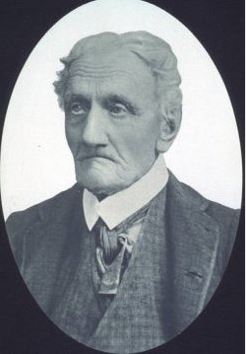
 John Woodcock Graves (1795–1886)We’re all familiar with “John Peel,” surely the most well-known foxhunting song of all time. We’re perhaps less familiar with the songwriter, John Woodcock Graves, who turns out to be a most fascinating and unpredictable character—rogue some might say—in his own way. We owe this insight into Graves’ life to our Cumbrian friend, Ron Black, who sent us excerpts from A Ramblers Notebook at the English Lakes (H. D Rawnsley, 1902).
In an earlier article, Foxhunting Life describes that night in 1829 when John Woodcock Graves sat in his parlor in Caldbeck, in England’s Lake District, with John Peel. Peel was a farmer, horse dealer, and foxhunter whose hounds were highly celebrated by the local sheep farmers. From the adjoining room, Graves overheard his son’s granny singing an ancient Irish melody to the child. Graves took that old melody and wrote a new set of lyrics to honor his friend, John Peel.
“I sang it to poor Peel,” Graves wrote, “who smiled through a stream of tears which fell down his manly cheeks, and I well remember saying to him in a joking style, ‘By Jove, Peel, you’ll be sung when we’re both run to earth!’’
Just a few years after that cozy night, however, Graves became embroiled in a violent altercation with an employee, the aftermath of which induced him to leave England forever. His adventures were just beginning.
What follows are extracts from Rawnsley.
“All the schooling young Graves ever got he got in a “clay-daubing” in a backyard at Cockermouth; but the glazier’s son grew to be fond of Euclid, of mathematics, of drawing, and of mechanics, took to weaving and a woollen factor’s life, married at the age of twenty-one, and was a widower within the year. He passed the next four years at Wigton, and then wedded a woman of remarkable fortitude and patience, one Abigail Porthouse, and apparently settled down for life at quiet Caldbeck [where John Peel lived], away at the back of Skiddaw.
“Things would have gone on smoothly enough with the woollen-factory, but for an unlucky visit of Mr. Brougham, afterwards Lord Brougham, and a Dumfriesshire friend, who knowing Woodcock Graves’ cleverness at mechanics and love of enterprise, induced the woollen-weaver to go in for a coal-mine speculation, away across the border. From that day the woollen-mill ceased to have first place in Graves’ heart. His savings and his profits were sunk in coal.
“An altercation with his manager at Caldbeck Mill ended in what was no uncommon thing for Graves for he was a violent-tempered man, a towering passion, which resulted in blows and a law court. This was in the year 1833. Disgusted with the whole business, [Graves] went to London, and in a few days had made up his mind to sail for the convict settlement of Van Dieman’s Land [now known as Tasmania, part of Australia], and try his fortune under other stars. To the peremptory message to his wife to pay, pack and follow, came remonstrance’s that were unavailing. Graves had always had his own way, was head-strong and was selfish, and, in answer to the entreaties of his wife, he only sent a message that she might choose between accompanying him, or being bereft of the children whom he claimed as companions of his voyage.
“Away they went, the mother with a babe in her arms, with her sons, John and Joseph, and her daughter, who afterwards grew up to be the kind angel of the sick at Melbourne, and who, as Mrs. Hubbard, the foundress of the Benevolent Asylum there, will be long and honourably remembered. The good ship Sirathieldsay landed them in Hobart Town in August of 1833, and with [little] in his pocket and the pictures and books he had brought from Fellside at Caldbeck, John Woodcock Graves began life anew in the convict city.
“The very first night the emigrants slept in their new home, their house was broken into by convicts, and Graves began to realise that he had left “honest-land” for “thief-land.” He cast about for employment, and found little or none; took to making varnishes of some of the native gums; tried his hand as newspaper correspondent, and fiercely inveighed in the press against the cruelties practised on the convicts. The Government, so Graves thought, had broken its word with him in not allotting the requisite number of acres of free ground to his family. Then in a fit of temper he quarreled with the authorities, and for the use of threats which seemed the threats of a madman, he was carried off to a lunatic asylum.
“It was, thanks to his love of the chase and swiftness of foot which he had learned when he followed John Peel “with his hounds and his horn in the morning,” that he escaped from this asylum. For he got into conversation with one of the visiting justices, and found him as keen a hunter as he was himself, and begged to be allowed to have some paint and brushes that he might decorate the asylum yard with pictures of a kangaroo hunt with the justice mounted and well up, and the hounds in full cry.
“The picture progressed till the time came for putting in the sky, when a ladder was required and was gladly put at the painter’s disposal. It was a grand Australian sky, blue as a sapphire, that had been daubed in, when in a twinkle, the painter hopped the wall and left the asylum, prison-hood and hunting picture behind forever.
“John Woodcock Graves might well enough have stayed in that asylum for all the help he was to his wife and family. He went off to New Zealand and Sydney without warning, and remained away for three years without sending word of his whereabouts; when he returned he rated the gentle, long-suffering, and unselfish wife for having broken up his home.
“Meanwhile, with the courage of her Cumbrian stock, Mrs. Graves, who was a well-educated woman, had turned her hand to teaching, to sewing, to washing, to anything that would earn an honest penny; and though the tears fell oft-time down her cheeks, no word of blame for her unhelpful, unstable and unthinking husband ever escaped her.
“The Bishop of Tasmania took one of the fatherless children into his family; another of the girls obtained a situation in a doctor’s family as governess; the invalid son John stuck to his work and obtained his articles as attorney, and became afterwards known as “the honest lawyer,” while the youngest brother, Joseph, grew up to take a shipwright’s place in South-port on the river Derwent, and became the prosperous owner of timber-sawing mills.
“The gentle mother died, the children were scattered with their children growing up about their knees, but the old father was, as he always had been, a lonely man who came and went and lived, people hardly knew how or where. Fond of his dogs, fond of his walk up Mount Wellington, fond of his own way, and quite content to be regardless of anything or any-body, if only he might have a comfortable fire, and books, and minerals, and acids, and mathematical instruments, and model mechanism beside him. Always inventing, always planning, but settling to nothing, and apparently able to forget in his restless wayward life all the nearest duties he ever had owed to his wife and family.”
Perhaps the most constant of all of Graves’ achievements throughout his long life was the song he wrote that night in his Caldbeck parlor in the company of his foxhunting friend, John Peel. In his later years, Graves wrote, “It must be near sixty years since I penned for my darling daughters and [son] this missive, heedless it ever would be heard beyond my own threshold, and yet it has greeted my ear since in all lands on that side or this of the world, through all grades and conditions of men.”
Posted April 28, 2015