With the seventieth anniversary of V-E Day, May 8, 1945, just days away, we’re reminded of two sportsmen—one in America and one in England—who together tried to preserve the best bloodlines of the modern English foxhound as that type was developing and gaining acceptance over the heavy and ponderous English foxhounds of the so-called “Shorthorn Era.”
Mason Houghland, MFH of the Hillsboro Hounds (TN) and Major W.W.B. Scott, MFH of the North Cotswold Foxhounds (UK) were good friends. As Hitler invaded Poland (September, 1939), and war threatened to engulf Europe for the second time in the century, English foxhound breeders prepared yet again for their government’s mandate of destruction. (In World War I, thousands of foxhounds had been destroyed by the English authorities as a measure to conserve food and grain supplies.) Houghland received the following cablegram from Scott:
“Can you take seventeen couple of hounds for the duration of the war? Lend to friends those you have no room for. Please reply.”
Houghland cabled back:
“Yes. Best of luck.”
To a friend in New York, concerning the shipment of the hounds, Houghland wrote:
“These hounds, in my judgement, are from one of the three best packs in England and are the result of great expenditure of time, money, and intelligence in selected breeding. They have a strong infusion of Welsh blood and have been selected on the basis of performance only. However, they do not represent a type. They are mostly small and largely white in color. It does represent the greatest opportunity I know to really study the best of the English effort. I am sure that these hounds will represent the cream of the pack, for the expense is so great that it would be folly to send anything else.”
The Associated Press quoted Houghland as saying, “It will cost about $7,000 to save [Scott’s] hounds but he’ll take the licking before giving them up. The chief expense items for him are ship and rail transportation and their upkeep when they go into quarantine for six months—as required by law—on their return to England.”
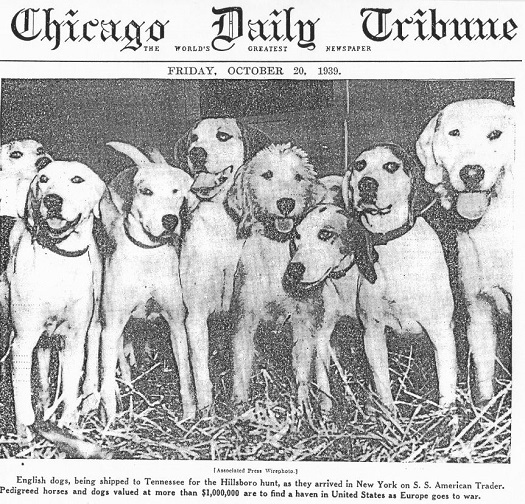
On October 20, 1939, the New York Daily Mirror reported their arrival:
“Barking loudly and wagging their tails, thirty-seven refugee foxhounds from England landed here today and were rushed to the country…. The foxhounds looked so impressive that the New York street hounds growled loudly at them…. On the way to the kennels of Major Scott’s friend, Mason Houghland of Brentwood, Tennessee, who will look after them during the war, I regret to report that New Yorkers, admiring the refugee hounds, referred to them as just ‘dogs.’
“Among other interesting passengers on the same liner were 670 English pheasants [and] nineteen English racehorses destined for American breeding grounds.”
According to Henry Hooker, current MFH of the Hillsboro Hounds, Houghland walked the hounds down Fifth Avenue to the train station with the help of Joe Thomas,* Charlie Carver,** and Simpson Dean, MFH of the Vicmead. Dean was prepared to take half the draft into his keeping. Arriving home with the hounds, Houghland immediately penned a letter to Scott:
Green Pastures
P.O. Box 941
Nashville, Tenn.
October 24, 1939
Dear Bill:
The hounds arrived and I went up to New York to unload them. You never could have devised a piece of propaganda as effective as this one was. No limpid-eyed movie star, staggering off the Normandie, burdened with orchids and rugs, could have ever brought as many cameramen to the dock! Newspapermen beset me on every side! And the next morning, all the principal newspapers of America carried pictures of the hounds and articles about you.
Had I known what a furor would have been raised, I might have done something really useful to the cause of the Anglo-Saxon solidarity. But you did enough. This office is deluged with calls and letters from all kinds of people who are moved by your efforts to save your stock. I will send you some of the newspaper clippings under separate cover.
All the hounds arrived in perfect shape at the dock, ready to go places and do things. A pack of Bengal tigers would not have been more difficult to restrain…. Such a scene of pandemonium among the boxes and crates, you never saw!
The United States Bureau of Animal Industry had a representative there who insisted upon checking the descriptions, etc., and when it came to the long-haired ones, he demurred and wanted them listed as sheep dogs. I finally convinced him that you were an agriculturist as well as a foxhunter and that these were dual purposed hounds, — in the summer they herded sheep and in the winter they hunted the fox.
I understand that the Baltimore Sun, one of our oldest and greatest newspapers, carried an editorial upon the shipment in Sunday’s issue. I have written for it and will sent it to you when I get it….
[B]e assured that all of America is standing guard over your hounds and that unless I deliver them all to you in cotton and wool upon your return from the war, I undoubtedly will be drawn and quartered….
Faithfully yours,
Mason
Henry Hooker concludes:
“[Major Scott’s] actions and his friendship with Houghland make a romantic chapter in the story of foxhunting, but one has to be thankful that the North Cotswold persevered so as not to need those hounds back. While some of that blood remains in the Hillsboro pack today and gives it suddenness on a serving scent, these are but the remnants of yesterdays and the days before yesterdays and deeds not unbecoming men.”
Posted May 5, 2015
*Joseph B. Thomas was MFH of the Piedmont and Mr. Thomas’ Hounds. Thomas was the largest breeder of foxhounds in the first half of this century; and he wrote the comprehensive Hounds and Hunting Through the Ages, Windward House, 1933.
**Charles Carver was among the first fifteen huntsmen (along with Mason Houghland!) inducted into the Huntsmen’s Room of the Museum of Hounds and Hunting. He hunted hounds for the Piedmont, Mr. Thomas’ Hounds, Foxcatcher, Green Spring Valley, Essex, and Vicmead.
The information in this story was provided by Martin Scott, ex-MFH of the Vale of the White Horse (UK). Scott is one of England’s most eminent foxhound breeders and is a valued member of Foxhunting Life’s Panel of Experts. He has visited the U.S. many times as a judge at our leading hound shows and as a panel member in MFHA-sponsored foxhound seminars. Norman Fine previously published this article in Covertside.