The Fantastic Mr. Jorrocks
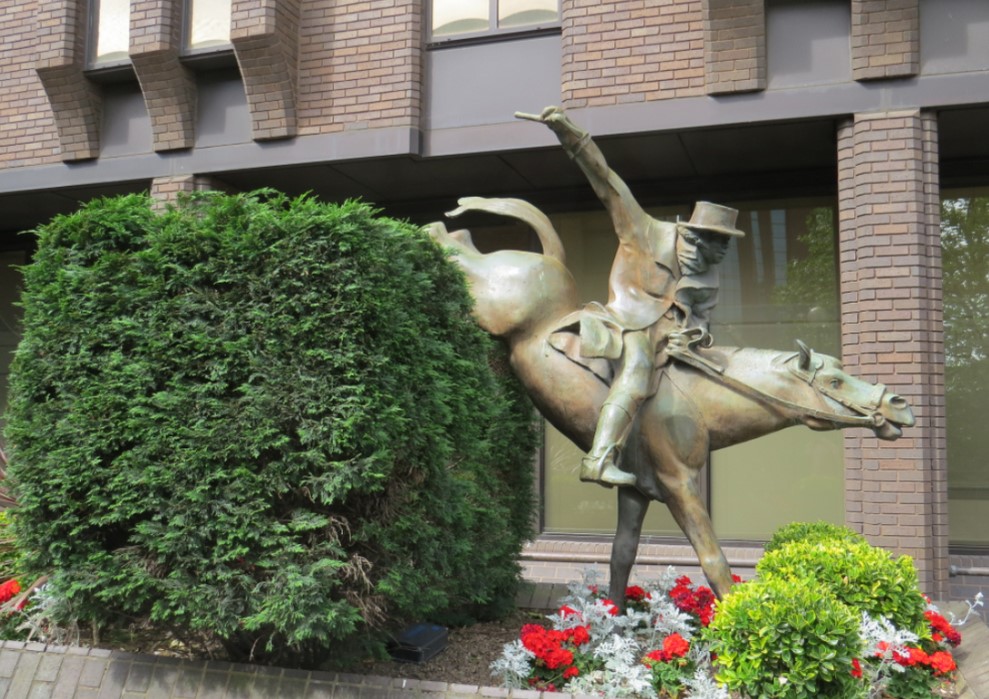
“Unting is all that’s worth living for — all time is lost wot is not spent in ‘unting — it is like the hair we breathe — if we have it not we die — it’s the sport of kings, the image of war without its guilt, and only five-and-twenty percent of its danger.”
—Jorrocks
John Mills, Mr. Jorrocks statue, Croydon. UK
As someone who, prior to 2012, had limited knowledge of sporting literature, art, and artists, I had absolutely no idea who Mr. Jorrocks was. In March 2020, right before the pandemic stopped the world, the National Sporting Library & Museum received a generous bequest from Mrs. Katrina Becker, a faithful friend of the museum for many years. Included in this gift was a portrait of a man with a cheery expression on his face. He made me laugh, and I asked our Head Curator Claudia Pfeiffer, “Who is that?!”
Riding Lesson
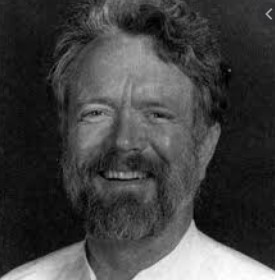
Henry Taylor is an American poet, author of more than fifteen books of poems, and winner of the 1986 Pulitzer Prize for Poetry.
I learned two things
from an early riding teacher.
He held a nervous filly
in one hand and gestured
with the other, saying, “Listen.
Keep one leg on one side,
the other leg on the other side,
and your mind in the middle.”
Liam Clancy: Foxhunter, Artist
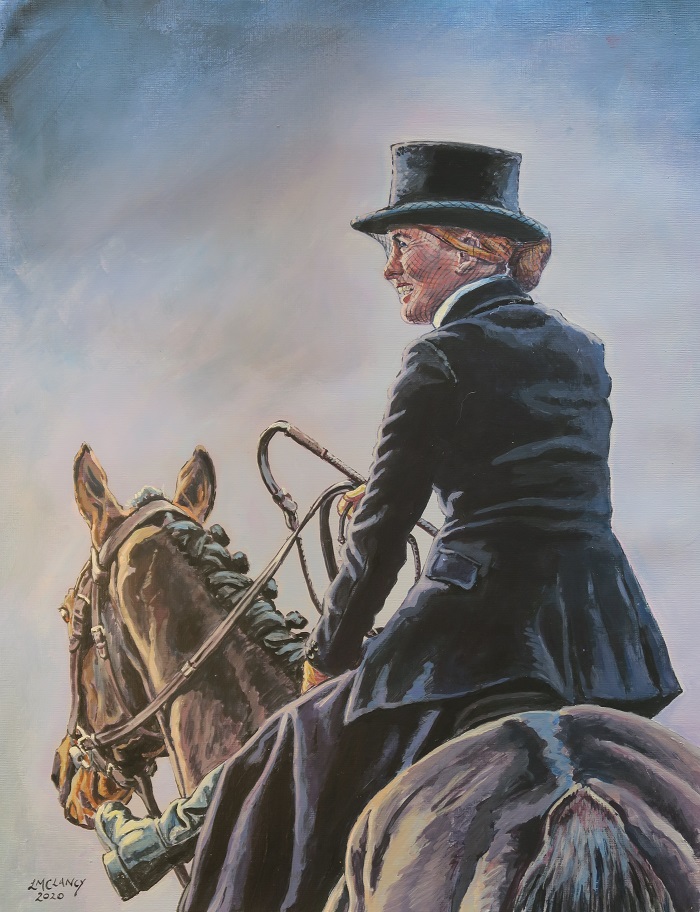
“Elegance.” Maureen Conroy Britell out with the Piedmont Fox Hounds (VA). Acrylic paint on textured acrylic paper.
Irish artist Liam Clancy made a fast tour of the Virginia and Maryland hunting countries during the first week of March 2020—just before the world stopped in its tracks as the result of COVID. He got in some hunting, both mounted and on foot, and he gathered material for his work—painting commissions.
Liam works mostly in acrylic paint, which he likes for its versatility. “I can dash off something that looks like a watercolor, or build up a painting in layers as you would with oils,” he explains.
Within the Confines of this Pasture, How the Universe Is Understood
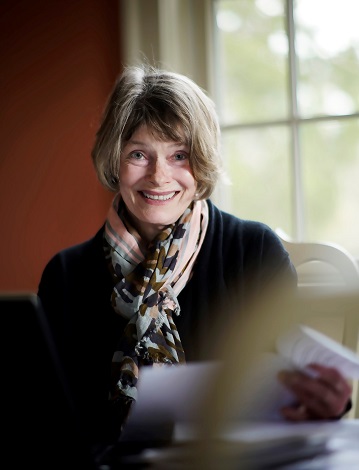
Wendell Hawken / Matthew Klein photo
September pitch-black mornings I leave the lights off
so I can see to find my horse out in his field,
his flat black shape darker than the dark.
Rope and halter in one hand, ankle-deep in tall grass dew,
I walk to where he might be – beside his rock outcrop,
or rump up to his poplar.
The Fox’s Morning
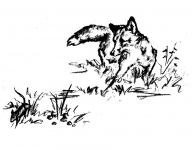
The Fox’s Morning & Other Stories, W.H. DeCourcy Wright, edited by Ann L. McIntosh, illustrated by Peggy Kauffman, The Elkridge-Harford Hunt, Maryland, 2010, 106 pages, $33.00It is possible that the fox was not content with such a diet as nature has provided for him, but chose to invade the domain of man, and to filch from an ill-protected roost of chickens, a matronly hen, whose eggs had been helping to fill the basket of some thrifty farmer’s wife. Pleasure would be too mild a word to employ in describing the fox’s sensations resulting from a successful venture of this kind. Wild rapture would be more appropriate, with a dash of sneering derision and scornful mockery of humankind, whose efforts at poultry raising the wild animal finds so interesting. In any event, it is probable that he welcomes the pale light of dawn as a signal for him to relax.
Hark! Old Horse
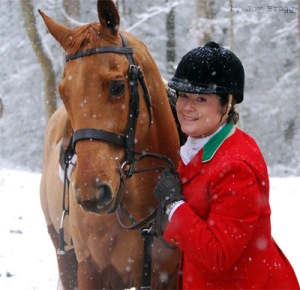
Carla Hawkinson, MFH with her soulmate, Forty-One, her inspiration for the poem / Joy Bragg This poem was first published in the Summer 2008 issue of Covertside when I was editor of that magazine. It was re-published in 2013 (the year the old horse passed away) in Foxhunting Life. It’s time for a reprise, if only to remind our readers that there are some excellent contemporary sporting poets still among us, though precious few.
The horse, Forty-One, died at age twenty-seven. He hunted the better part of nineteen seasons for the author, who was MFH of the Tennessee Valley Hunt.
The Hunt-Inspired Fine Art of Miniatures
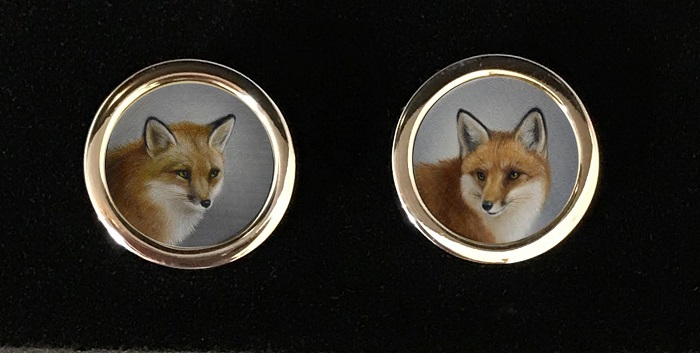
Interchangeable cufflinks, dime size 17.91mm
When Beth de Loiselle—a painter and instructor of fine arts—met up with the work of Susan Smith Burnett and Paul Eaton—both designers and makers of fine bespoke jewelry—the result was art for wearing, not hanging.
Dog and Horse Fine Art Gallery in Charleston, South Carolina was representing these fine artists individually, but gallery owner Jaynie Spector also saw advantages to be derived by connecting the painter, de Loiselle, with the jewelers, Burnett and Eaton. She scheduled a sporting art event at the gallery and prompted Beth to furnish miniature horse portraits for cufflinks.
At Galway Races

William Butler Yeats“At Galway Races” was written in Coole Park, Lady Gregory’s house, in 1908 after the poet had spent a day at the Galway Race Meeting. That is over a century ago but the wish it expresses is the same as that expressed by the new Minister for the Arts in Ireland, Heather Humphries, in a recent radio interview. It is a wish that is shared by virtually all artists, literary and otherwise, however ‘elitist’ they’re supposed to be: “Art for everybody.” And it is one that Yeats expressed often in prose and poetry.
AT GALWAY RACES
The Fox’s Prophecy

Painting by Anthony BarhamThe Fox’s Prophecy was written in 1871 by D. W. Nash and presented to the then Master of the Ledbury Hounds. Foxes have forever been suspected of harboring deep thoughts, and this poem certainly reflects those ancient superstitions. Through Nash’s fox we read predictions of a future that might well be recognizable to many readers in these times.
However, Foxhunting Life remains apolitical, as always, and, if you read carefully, you will find that for every stone cast by this poem at anyone who might take offense, be assured that there is a stanza here casting a stone as well at the opposite end of the spectrum. The fox, also apolitical, seems to believe that all humans have something to answer for.
For swiftly o’er the level shore
The waves of progress ride;
The ancient landmarks one by one
Shall sink beneath the tide.
Phillipa’s Fox-Hunt (Part 2)
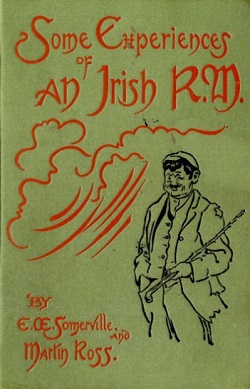
In this week’s Bonus article, free to all (no subscription necessary), we rejoin Philippa as she is escorted into the dining room at Aussolas Castle after her first foxhunting experience. She is fully out of breath, having followed hounds by bicycle and across the country on foot led by two local country lads showing her the way. Major Sinclair Yeates, R.M., who has been following hounds on a supremely confidential hunter borrowed from Lady Knox, finds his new bride in a state of unsuppressed excitement scarcely recognizable from the proper young English lady he supposed he had married.
Mrs. Knox was already at breakfast when Philippa was led, quaking, into her formidable presence. My wife’s acquaintance with Mrs. Knox was, so far, limited to a state visit on either side, and she found but little comfort in Flurry’s assurances that his grandmother wouldn’t mind if he brought all the hounds in to breakfast, coupled with the statement that she would put her eyes on sticks for the Major.