
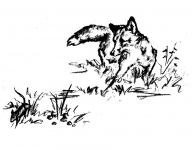
 The Fox’s Morning & Other Stories, W.H. DeCourcy Wright, edited by Ann L. McIntosh, illustrated by Peggy Kauffman, The Elkridge-Harford Hunt, Maryland, 2010, 106 pages, $33.00It is possible that the fox was not content with such a diet as nature has provided for him, but chose to invade the domain of man, and to filch from an ill-protected roost of chickens, a matronly hen, whose eggs had been helping to fill the basket of some thrifty farmer’s wife. Pleasure would be too mild a word to employ in describing the fox’s sensations resulting from a successful venture of this kind. Wild rapture would be more appropriate, with a dash of sneering derision and scornful mockery of humankind, whose efforts at poultry raising the wild animal finds so interesting. In any event, it is probable that he welcomes the pale light of dawn as a signal for him to relax.
A little later when he settles down near the edge of the woods, he beholds the appearance over the far horizon of an arc of fiery red with calm satisfaction. No call to work is the rising sun to him. Let human beings busy themselves with their complicated duties, as the day shall advance. For him it only means that nature is lighting a fire this wintry morning to bring warmth and rest to him. Guilelessness, playful innocense, languid rapture are terms that have no meaning in the life of a fox, I fancy. Rather there is much of the grim heroic in his nature, which may be understood readily if we bear in mind the history of his species extending back for thousands of years, during the course of which successive generations have perpetuated themselves, hanging on to the skirts as it were, of civilized agriculture, ever regarded as pests to be exterminated, yet always surviving and incidentally furnishing sport to gladden the hearts of men.
The aura of sensations and yearnings that make up the fox’s conscious life must have many high-colored gleams, as well as humdrum shades of paleness. Ever since biblical times when fox’s got into trouble through their fondness for grapes, they have been guilty of intrusions into the rustic arrangements of mankind. With respect to grapes nature took notice of that vulpine weakness and evolved a kind of wild grape (fox grape) that may be enjoyed by foxes in all innocense.
With respect to the particular fox now serving as a model for crude delineation, we may easily fancy the sublime sense of satisfaction that steals over him as he stretches himself at the root of a tree where the wind has managed to accumulate a thick bed of leaves for whosoever may choose to lie there. His suspicious eyes close sleepily as the “eyelids of the morning” open and the red arc over the horizon grows into a glorious sunrise. Crows take wing in the frosty air, roosters begin to crow, calves bawl, and pigs squeal as the countryside awakens; and the fox relapses into a blessed slumber.
Walls upon which hang crude pictures, but which for the most part shut out the real world that exists so beautifully all about a human sleeper, does not enclose the fox’s bedroom. His bedroom is wide open to the winds, the morning star, the rising sun, and the glaring light of the day; all the forces of nature can operate on him without let or hindrance, and he has thus been invested with a special talent that accounts in some measure for the survival of his species. He has a marvelous knack of slipping away when the whole world rises up and demands his destruction. He has a great facility for withdrawing from scenes where hostile forces converge upon him in overwhelming power.
Some people have a similar talent and can wriggle out from conditions that have become too adverse for comfort. We are inclined to condemn such a human characteristic as cowardly, and to admire those who, with backs to the wall, face their enemies to the bitter end, whatever it may be. Yet in the case of the fox, it is his talent for speedy retreat to the far corners of his domain that exalts him in the estimation of many. By his skill in running away, he is glorified—at least in the eyes of those numerous people who find surcease of sorrow and relief from the dreary monotony of life in the ancient sport of foxhunting.
The pile of leaves on which the animal above mentioned had chosen for his bed was close to the edge of the woods, the latter being bounded by a dilapidated worm fence of chestnut rails. One panel of this remained standing, directly in front of him, with an opening where the middle rail had fallen out of place. To those who like woodland scenes where oak and hickory leaves carpet the earth, and old fences slowly go to ruin, where broom sedge waves and glistens in the field beyond, where scrub pines catch the gleams of early morning sunlight, it would seem to be a pleasant, sympathetic spot for a fox to choose for his morning nap. Life is full of adventure for him, however, and since he seldom succeeds in having his full measure of sleep aboveground without interruption, it was not without precedent that he should be awakened in a rude and shocking manner.
Very suddenly sleep left him. His eyes popped open and he was awake in very fiber of his body, for there confronting him was the face of a hound, framed in the opening between
the fence rails. A black face it was, trimmed with tan, and it contained two soulful brown eyes, focused upon the prostrate fox. Fortunately for the latter the opening in the fence was big enough for the hound’s head to stick through but not for his body, so when the fox’s state was altered from one of repose to one of great mobility, he himself became a mere reddish streak flashing through the woods. The hound tried to push through the fence, bringing the rails down on top of him to his delay and embarrassment, and evoking from him a furious howl.
It is not my desire to describe the hunt that ensued, or to relate that other hounds joined in and made the woods ring with a melodious chorus. The whole matter ended in half an hour, at a hole in the ground, several miles away. Hounds, after scratching the earth and quarreling with one another, as is their wont, were induced to leave for other parts, and silence returned.
Posted August 25, 2020
Extracted from The Fox’s Morning & Other Stories by W.H. DeCourcy Wright, edited by Ann L. McIntosh, illustrated by Peggy Kauffman, The Elkridge-Harford Hunt, Maryland, 2010. Mr. DeCourcy Wright was one of the “defining personages from the glory days” of the Elkridge-Harford Hunt (MD), wrote Turney McKnight in his review of The Fox’s Morning, published posthumously by the hunt in 2010. W.H. DeCourcy Wright suffered a fatal fall from his horse in 1951 while foxhunting.