“Unting is all that’s worth living for — all time is lost wot is not spent in ‘unting — it is like the hair we breathe — if we have it not we die — it’s the sport of kings, the image of war without its guilt, and only five-and-twenty percent of its danger.”
—Jorrocks
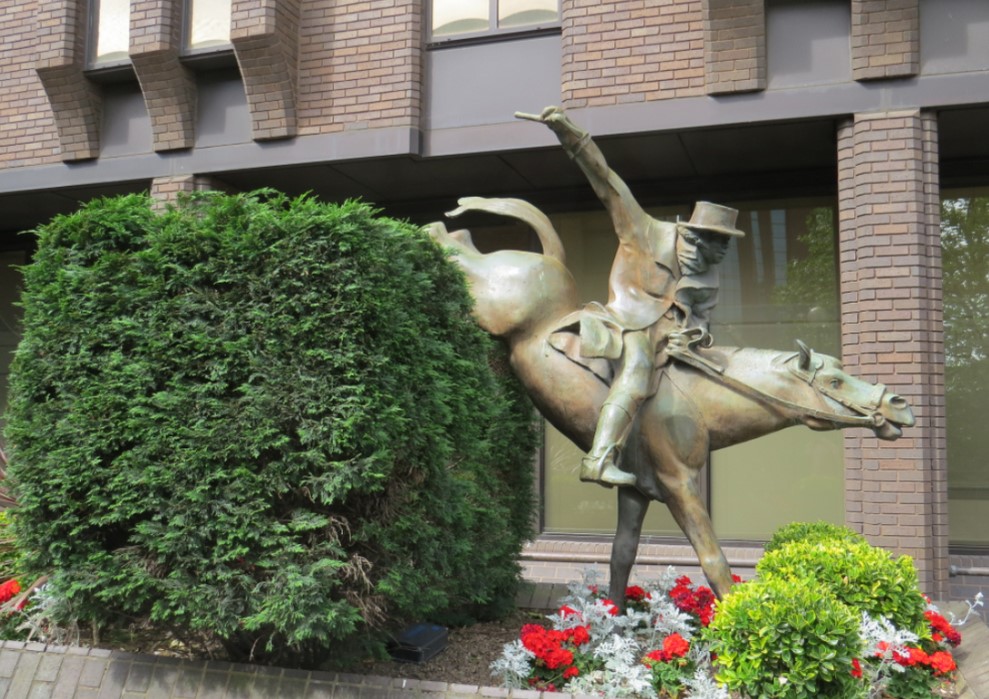 John Mills, Mr. Jorrocks statue, Croydon. UK
As someone who, prior to 2012, had limited knowledge of sporting literature, art, and artists, I had absolutely no idea who Mr. Jorrocks was. In March 2020, right before the pandemic stopped the world, the National Sporting Library & Museum received a generous bequest from Mrs. Katrina Becker, a faithful friend of the museum for many years. Included in this gift was a portrait of a man with a cheery expression on his face. He made me laugh, and I asked our Head Curator Claudia Pfeiffer, “Who is that?!”
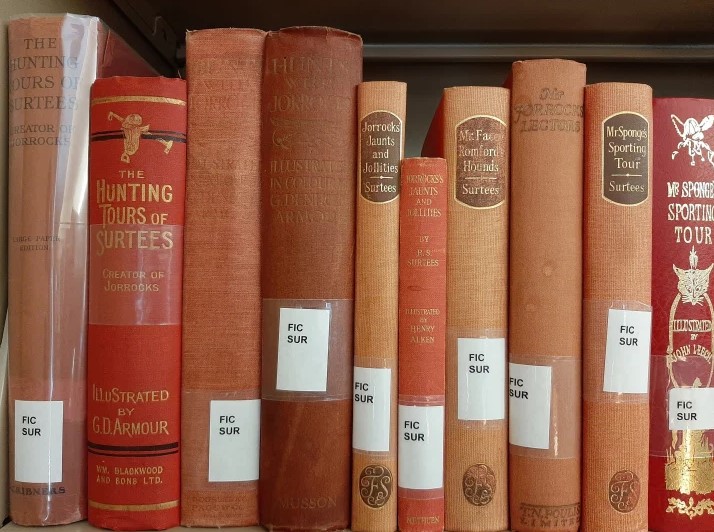
Claudia enlightened me. She explained it was, in fact, the illustrious Mr. Jorrocks, a popular fictional character from English literature, created by Robert Smith Surtees in the early 1830s.
Mr. Jorrocks was featured in serials in the New Sporting Magazine and then in 1838, he was promoted to book form, beginning with Jorrocks’ Jaunts and Jollities; or, The Hunting, Shooting, Racing, Driving, Sailing, Eating, Eccentric and Extravagant Exploits of That Renowned Sporting Citizen, Mr. John Jorrocks, of St. Botolph Lane and Great Coram Street. Quite the teaser.
The titular character, Mr. Jorrocks, is a grocer from the city with a sharp Cockney accent who enjoys the sporting life. Depictions of him often show a corpulent man with a red face, generally (but not always, as seen below) in his scarlet hunt coat. He appeared in several books and was illustrated by such well-known sporting artists as Cecil Aldin (English, 1870–1935) and Henry Thomas Alken (English, 1785–1851).
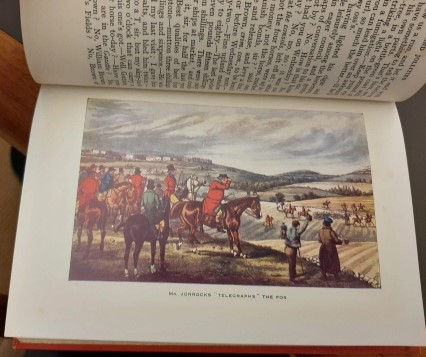 R.S. Surtees’ Jorrocks’s “Jaunts and Jollities,” with illustrations by Henry Alken; Longmans, Green & Co., Edward Arnold & Co., 1924, National Sporting Library & Museum
The writing is wonderfully colorful and descriptive:
“He has lost his wig, his hat hangs to his back, and one side of his person and face is completely japanned with black odoriferous mixture. ‘My vig! exclaims he, spitting and spluttering, but that’s the nastiest hole I ever was in—Fleet Ditch is lavender-water compared to it! Hooi yonder!’ hailing a lad, ‘Catch my ‘oss, boouy!’ Tom Hills has him; and Jorrocks, pocketing his wig, remounts, rams his spurs into the nag, and again tackles with the pack, which had come to a momentary check on the Eden Bridge road.”
Surtees has been compared to Charles Dickens for his social critique (Surtees and Dickens actually used the same illustrator, Hablot Knight Browne. Browne, known as “Phiz,” illustrated Hawbuck Grange for Surtees and several Dickens’ novels including Pickwick Papers and David Copperfield). Encyclopedia Britannica describes Surtees as “a mordant satirist. The snobbery, envy, greed, and ignorance that consume many of his characters are set down without geniality. His portrayal of provincial England just leaving the coaching for the railway era exposes its boredom, ill manners, discomfort, and coarse food, and its matter-of-factness makes admirable social history. Yet the descriptions of fast runs with hounds over open country leave the most lasting impression.”
I’ve only read Jaunts and Jollities, so please do correct me if I’m wrong, but it seems like an interesting viewpoint; at times we seem to laugh along with Mr. Jorrocks and at others, we laugh at him.
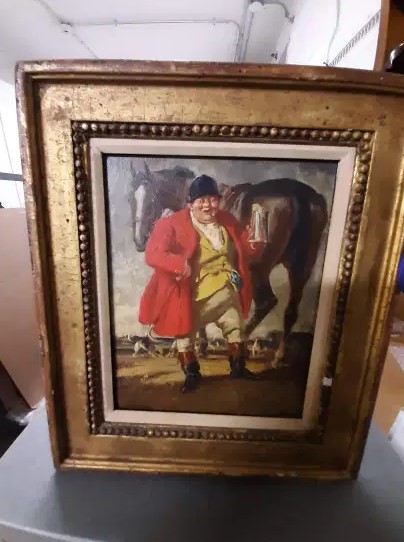 Raoul H. Millais, Mr. Jorrocks, 20th c., oil on canvas, 9 1/2 x 7 1/2 inches, National Sporting Library & Museum, Gift of Katrina Hickox Becker, 2020.
The small painting of our favorite grocer within the NSLM collection is by artist and sportsman Raoul H. Millais (English, 1901–1999). Does “Millais” ring other bells? Raoul Millais is the grandson of Pre-Raphaelite John Everett Millais (English, 1829–1896).
Raoul Millais undertook commissions by several familiar names, such as King George VI and Winston Churchill. Classmates with John Skeaping (English, 1901–1980) and friends with Alfred Munnings (English, 1878-1959), he, perhaps not surprisingly, disapproved of Modernist art, calling it “the Picasso lark.” Our charming piece shows Mr. Jorrocks standing in front of his horse with a jolly smile and holding a pint. He is wearing his customary scarlet coat and hunt cap as hounds mill about behind him. They take up the entire canvas. Mr. Jorrocks looks directly as us, as if he is inviting us to join him.
In the town of Croydon, south of London, is a life-size sculpture of the famed literary foxhunter (lead photo). Artist John Mills (English, b. 1933) was commissioned to create a sculpture for a Waites Construction site and, whilst discussing possibilities with the patron, the latter expressed his affinity for the fictional character. It was decided that a statue depicting a specific scene of Mr. Jorrocks would be erected: the “Surrey subscription hounds gathering for their hunt at Croydon and the chaotic ride that John Jorrocks made from Covent Garden to join the hunt.” We see a very animated Mr. Jorrocks on horseback, barely holding on, crashing through a real hedge.
The Library has several of Mr. Jorrocks’ adventures in its holdings. The NSL&M is open on Fridays and Saturdays at this time and by advance reservations.
Sources:
Encyclopedia Britannica
Raoul Millais obituary in the Independent
Posted October 15, 2020
Lauren Kraut is the Collections Manager at the National Sporting Library & Museum. Her primary focus is to maintain and preserve the works of art in the collection and on loan. Lauren may be reached via email.