
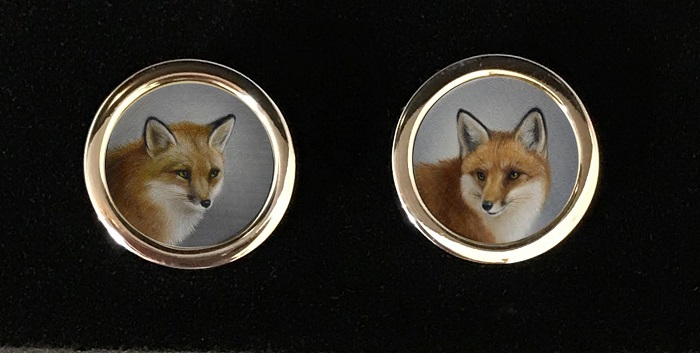
 Interchangeable cufflinks, dime size 17.91mm
When Beth de Loiselle—a painter and instructor of fine arts—met up with the work of Susan Smith Burnett and Paul Eaton—both designers and makers of fine bespoke jewelry—the result was art for wearing, not hanging.
Dog and Horse Fine Art Gallery in Charleston, South Carolina was representing these fine artists individually, but gallery owner Jaynie Spector also saw advantages to be derived by connecting the painter, de Loiselle, with the jewelers, Burnett and Eaton. She scheduled a sporting art event at the gallery and prompted Beth to furnish miniature horse portraits for cufflinks.
Beth’s first step in researching this new sporting genre brought her to her first Blessing of Hounds in Hunt Valley, Maryland, where she was “blown away by the beauty and atmosphere of the event.” She created multiple paintings for cufflinks that would be interchangeable for the wearer and would also work as brooches. Susan Smith Burnett and Paul Eaton custom designed the jewelry to complete the pieces, and the results were an artistic hit. The Gallery now represents both lines of jewelry incorporating de Loiselle’s miniature art, and continues to represent the individual works of all three. (Eaton is also a world acclaimed miniature sculptor.)
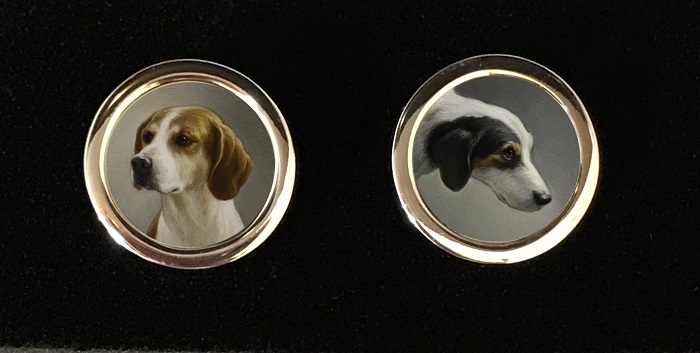 Interchangeable cufflinks, dime size, 17.91mm
Miniatures
According to Wikipedia, portrait miniatures developed out of the techniques of the miniatures in illuminated manuscripts, and were popular among 16th-century elites, mainly in England and France. Miniatures spread across the rest of Europe from the middle of the 18th century, remaining highly popular until the development of daguerreotypes and photography in the mid-19th century. They were usually intimate gifts given within the family, or by hopeful males in courtship, but some rulers, such as James I of England, gave large numbers as diplomatic or political gifts. They were especially likely to be painted when a family member was going to be absent for significant periods, whether a husband or son going to war or emigrating, or a daughter getting married.
The first miniaturists used watercolour to paint on stretched vellum, or (especially in England) on playing cards trimmed to the shape required. During the second half of the 17th century, vitreous enamel painted on copper became increasingly popular, especially in France. In the 18th century, miniatures were painted with watercolour on ivory, which had become relatively cheap. As small in size as 40 mm × 30 mm, portrait miniatures were often fitted into lockets, inside watch-covers or pieces of jewelry so that they could be carried on the person. Others were framed with stands or hung on a wall, or fitted into snuff box covers.
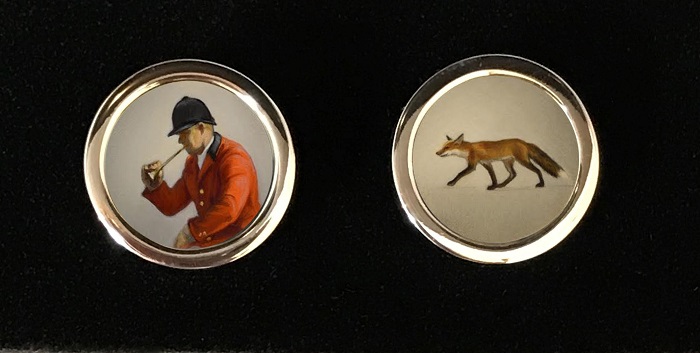 Interchangeable cufflinks, dime size, 17.91mm
An Education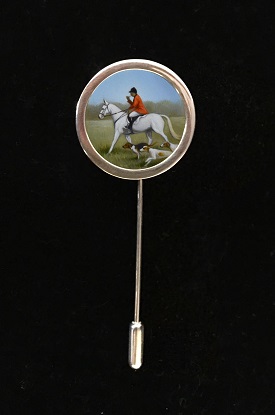 Stick Pin, nickel size 21.21mmBeth attended the Schuler School of Fine Arts in Baltimore under a Timothy Dill scholarship. There she studied the fundamentals of the old masters, starting with drawing as a foundation for all that follows. Students at Schuler study painting and sculpture, as well as the technical aspects of preparing their own paint by grinding powdered pigments with oil, preparing painting surfaces, mold making and casting. The classes taught at the Schuler School train the artist in the perfection of both their art and their craft.
Beth now teaches animal art, floral oil painting and the art of miniatures at the Schuler School. She has exhibited her paintings in New York, Paris, and London, and has received international awards for her miniatures. Her art can be found in collections across the United States as well as in France and England.
The Process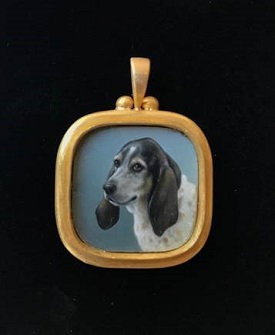 Beth’s preferred surface for her miniature paintings is ivorine—a synthetic version of ivory. “The beauty of this surface is not only how smooth it is but that you can custom cut it to any shape or size,” explains Beth.
“The ivorine doesn’t require any prep work and can be painted on directly. I choose oil paints because of their vibrant colors and enjoy the ease of how they blend. There’s also the added benefit to the paints staying workable for hours before they start to set up. This allows for a large window to refine and build a painting, wet paint into wet paint. I choose to grind most of my pigments just as the Old Masters did. I was trained to do this during my time at the Schuler School, which is also where my love for miniature work began.”
Beth does use some commercial colors from tubes, but doesn’t like the oil/pigment consistency as well as what she can prepare.
“I use Maroger medium, which was developed by Jacques Maroger to emulate the painting medium of the Old Masters. This medium is pre-darkened allowing the paints to stay as vibrant as the first day the painting was created.”
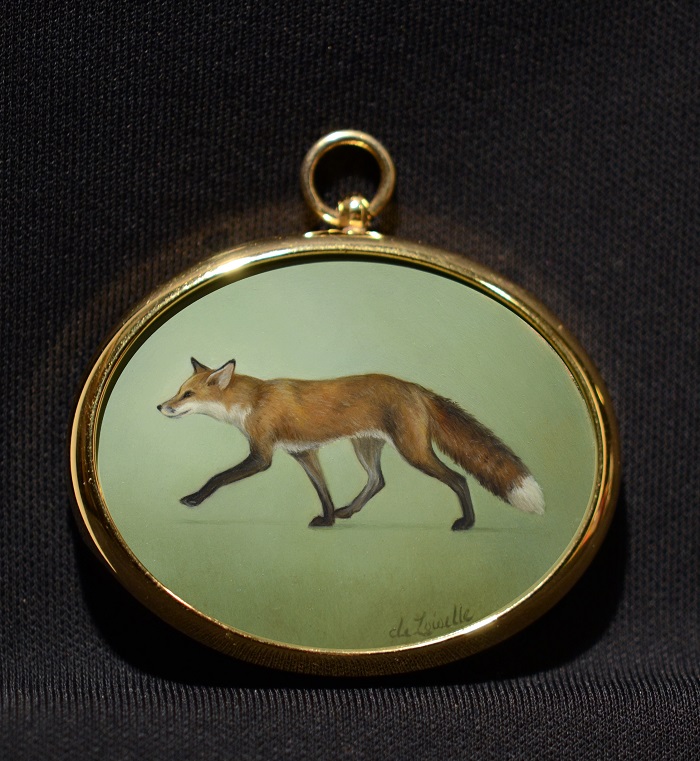 On the Loose, 1.5×2 inches
Most foxhunters have seen the antique European miniatures—horses, hounds, foxes—meticulously painted on crystal and used for stockpins, lapel pins, and bracelets. Beth attempted her first miniature while a second-year student at the Schuler School. She had just completed a three-foot by four-foot commission of the Roman Coliseum and wanted to work on something smaller and more intimate. She set up a simple still life of a shell and pink dogwood that was only one by two inches and fell in love with the process—enjoying the challenge of working small, then experiencing the impact a small-scale piece could produce. After graduation, she remembered that pleasurable exercise and eventually increased her output of miniature paintings.
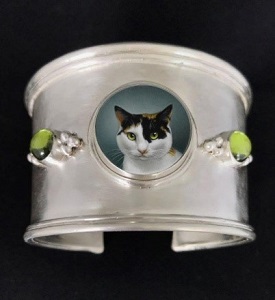 Burnett / de Loiselle Roman CuffI had to wonder if painting miniatures was a time saver for an artist! Apparently not, according to Beth.
“I have had some miniatures take longer than a simpler large painting,” she says.
Complex pieces can take up to a month and a half, whereas simple designs she creates for herself can be completed in as few as four painting sittings. For commissions, though, the requirements of producing a subject’s likeness makes the painting take longer. Sometimes a single sitting takes as little as two hours, while others may take up to six hours. It all depends, she says, on the subject and how the paint is setting up on the surface.
“Once dry I apply what’s called glazes and half-pastes,” Beth says. “Using the Maroger medium to thin the paint is what makes this possible in my work. These techniques add a beautiful luminosity and depth to the work.”
I couldn’t figure out where one could buy paint brushes tiny enough to do this kind of work. Beth explained that the brushes get smaller and smaller as the painting approaches the final stages. That’s when the smallest details are applied. The same process applies to large paintings as well; it’s just the overall scale of the tools that differ.
“I start with the largest brush I can handle within a given space and work my way down to the smallest detail brushes. This allows me to be efficient with coverage from the start, and refine as I go. Of course with my smaller miniatures, the largest brush I am working with is often only one eighth of an inch thick or smaller. My smallest and finest haired brush is a 30/0. I was thrilled to discover this tiny, sharp-pointed brush through a small tool specialty shop. The hairs are nice and thin, allowing the most delicate of lines. I will use this typically on the last or second to last sitting.”
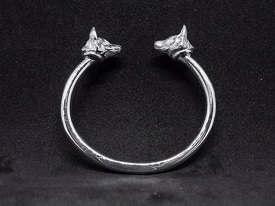 Paul Eaton braceletHow many hairs does a tiny brush have? I had to wonder.
“It’s not so much the quantity of the hairs on the brush but the spring the bristles have and the tapered point. My favorite brush is an 18/0 that works just as nicely with delicate lines as my 30/0 but is a bit sturdier in the bristles.
“There are many layers to the painting and during that last stretch I need to allow dry time between each coat in order to get the details where I want them to be. Fun details like little wisps of hair and whiskers are not put into place until the last sitting.
“I am currently video recording my painting process for a couple of my miniatures, which we hope to use to promote the miniatures and jewelry line at Dog and Horse Gallery. I will often document the stages of a piece and show them later on social media or my newsletter platform. I enjoy providing my viewers with the inside thoughts and stages to a piece.
“The smallest portrait I have created was a dime-sized commission, which featured two Pomeranians. This is the piece that had me seek out the smallest detail brush I could find, the 30/0.”
Beth typically starts a miniature with a drawing directly on the surface to be painted. She’ll use a .03 mm mechanical pencil (more than ten times smaller than the 0.5 mm leads in the fine mechanical pencils on my desk) and sometime will even have to sharpen that tip to the point of a needle for more control and precision. The most precision comes during the painting process where she can manipulate the brush to the desired shape.
“To gain a bit more traction on top of the ivorine, I will use a very fine grit sandpaper to do a crosshatch sanding method. This also cuts the sheen from the graphite in the preliminary pencil drawing. There are many ways of starting the painting process, all of which are followed with blending and sanding in between sittings to keep the surface smooth. An underpainting which uses one tone of pigment over the graphite allows me to take the drawing and likeness further in paint.
“I follow this up with full color after it dries, or proceed to grisaille, which is working in shades of gray. Grisaille also acts as the underpainting and has the added benefit of more value ranges, which helps with rendering a life-like three-dimensional form.”
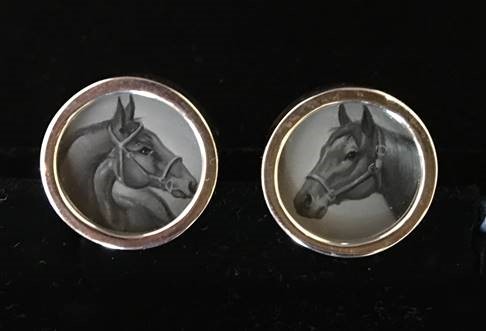 Cufflinks, grisaille
During the final stages of capturing the fine details, Beth may use a headband magnifier, allowing her to see and work close up and hands-free. Beth teaches miniature painting throughout the year in her workshops, demonstrating the process from start to finish. She discusses supplies, preparations, tips for the painting process, and opportunities for exhibitions with her students.
Posted August 6, 2020
Full disclosure: Dog and Horse Fine Art Gallery is a longtime advertiser with Foxhunting Life. The publication of articles on sporting art, wherever they originate, has been a continuing purpose of Foxhunting Life since its inception.