Rupert Isaacson and Horse Boy
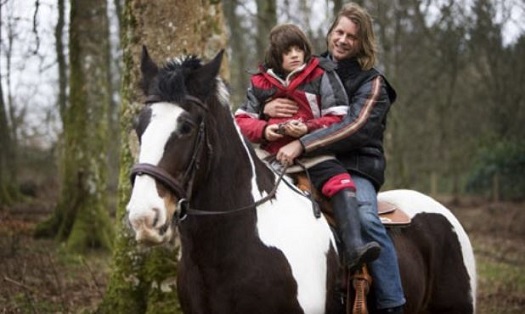
Rupert Isaacson discovered that horses were therapeutically beneficial to his autistic son Rowan. Their lives grew from that starting point.
When we talk about Rupert Isaacson and “Horse Boy,” we could be talking about him and his autistic son Rowan, his internationally best-selling book, his award-winning documentary film, and/or his world-wide organization that helps autism families.
Rupert was an avid foxhunter until other imperatives occupied his life. He is also a gifted and persuasive writer. But Rupert’s principal gift to humanity is a mind set that allows no limits on what is possible. No cause, no matter the odds, is hopeless to Isaacson, and time and again he has tilted at windmills and accomplished astonishing results.
Rupert was born in England and roamed the world as a travel and environmental writer, specializing in Africa. It was there that he came upon a cause that captured him totally—the displacement and removal of the Bushmen of the Kalahari from their traditional hunting grounds by their own government. Isaacson became a vigorous activist for the Bushmen, gave speeches, wrote a book about their plight, and arranged for the Bushmen to appear before the United Nations to plead their case. They won.
At about that time, Isaacson and his wife, then living in Texas, discovered that their infant son Rowan was autistic. Conventional treatment protocols—and they tried many—were unable to improve the boy’s most troubling behavioral problems, and Isaacson immersed himself into finding alternate solutions. He discovered that horseback riding while holding his son in front of him in the saddle was therapeutic for the boy. But only temporarily.
A New Keswick MFH: Her Story
Sandra Forbush photo
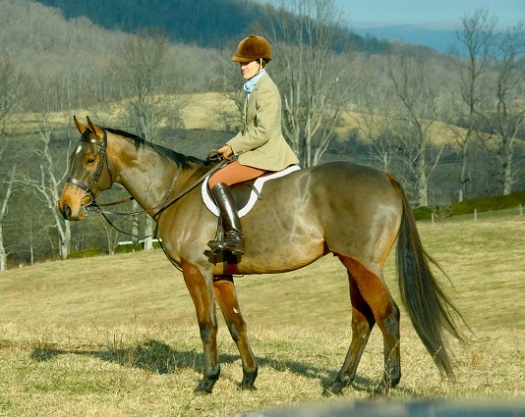
If you are wondering where in the Keswick countryside the cover picture was taken, you are observant. It was not taken in Keswick but at Massie’s Corner in Rappahannock County where I grew up. My father, Wade Massie, loved to hunt foxes. My Uncle Jim tells how Pop used to get on the school bus in the morning and get off a few stops later where there would be a horse waiting for him. He would hunt all day with Ennis Jenkins, Larry Jenkins’ father, and get back on the bus in the afternoon. His parents were none the wiser.
Later Jack Bruce helped Pop put together a pack of hounds which Clint Eastham, son of famous hound breeder C.C. Eastham, would hunt for him. (It is kind of fun to think about how I would hunt with hounds and people with a lot of the same bloodlines sixty years later).
Pop also hunted with Rappahannock and was a whipper-in there. Current Rappahannock Master Oliver Brown likes to tell a story about how Pop could make any horse quiet. One day a visitor from New Jersey had come down to hunt. The visitor’s horse was rank, while Pop’s was going along well. Halfway through the day Pop offered to switch horses. By day’s end Pop’s new mount was going along on the buckle, and the visitor’s horse was jigging all around.
Haight, White, Barclay Inducted into the Huntsmen’s Room
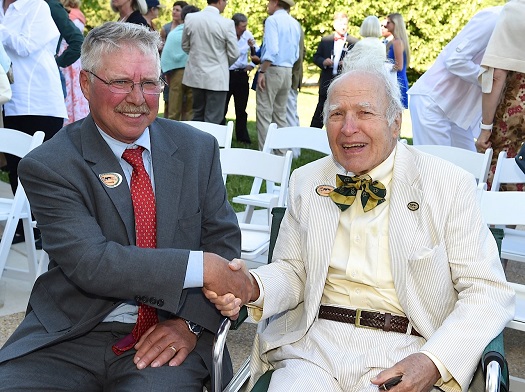
Andrew Barclay (left) and Sherman Haight congratulate eachother on the occasion of their mutual induction into The Huntsmen’s Room at the Museum of Hounds and Hunting. / Douglas Lees photo
Three huntsmen, two living and one deceased, were honored the day before the Virginia Foxhound Show for their uncommon skill as huntsmen and for their contributions to foxhunting in North American. Sherman P. Haight, Jr., ex-MFH; William John White, Jr.; and Andrew T. Barclay were inducted into The Huntsmen’s Room of the Museum of Hounds and Hunting in ceremonies held at Morven Park on Saturday, May 23, 2015.
While recognized by this honor for their achievements in handling hounds in the field and producing the highest level of sport, each of these three men of disparate backgrounds contributed uniquely to our sport. Their stories are just as uniquely fascinating.
Tommy Hitchcock, Jr: Sportsman, War Hero
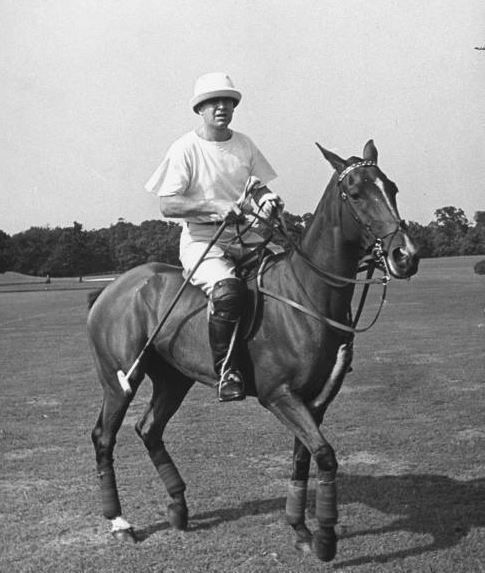
May 8, 2015 will mark the seventieth anniversary of V-E Day, Victory in Europe, the end of the Nazi menace. It’s a propitious time to remember a foxhunting sportsman named Tommy Hitchcock, Jr.
Most Foxhunting Life readers are familiar with his name. Born in Aiken, South Carolina, Hitchcock was an all-around sportsman, a foxhunter, and perhaps the greatest American polo player of all time. A ten-goal player by age twenty-two, Hitchcock led the U.S. team to their first victory in the 1921 International Polo Cup. He followed that feat by leading four teams to U.S. National Open Championships. In 1939, after the death of his mother, Louise Eustis Hitchcock, MFH of the Aiken Hounds, Tommy and his sister Helen founded what is know today as the Hitchcock Woods Foundation in Aiken—a magnificent gift to subsequent generations of horsemen and women from all across North America.
Perhaps less known, however, is the singular role that Hitchcock played in the winning of World War II. If not for Hitchcock, the date June 6, 1944 would most likely not be known to history as D-Day. The invasion of the European mainland would have necessarily been postponed. And if it hadn’t, thousands more Allied soldiers would have been slaughtered on the beaches by the German Air Force.
Mark McManus: Huntsman and Mentor
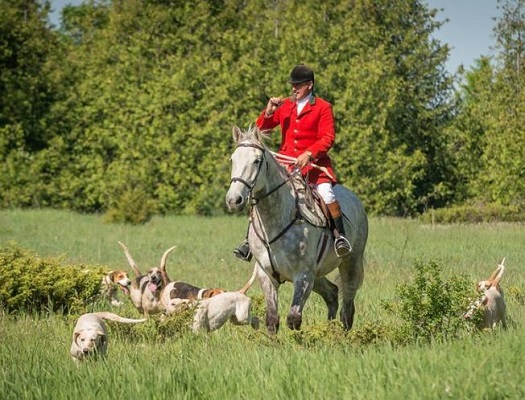
Mark McManus is the new huntsman at the Chagrin Valley Hunt (OH).
When a huntsman retires after a long and successful career hunting hounds for a respected hunting establishment, that vacuum creates a ripple effect throughout the hunting community. So it was when Larry Pitts retired after thirty-five seasons hunting hounds at the Potomac Hunt (MD). Pitts’s vacancy was filled by huntsman Brian Kiely from the Myopia Hunt (MA); the void at Myopia was filled by huntsman Philip Headdon from the Chagrin Valley Hunt (OH); and the Chagrin Valley opening will be filled this season by huntsman Mark McManus from the Ottawa Valley Hunt (ON).
During his time at Ottawa Valley, McManus definitely left his mark (pun intended). OVH Master Anne McKibbin lets sixteen-year-old whipper-in Carmen Powell-Sadik tell us how.
Mark is an enjoyable person to be around, with many a good story to tell depicting various scenes of humor and horror taken from an exciting and sometimes perilous life of foxhunting in his native Ireland. He remembers times of his childhood riding with his baby brother “sat in me lap” as he (much to his father’s chagrin) jumped the hedges!
Codie Hayes and Her Hounds: A Love Story
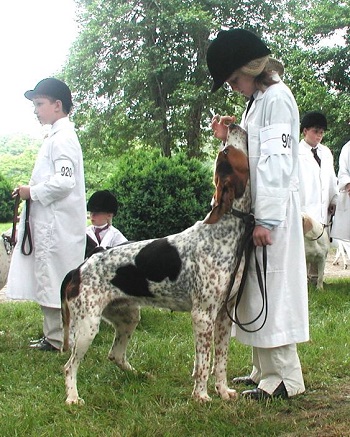
At age 12, Codie Hayes showed Rose Tree Needy to the Grand Championship at the 2004 Virginia Foxhound Show, the first time ever for a Penn-Marydel. / Lauren Giannini photoFrom the moment Codie Jane Hayes became aware of the world around her, she took to hounds. She progressed from crawling to toddling among the pack of Penn-Marydel foxhounds bred and hunted by her grandfather Jody Murtagh, Jr., ex-MFH. She was a wunderkind, totally at home with hounds and crazy about them. From the way hounds take to her, she was born with a gift—that coveted invisible thread connecting her to hounds wherever she goes.
In August 2014, Codie, twenty-two, became the professional huntsman for the Golden’s Bridge Hounds in North Salem, New York. This position at any hunt entails huge responsibilities, but after a glimpse into how she spent her childhood and teen years, there’s no doubt that she has been training to be huntsman since she came into the world.
In the Footsteps of a Huntsman
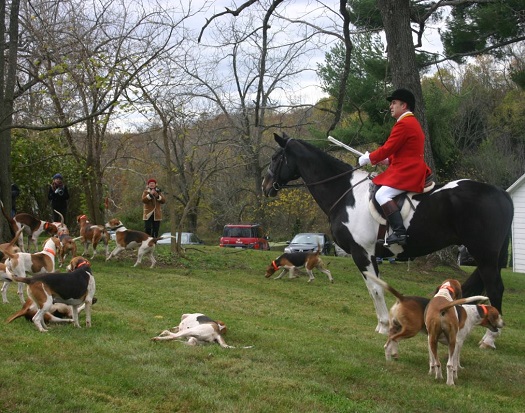
From London’s streets to Virginia’s hunt country
Huntsman Andy Bozdan and the Loudoun Fairfax hounds / Laura Riley photo
The job: huntsman. The man: Andrew Bozdan—leader of fifty couple of Old English foxhounds. One hundred canines. How is this possible? In all my life as a dog owner, I’ve only had a handful who actually came when I called. How is it that we mortals have such difficulty in getting our dogs to sit and come and not potty in the house, while this man steers his entire pack in an apparently seamless manner.
The answer is, as always, nothing is ever as easy as it looks. Before the man appears in public, seated atop his skewbald gelding, wearing his scarlet coat, and blowing his copper horn to speak to the mass of hounds seething below, one heck of a lot of work happens and many miles are traveled.
Graham Buston Is New Huntsman at Blue Ridge
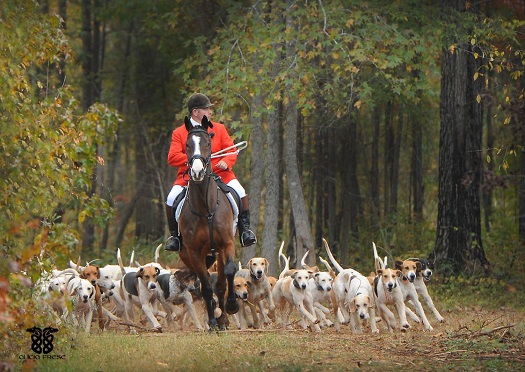
Graham Buston and the Bear Creek Hounds in Georgia / Alicia Frese photo
When this season wraps up, Bear Creek Hounds huntsman Graham V. Buston will bid Georgia good-bye and head to Clarke County, Virginia as the new huntsman for the Blue Ridge Hunt. While he is excited about the position, the leave-taking comes with some regrets—the wonderful friends he and his wife, Sheri, have made; some excellent hunting territory in Georgia; and that he will not get to hunt the results of the breeding program he started.
Huntsmen on the Move: 2015
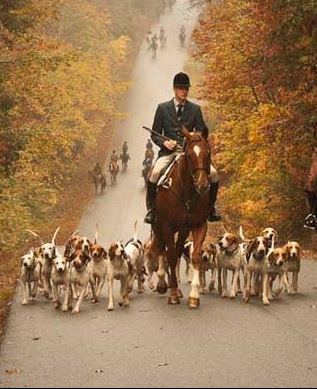
Huntsman Jordan Hicks moves from the Tryon Hounds to the Piedmont Fox Hounds / Erik Olsen photoAs we approach the close of the 2014/2015 foxhunting season, here’s our report on thirteen hunts that have either hired or will require a new huntsman for next season. We have already featured personal close-ups of three of the migrating huntsmen—Guy Allman, Brian Kiely, and Graham Buston—and we plan to bring you more.
We invite readers to fill us in on any moves that we’ve missed. We also invite you to send us a personal profile on any of these huntsmen that we can publish as a feature article. Or, just send us the information, and we’ll write the story. Use the “Contact Us” link that appears at the bottom of every screen to communicate directly with me, and be sure to include your phone number.
What follows is foxhunting’s version of musical chairs.
Brian Kiely Is New Huntsman at Potomac
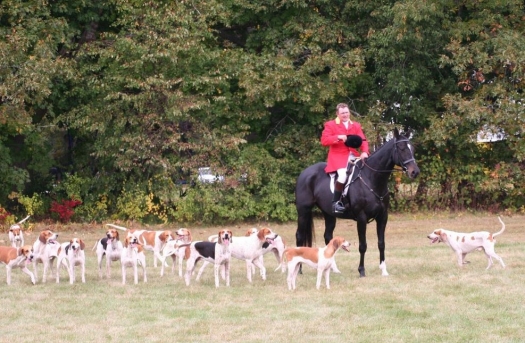
Brian Kiely and the Myopia foxhounds / Ashley Hill photo
Brian Kiely knows he will have big boots to fill when Larry Pitts, huntsman for the Potomac Hunt (MD), retires after thirty-five seasons there. Brian spent a weekend recently with the Potomac Masters, had a chance to hunt with Larry, and accepted the position of huntsman starting next season.
“The way Larry conducted himself, the way the hounds related to him, was poetry,” said Brian. “It was a fabulous experience just to watch him.”
“I remember seeing Larry some years ago at the Virginia Foxhound Show,” Brian continued. “Hounds from hunts all over were arriving at the kennels…nervous…running off…and there was Larry, calmly walking his pack through all the confusion, without a care.”