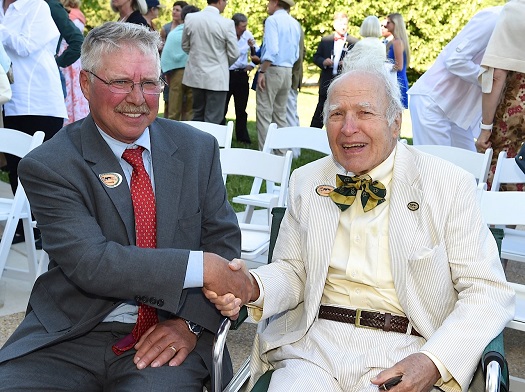
 Andrew Barclay (left) and Sherman Haight congratulate eachother on the occasion of their mutual induction into The Huntsmen’s Room at the Museum of Hounds and Hunting. / Douglas Lees photo
Three huntsmen, two living and one deceased, were honored the day before the Virginia Foxhound Show for their uncommon skill as huntsmen and for their contributions to foxhunting in North American. Sherman P. Haight, Jr., ex-MFH; William John White, Jr.; and Andrew T. Barclay were inducted into The Huntsmen’s Room of the Museum of Hounds and Hunting in ceremonies held at Morven Park on Saturday, May 23, 2015.
While recognized by this honor for their achievements in handling hounds in the field and producing the highest level of sport, each of these three men of disparate backgrounds contributed uniquely to our sport. Their stories are just as uniquely fascinating.
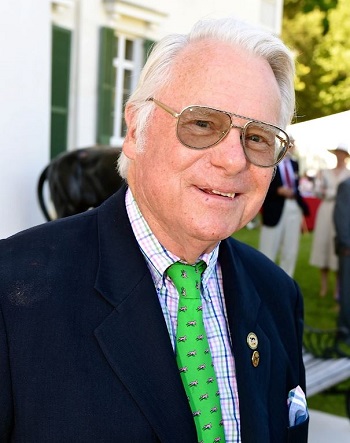 Jake Carle served as Master of Ceremonies and presented Sherman Haight during the ceremonies. / Douglas Lees photoSherman P. Haight, Jr., ex-MFH (b. 1922)
Sherman Haight has been a leader of our sport for more than a half-century. He comes from a dedicated foxhunting family: his father, his father-in-law, he, and his brother were all Masters, and his mother followed hounds both in the U.S. and in England. Sherman was MFH and huntsman of Mr. Haight’s Litchfield County Hounds (CT); president of the United States Pony Clubs; a revolutionary in the wrenching change that established term limits for MFHA presidents in 1970, thereby changing that organization from a moribund men’s club to an vibrant association guiding the sport though a period of sweeping social changes. Sherman also served as president of the MFHA from 1978 to 1981, and he was a founder of the Museum of Hounds and Hunting.
It is so fitting that Sherman be inducted into The Huntsmen’s Room since, in addition to his qualifications as huntsman, it was he who spearheaded the creation of The Huntsmen’s Room at the museum.
A member of the 7th Cavalry in World War II, Sherman saw reconnaissance action in the Pacific until finally catching multiple rounds from a Japanese .25-caliber machine gun in the stomach, head, and elbow. The triage doctor in the field placed him with other severely wounded men upon whom, in that doctor’s estimation, medical time and resources were not to be wasted. But Sherman lived!
After his return from service, he carried the horn for Mr. Haight’s Litchfield County Hounds (CT) for thirty-four seasons. He is widely acknowledged as a superb judge of foxhounds. In the 1960s Sherman was a member of the Standards Committee of the MFHA, along with Wilbur Ross Hubbard, Fletcher Harper, and MFHA President William Almy, that wrote the standards against which foxhounds were judged for the next twenty years. Then in the 1980s, Sherman chaired a committee consisting of himself, Bill Brainard, Ben Hardaway, and Jake Carle to revise and update those standards which remain in use to this day.
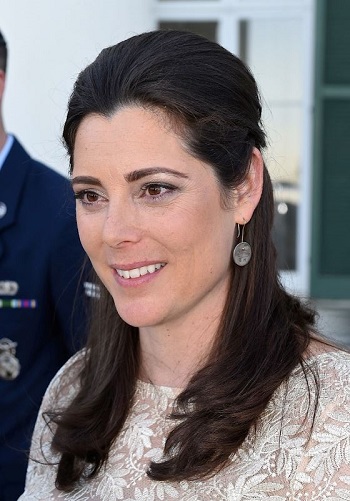 Molly Murphy White presented Johnny White to the audience. / Douglas Lees photoWilliam John White, Jr. (1918–1996)
What follows is extracted from material written by Molly Murphy White.
Johnny, as he was called, was born and raised on a dairy farm. He grew to be a talented left-handed pitcher, was scouted for the semi-pros, but was called back to the farm by his father. He served in World War II, and after his discharge he answered an ad for a stable hand at Brandywine Meadow Farm, home of the Mather family and the Brandywine Hounds.
Gilbert Mather was Master and huntsman at the time, and Johnny soon worked his way from the stables to the kennels. By 1948, he was whipping-in to Mather, and a bond of friendship and respect quickly formed between the two men. Johnny’s work in the field and with the hounds improved to the point where Mather, if he had to leave the field for the office, would pass the horn to Johnny, and the hunt would continue seamlessly.
After Mather suffered a stroke in 1959, then died, the Mather family decided to sell Brandywine Farm. Mather’s daughter Jane Sullivan became Master and in 1965 purchased ten acres of Johnny’s farm where new hunt kennels were built and hounds were relocated.
Johnny sold his dairy cows, moved the hunt horses in, and single-handedly roaded the pack from Brandywine to the new kennels. Johnny became sole huntsman and kennelman and continued to run his farm.
He roaded hounds to all meets, both to maintain their fitness and to give hounds a sense of where their home was geographically. He had ten different fixtures in two hundred square miles of contiguous hunting country, and he hunted every covert until the sun went down.
Johnny had an uncanny ear for each hound’s voice, and had the ability to stay with hounds and show superb sport. He gave the hunt fifty years of dedication and hard work before succumbing to lung cancer in 1996.
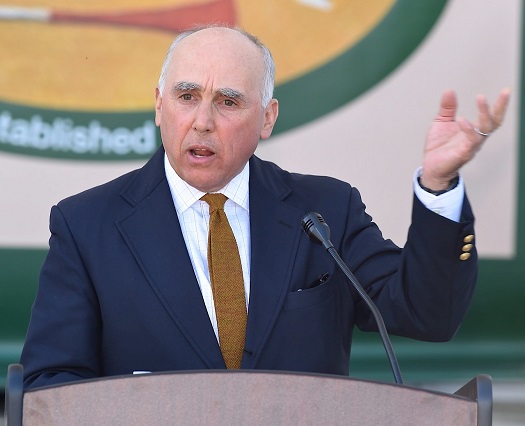 Ned Halle, MFH, Green Spring Valley Hounds, presented Andrew Barclay with both humor and obvious respect. / Douglas Lees photo Andrew Barclay (b. 1954)
Eventing was Andrew Barclay’s sport of choice as a youngster until he discovered foxhunting. His family lived near Gettysburg, Pennsylvania, and the Rose Tree Foxhunting Club had moved to the York area. As soon as Andrew reached his sixteenth birthday and could obtained a driver’s license and transport himself to the meets, he hunted with Rose Tree as often as he could, often serving as honorary whipper-in.
In 1974, the Green Spring Valley Hounds (MD) were seeking a professional whipper-in to turn hounds to huntsman Les Grimes. Andrew applied, got the job, and for seven years whipped-in to Grimes, himself a 2001 inductee into The Huntsman’s Room. Upon Grimes’s retirement, the horn was passed to Andrew, who carried it with distinction for the next twenty years.
Around the time that Andrew was getting ready to retire as huntsman, MFHA Director Tony Leahy was formulating what is now known as the MFHA’s Professional Development Program—a structured training program for young aspiring huntsmen. One aspect of the program required that a knowledgeable mentor be available to work with each individual admitted into the program. It was serendipity for Andrew and for foxhunting. Just as he had been mentored by Grimes, Andrew was ready to pass it forward.
The MFHA engaged Andrew for the program, and he hunted with young staff members all over the country. He had already walked the walk, but he also possessed the ability to articulate and commit his views, observations, and recommendations to paper for the benefit of those he mentored.
One day I happened to read one of Andrew’s constructive debriefing letters that he had sent to one of his young huntsmen after a day in the field. As editor of Covertside at the time, I was always on the lookout for well-written, informative, and substantive writings on foxhunting. The tone of Andrew’s letter was much like the letters in Peter Beckford’s 1781 foxhunting classic, Thoughts on Hunting: In a Series of Familiar Letters to a Friend. I published Andrew’s letter—and many thereafter—in the same instructive vein as Beckford had done.
In 2012 Andrew published his excellent book, Letters to a Young Huntsman, a collection of instructional letters in the Beckford model. In some instances, Andrew answers specific questions asked by his young charges; in others he critiques and encourages young huntsmen after observing their work in the field. The collection covers a broad swath of foxhunting subjects, and I can’t imagine any hunting enthusiast—beginner or expert—who would not be enlightened by the content.
The Huntsmen’s Room of the Museum of Hounds and Hunting periodically recognizes those preeminent huntsmen who have carried the horn with honor, courage, and distinction in the United States and Canada. To date, thirty-eight huntsmen have been so honored.
Posted May 29, 2015