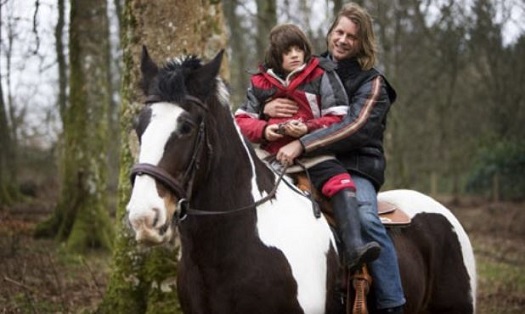
 Rupert Isaacson discovered that horses were therapeutically beneficial to his autistic son Rowan. Their lives grew from that starting point.
When we talk about Rupert Isaacson and “Horse Boy,” we could be talking about him and his autistic son Rowan, his internationally best-selling book, his award-winning documentary film, and/or his world-wide organization that helps autism families.
Rupert was an avid foxhunter until other imperatives occupied his life. He is also a gifted and persuasive writer. But Rupert’s principal gift to humanity is a mind set that allows no limits on what is possible. No cause, no matter the odds, is hopeless to Isaacson, and time and again he has tilted at windmills and accomplished astonishing results.
Rupert was born in England and roamed the world as a travel and environmental writer, specializing in Africa. It was there that he came upon a cause that captured him totally—the displacement and removal of the Bushmen of the Kalahari from their traditional hunting grounds by their own government. Isaacson became a vigorous activist for the Bushmen, gave speeches, wrote a book about their plight, and arranged for the Bushmen to appear before the United Nations to plead their case. They won.
At about that time, Isaacson and his wife, then living in Texas, discovered that their infant son Rowan was autistic. Conventional treatment protocols—and they tried many—were unable to improve the boy’s most troubling behavioral problems, and Isaacson immersed himself into finding alternate solutions. He discovered that horseback riding while holding his son in front of him in the saddle was therapeutic for the boy. But only temporarily.
Slowly the plan formed in his mind to take his son, then perhaps seven years old, on an arduous horseback trek through Mongolia to visit the most powerful shamans he could find to see if they could help. That incredible story is told in his 2009 international best-seller, The Horse Boy: A Father’s Quest to Heal His Son, and the award-winning documentary film that followed.
Today, according to Katie Hankinson writing for the Post Independent (CO), “Rowan is able to read, write and do basic algebra. He is interested in opening a zoo for ‘endangerous’ (his word) animals—endangered and dangerous. Most important of all, though, he is able to maintain friendships with people of all ages, especially his parents….The source of this miraculous change? A horse.”
Hankerson’s article goes on to relate how Rupert has founded an organization—Horse Boy—to “bring the healing effects of horses, nature and supportive community to autism families free of charge.”
Today, according to Hankerson, “Horse Boy has more than 1,000 practitioners administering a scientifically proven, six-stage method that has seen positive results in autistic children and their families universally, reaching 12,000 families weekly. The method is simple enough: get outside and move.
Rupert insists that anyone can learn the method and become a Horse Boy practitioner. Through Horse Boy’s five-level training technique, anyone can become certified in these therapeutic practices, and use them anywhere in nature with a horse or in a living room with a rocking chair.
Rupert considers these children to be “dream whisperers” and looks upon his son as his “biggest mentor.”
“We learn more and more about life together every day,” he says. “The method is a logical way for a neuro-typical brain to understand a non-neuro-typical brain. Autism doesn’t close doors, it opens them.”
Posted June 24, 2015
Foxhunting Life carries Rupert Isaacson’s book, The Wild Host: The History and Meaning of the Hunt in our Shop. It is a beautifully illustrated history of hunting; a meditation on the meaning of hunting spiritually and culturally; and a personal hunting account. In it, Rupert justifies and celebrates hunting while acknowledging the realities of a modern world of heightened compassion.