
Lori and Frankie
Day 1
September 10, 2014
A moderate two hours of hunting and I have been fighting to stay awake the past four hours. My brain is pooped. I feel like I carried Frankie around the fixture rather than vice versa. Emotionally I guess I did. A shower helped but I did have a bit of a shock when I thought I was bleeding under my arm. It was a just piece of red fuzz from my polo shirt.
Having finally cracked my ten-year-old Wintec leathers through to the nylon core (probably still strong enough but not confidence inspiring), I purchased the only pair I could find yesterday—in black. No way am I going to buy leather ones for a hundred dollars only to swim in them all summer long. The fact that they were not more traditional brown didn’t bother me. Riding a glow-in-the-dark pale horse with bubble gum-pink skin and transparent eyes, no one is going to notice the color of what my stirrups are hanging from. Sporting his new hunt bridle, I figured at least he would look the part. My philosophy: even if you fail miserably it is somehow better if you are dressed appropriately.
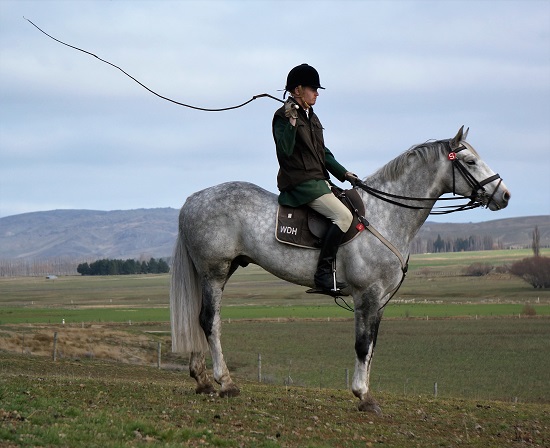
Ben Lott hunts Gavin and Tracy Crossan's Brian (aka Ballineen Blue Mountain by Bealagh Blue ex Ballineen Glen Abbess), a 16.2-hand Irish grey stallion imported from England in 2011.
In the beginning there was Thady Ryan. Master and huntsman of the three-hundred-year-old family-owned Scarteen hounds of County Limerick, Ireland, Thady retired in 1986 to Temuka, South Island, New Zealand with his New Zealand-born wife Anne. The following summer, Thady and Anne imported Kingsway Diamond (King of Diamonds x Bawnlahan Beauty), a chestnut 17-hand Registered Irish Draught (RID) stallion from Ireland.
To their surprise, another RID stallion arrived, consigned to Glyn and Edwina Morris of Wynyard Lodge Stud in Christchurch, also South Island, New Zealand.
“Laughton’s Legend (Lahinch x Starlight), a 16.2-hand chestnut, was on the same flight to Christchurch as Kingsway Diamond,” said Lesley Spence of Christchurch, secretary of the Irish Draught Horse Society of New Zealand (IDHSNZ). “On that flight was also a King of Diamonds mare, Kilmarna Queen. Suddenly, there was a competition: both men thought they would revolutionize the New Zealand sporthorse breeding industry.”
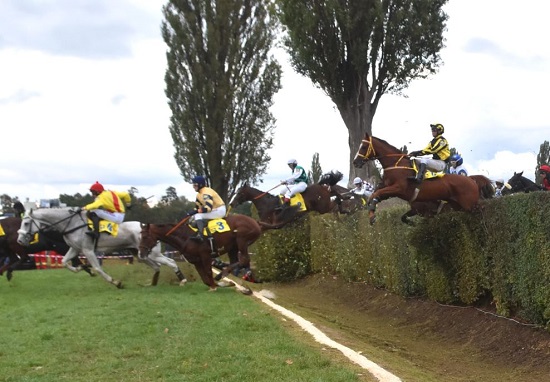
For race enthusiasts our Irish correspondent Noel Mullins introduces us to a venerable steeplechase race in the Czech Republic, where a few Irish and English bloodstock agents, trainers, and jockeys have found good markets.
The famous Taxis Ditch on the Velka Pardubice racecourse in the Czech Republic / Noel Mullins photo
A steeplechase race in the Czech Republic, with its roots in foxhunting, is recognised as one of the three most challenging steeplechases in the world, the others being the Aintree Grand National in Liverpool and the Maryland Hunt Cup in the U.S. The 126th running of the Velka Pardubice Steeplechase took place on October 9, 2016.
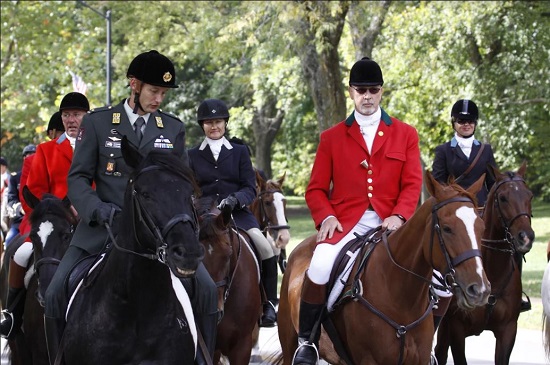
As a part of Opening Meet Weekend 2016, Riders in formal attire participate in a tribute at the Buffalo Soldiers monument. Front, l-r: Infantry Major Jeroen van Rantwijk of the Royal Netherlands Army, who is attending the Command and General Staff College, and Honorary huntsman Dr. Steven Thomas.
The Fort Leavenworth Hunt (KS) put together an Opening Meet Weekend attracting foxhunters from ten states and featuring the hunt’s unique place in our nation’s history. One hundred mounted riders and fifty car-toppers participated in a three-day program that included a historic ride on the 5,600-acre post, Opening Meet, Military Hunt Ball, wreath laying ceremony at the Buffalo Soldiers monument, and guided tours. The events were led by both military and civilian personnel, as appropriate.
Attending guests included current Masters from Bijou Springs Hunt (CO), Bridlespur Hunt (MO), North Hills Hunt (NE) as well as members from other hunts hailing from Alabama, California, Colorado, Kansas, Kentucky, Missouri, Nebraska, Iowa, South Carolina, and Virginia.
Built in 1827, Fort Leavenworth is the oldest active United States Army post west of Washington, D.C. The fort is also the oldest permanent settlement in Kansas. Historically, Fort Leavenworth has been known as the Army’s intellectual center. During the country's westward expansion, Fort Leavenworth was a forward destination for thousands of soldiers, surveyors, immigrants, American Indians, preachers and settlers who passed through. The fort was the eastern terminus of the Santa Fe and Oregon Trails, and the weekend events were aimed at exposing visitors to much of the post's history.
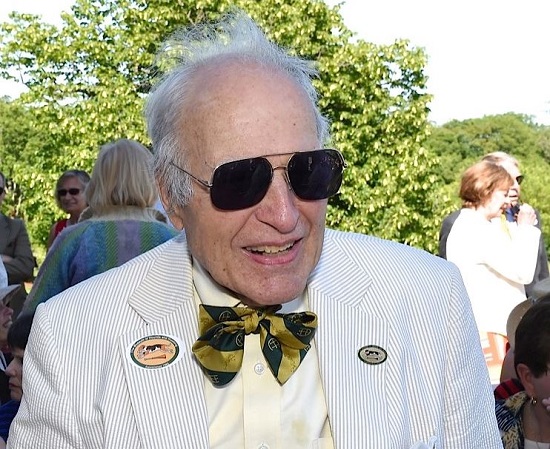
Sherman Haight is inducted into the Huntsman's Room of the Museum of Hounds and Hunting in May, 2016. / Douglas Lees photo
With the passing of Sherman Haight, the foxhunting world has lost one of its longest serving gentleman-statesmen. He was ninety-three.
I use the term “gentleman” in its fullest sense, mourning both Sherman and an age that is passing with him and his few remaining contemporaries. I don’t believe I ever saw Sherman without a shirt and tie, even in his own home and even when visiting in the morning.
He was a true statesman for our sport, born of a dedicated foxhunting family. His father, his father-in-law, his brother, and he were all Masters. His mother, game for any adventure, followed hounds on both sides of the Atlantic. His record of accomplishments and innovations, many of which are taken for granted by today’s foxhunters, is lengthy.
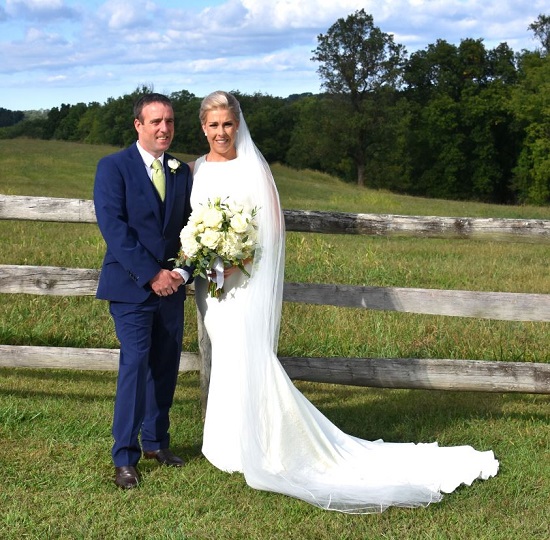
Noel Mullins photo
Considered the social event of the year in the Unionville, Pennsylvania equestrian world, family and friends gathered from both sides of the Atlantic to celebrate the marriage of Irishman Ivan Dowling and Californian Stephanie Boyer. Dowling, a native of Loughrea in County Galway, grew up hunting with the Galway Blazers before emigrating to America as huntsman of Mr. Stewart’s Cheshire Foxhounds for the last twelve seasons. Dowling successfully carried through the daring foxhound breeding experiment at Cheshire initiated by previous huntsman John Tulloch.
Boyer, having changed careers from eventing, served the Cheshire as professional whipper-in to Dowling. Boyer had worked with international event riders, Philip Dutton, Olympic dual gold and bronze medallist, and Buck Davidson, Pan American Games and Olympic rider. She has competed at the highest level in eventing, including riding her own Irish-bred eventer Macloud at the Rolex 4* event in Kentucky in 2009. She also breezed horses for top race trainers Michael Matz and Jonathan Sheppard.
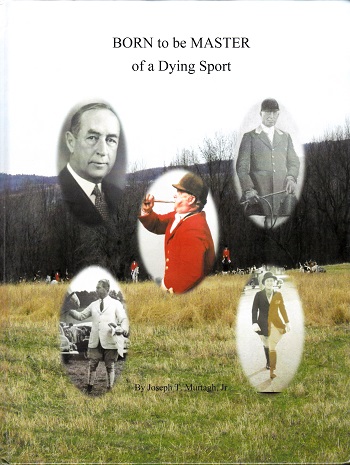
Born to Be Master of a Dying Sport by Joseph T. Murtagh, Jr., ex-MFH, 2016, 287 pages, illustrated, $45.00 plus $5.00 shipping. Purchase direct from author by clicking on this email address: [email protected]. Inscribed, signed copies may be requested.What follows is an excerpt from Jody Murtagh’s new memoir, Born to Be Master of a Dying Sport. The book tells the unvarnished story of the ups and downs of a man trying gallantly to keep his hunt and his heritage going in a changing world and his love for the Penn-Marydel foxhound, a breed formally established by his maternal grandparents.
A Penn-Marydel is a true American hound that was a derivative of hounds that came to America from England and France in the early 1600s with the settlers of the time. These settlers came to what we now call the Eastern Shore regions. One such family with which I am very familiar—the Jackson Family—settled around 1682 in the Maryland family seat, Jackson’s Choice, a three hundred-acre tract on the Eastern Bay shore opposite Lower Kent Island, patented to Richard Jackson by Lord Baltimore in 1664.
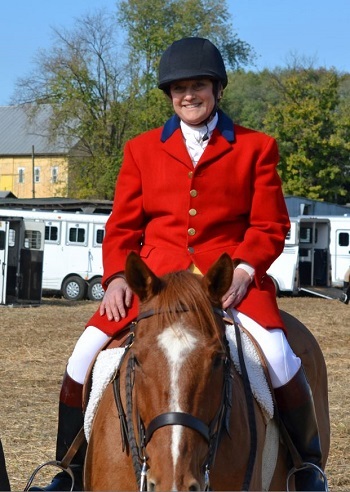
Jackets excused, we started out on this warm early autumn day by hacking left out of the drive and down Lees Mill Road. Passing behind one of the houses a man was bent over a small back door garden while an elderly man watched from the adjacent deck. Although he looked our way the elderly man did not respond to our waves, standing with his arms slack at his sides. The younger man pointed at us and, barely audible, I heard him say we were “looking for the fox.” Closing in on the one year anniversary of the death of my father-in-law, it was a bittersweet scene. Much more sweet than bitter to witness this quiet exchange between what I imagined to be an adult son and his father.
Approaching the creek crossing we heard a whipper-in’s view halloa ahead of us. Shortly after that we heard third field’s view; they had crossed the creek the usual way by the machine shed. The run lasted roughly an hour-and-a-half. At one point there were simultaneous views on opposite sides of the strip of corn running alongside Doss Garland Drive. There were views being called all over the place. Hearing them ahead of me I rushed up only to miss them. Second Field was viewing behind me, and I missed those, too.
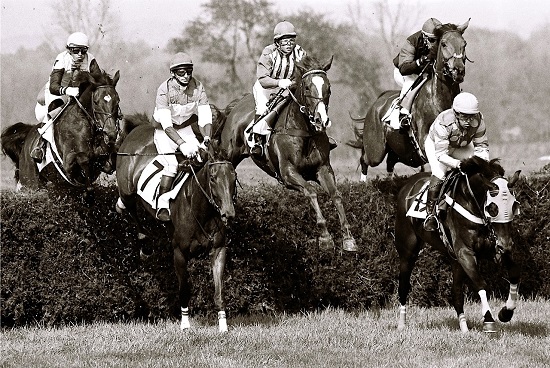
Peter Walsh (number 7) in the Swan Lakes Stakes, 1993 Virginia Gold Cup Races. Lonesome Glory (white blaze, Blythe Miller up) went on to win the race and capture his second Eclipse award that year. / Douglas Lees photo
In 2014, Peter Walsh, ex-steeplechase jock, served as Field Master and hunted with both the Piedmont Fox Hounds and the Orange County Hounds, neighboring packs in Virginia. He was hunting five days a week and working as Farm Manager for Milton Sender, a field member of both packs. In the off-season, he played golf avidly.
Today, Peter Walsh is still hunting with both packs, still managing the farm, and still playing golf avidly. It would almost seem as if nothing had changed...except that between then and now, Peter lost his right arm.