
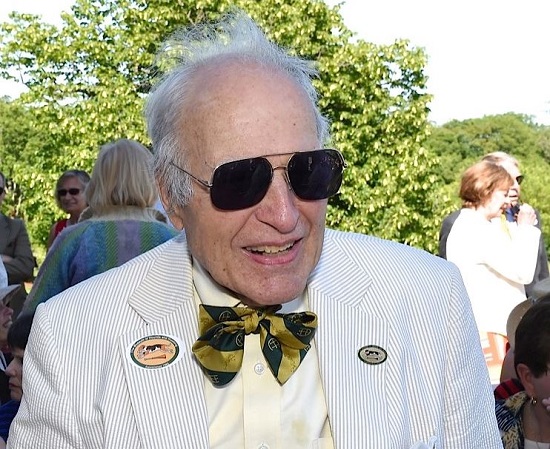
 Sherman Haight is inducted into the Huntsman’s Room of the Museum of Hounds and Hunting in May, 2016. / Douglas Lees photo
With the passing of Sherman Haight, the foxhunting world has lost one of its longest serving gentleman-statesmen. He was ninety-three.
I use the term “gentleman” in its fullest sense, mourning both Sherman and an age that is passing with him and his few remaining contemporaries. I don’t believe I ever saw Sherman without a shirt and tie, even in his own home and even when visiting in the morning.
He was a true statesman for our sport, born of a dedicated foxhunting family. His father, his father-in-law, his brother, and he were all Masters. His mother, game for any adventure, followed hounds on both sides of the Atlantic. His record of accomplishments and innovations, many of which are taken for granted by today’s foxhunters, is lengthy.
Though Sherman began hunting at the age of twelve, it wasn’t until after his service in World War II that he began his leading role in the sport of foxhunting. In 1947, Sherman and his brother Frederick were invited to take possession of an existing Connecticut pack, the Watertown Hounds. They moved the pack and established the Litchfield County Hounds the following year. Sherman carried the horn for the next thirty-three seasons.
In 1952, Sherman was invited to be a District Representative for the Masters of Foxhounds Association (MFHA). He served as president of the United States Pony Clubs from 1961–1964, vice-president of the MFHA from 1973–1978, and president of the MFHA from 1978–1981. He served as Trustee of the Hunt Staff Benefit Foundation, was a founder of the Museum of Hounds and Hunting at Morven Park in Leesburg, Virginia and was the driving force in the establishment of the Huntsmen’s Room at the museum. Sherman believed that huntsmen—whether amateur or professional—who handled hounds in the field with distinction are at the very heart of our sport and deserve recognition. He was chairman of the selection committee that inducts huntsmen to be so honored until several years ago.
While serving his term as District Representative in the early 1950s, Sherman helped solve his first problem for the MFHA. Each January during the Annual Meeting in New York City and after the Masters’ Dinner which was held those days on a Friday night, spouses, lady Masters, and the men still attired in their scarlet tails—resembling waiters and doormen themselves—set out to avail themselves of the New York night club scene.
Before long, they found themselves being turned away from the Stork Club and from other nightclubs, ostensibly for filling seats and tables and making them unavailable to the “regular patrons.” We won’t speculate on possible disruptive behavior by some of the scarlet-clad men turned loose in the city who perhaps tarred their similarly-clad, but well-behaved brethren, with the same brush.
One such year, Sherman, Peggy, and friends were waiting impatiently without having yet been admitted to the El Morocco when one reveler in their group suggested, “Why don’t we have our own party?” Another piped up, “Why not a Ball?” After more discussion, Sherman said, “Peggy, you fix it!” And Peggy did. She researched the hotels for a venue; Millbrook MFH Hopeton Kimball proposed to the Board that future Masters’ Dinners be rescheduled from Friday to Thursday night; and Peggy organized the first few Masters Balls for Friday night in New York. So, for those many readers who have enjoyed that glamorous January affair, that’s how it started.
Today’s foxhunters, accustomed to receiving Covertside and other regular communication from the MFHA, as well as attending the MFHA’s periodic educational programs, are perhaps unaware that through most of the twentieth century the MFHA was akin to a slow-moving private mens club. Some presidents held their posts for ten years or more, and communication of any sort with the general foxhunting public was a non-starter.
Sherman believed the MFHA should be doing more for its membership and for the sport it represented. Risking the wrath of close friends, he was a prime mover in 1970 in a wrenching change to establish term limits for presidents. Later, during his own term as president (1978–1981), Sherman organized the Board into working committees, each with a specific area of responsibility.
Foxhound conformation standards were long a subject of interest and concern to Sherman, who was intent on articulating those physical attributes of hounds that are directly associated with athleticism and longevity. He became an acknowledged judge of foxhounds early on and applied himself to improving the American and Crossbred foxhound breeds.
Foxhound standards through much of the twentieth century were a matter of agreement between the Foxhound Club of North America and the MFHA. In 1960, Sherman was appointed to a committee to revise the standard. The new standards were ultimately accepted by both organizations, and the following year Sherman was elected president of the Foxhound Club of North America. Twenty-eight years later he chaired another distinguished committee, consisting of himself, Bill Brainard, Ben Hardaway, and Jake Carle, to revise and update those standards, which remain in use to this day.
Last May at the Virginia Foxhound Show, Sherman was inducted into the Huntsmen’s Room at the Museum of Hounds and Hunting along with two other distinguished huntsmen for their uncommon skill in hunting hounds and for their contributions to foxhunting in North American. It was such a fitting tribute, not only because he deserved it, but because it was Sherman himself who co-founded the Museum and who spearheaded the creation of the Huntsmen’s Room.
A member of the 7th Cavalry Reconnaissance Platoon of the First Cavalry Division in World War II, Sherman saw action in the Pacific theater until finally catching multiple rounds from a Japanese .25-caliber machine gun in the stomach, head, and elbow. The triage doctor in the field placed him with other severely wounded men upon whom, in that doctor’s estimation, medical time and resources were not to be wasted. But he lived to tell his story.
Sherman’s mother was every bit as adventurous as the male side of the family. In Connecticut late one summer, heavy rains left the nearby river running so high as to barely allow a canoe to pass safely under the bridge. Thirteen-year-old Sherman proposed that he and his mother should shoot the rapids in their canoe, a notion to which his mother readily agreed. A household employee drove them to the point of entry, then departed to meet them below the rapids. The driver arrived at the calm waters below the rapids and eventually saw the canoe floating toward him—empty.
“I was to paddle stern position,” wrote Sherman, “and we set out for the ride of our lives! The rocks were mostly obscured by high waves; the force of the water was immense. My mother, in the bow of the canoe, shouted orders which I was to follow. We passed under the bridge thinking the worst was behind us, but little did we know! In the lower stretch of the rapids there was a sharp turn in the river that caused the canoe to be thrown against the bank with such force that we were thrown out. My mother and I stayed together until we found a tree with branches leaning over the river, which we used to get on dry land.” (Biography of a Sportsman, II by Sherman P. Haight, Jr., privately printed.)
Sherman grew up, depending upon the season, in New York City and in the northwest corner of Connecticut. In his memoir, Sherman admits to being raised in a life of privilege, but with that came a family heritage of integrity and responsibility.
Sherman will be buried privately. In lieu of flowers, the family suggests that donations in his memory be made to the charity of the donor’s choice.
Posted October 23, 2016
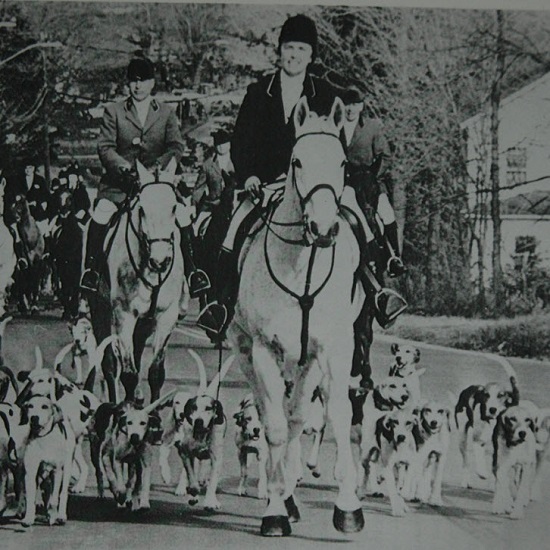 Sherman and Peggy Haight with the Litchfield County Hounds (CT), circa 1979–1980