Gone Away With Casanova Hunt
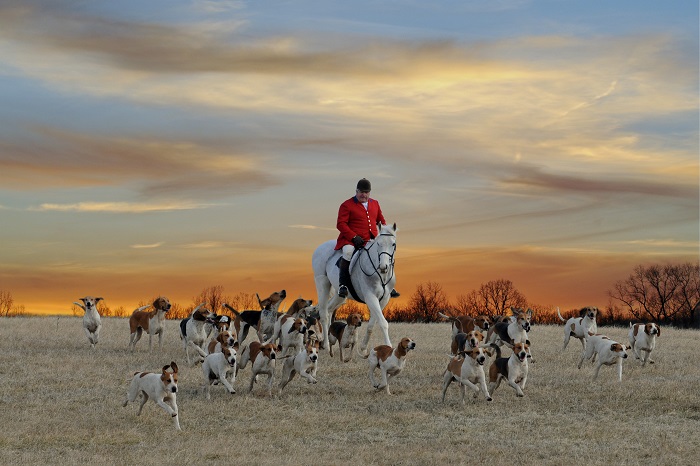
Huntsman Tommy Lee Jones and the foxhounds of the Casanova Hunt, now disbanded. / Richard Clay Photography
For the Casanova Hunt (VA), established in 1909 during the waning days of Theodore Roosevelt’s term as president, June 30, 2020 marks the end of the era. It’s a real heartbreaker. And a personal one.
It was an easy hack from the kennels at Weston to the Boarding House covert, so named half a century ago by Capt. Ian Benson, MFH and huntsman, because that covert harbored everything. It was often a quick cast and hounds were away.
Hunt Mergers Bring Stability, Benefits
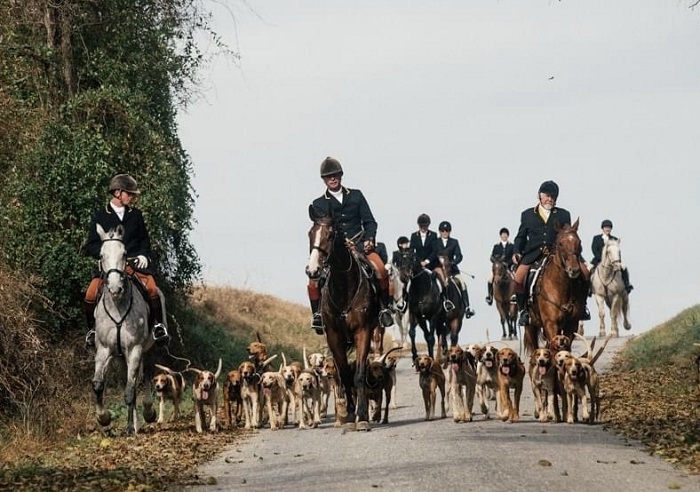
Sean Cully, MFH and huntsman (center), with hounds of the Rose Tree-Blue Mountain Hunt (PA). To the left is Brady Cully, whipper-in; to the right is Dr. Edward Franco, Joint-MFH and whipper-in.
When hunts merge, the resulting whole can often become greater than the sum of its parts. Take the case of a once-small hunt in Pennsylvania—the Blue Mountain Hunt. It was established by Sean Cully, MFH, in 1999 as a farmer’s foot pack. It became a mounted pack in 2009, was Registered with the MFHA in 2011, and became a Recognized pack in 2014.
Through unanticipated but judicious mergers, Cully’s little foot pack has stabilized a historic foxhunting country in Pennsylvania, rejuvenated the oldest subscription pack of foxhounds in the United States, and become a national influence and model for the sport.
County Limerick at Knockainey
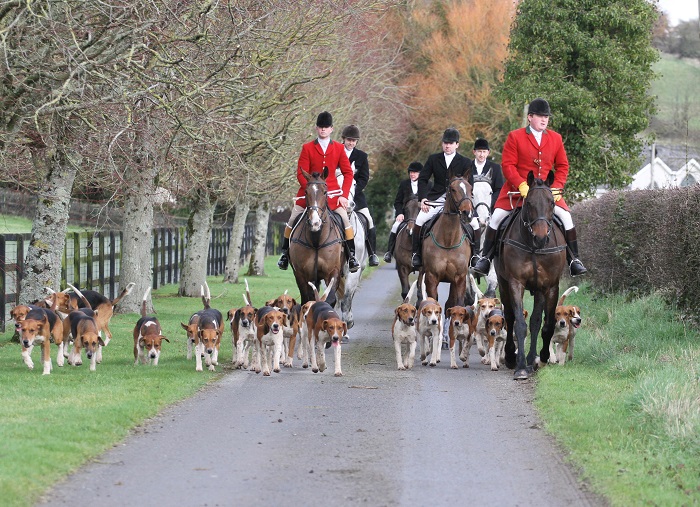
Traditionally-bred English foxhounds of the Co Limerick with huntsman Fergus Stokes (right) and whipper-in David Beecher (left) / Catherine Power photo
George Blenerhaasset of Ridelstown is credited with being the first Limerick Master around 1800. In about 1830 Mr. Croker of Ballinagarde took on the pack with Geo Fosbury which went on to become the County Limerick Foxhounds.
Hounds have been kennelled in Clonshire, the hunt property in Adare, since 1930. The village is now one of Ireland’s leading equestrian centres. Former County Limerick Masters familiar to many in the U.S. are the recently mourned American Master Al Schreck of the Los Altos Hounds (CA) and Master and huntsman Hugh Robards who hunted the Co. Limerick for twenty-seven seasons before coming to North America.
Keeping Score in the Hunt Field
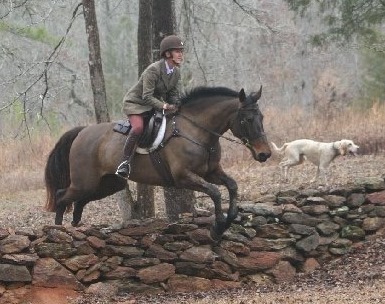
Judith on Parker, the Perfect
With the close of the recent hunting season, I’m feeling the need for some deep reflection since I fell six times. That’s right—six times—this season! Read on, as I evaluate each fall and its root cause.
Fall # 1: I was behind Ken Trogden when he and his horse, Moseby, took a bad jump over the coop into Gentlemen’s Hill. Ken hit the ground on landing and broke his wrist. My horse, Parker, and I were landing after jumping the coop just as Ken hit the ground and his air vest deployed. Parker spun at the sight and sound. I almost stuck it but, in the end, had to bail. When I ask myself how this ride went, I can hear Barbara Lee, one of my riding instructors, in my head, “You were following too close!” Okay. Mea Culpa.
HORSE-0 RIDER-1
The Reluctant Foxhunter
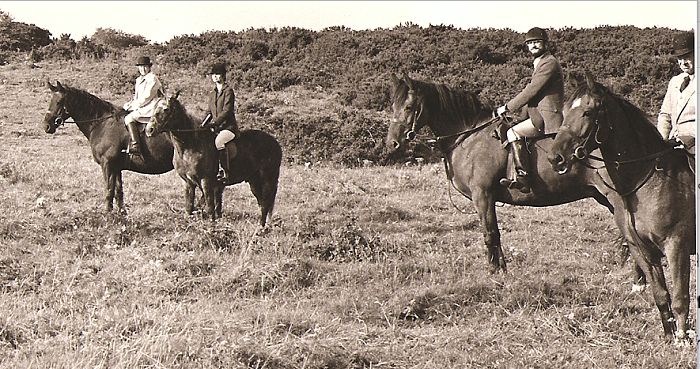
Author-editor Steve Price was so smitten with Dickie Power’s Scarteen hunt report in our last issue, that he offers this slice of his own experience at Scarteen. Steve is in the process of writing his equestrian memoir, “The Outside of a Horse,” and has allowed us to publish this advanced peek at his work-in-progress in which he recalls a day with the Scarteen while on a 1973 equestrian journalists’ junket to Ireland.
Steve Price (right-center) and Carol Clark (left-center) hunting with the Scarteen in 1973
Carol Clark, then editor of the Practical Horseman, had done her homework. During our Friday-morning drive to the village of Knocklong on the Limerick-Tipperary county line, she told me about our host, Thady Ryan. The Ryans had owned the Scarteen pack, named after their ancestral manor house, since 1798. Thady (né Thaddeus) was the most recent in the chain of Ryan men to serve as Master and huntsman. In addition to breeding, training, and caring for his hounds, and breeding and hunting his horses, Thady was a Dublin Horse show official and chef d’équipe of the Irish Olympic three-day team at the Tokyo and Mexico Olympics.
North Galway Foxhounds at Shrule, County Mayo
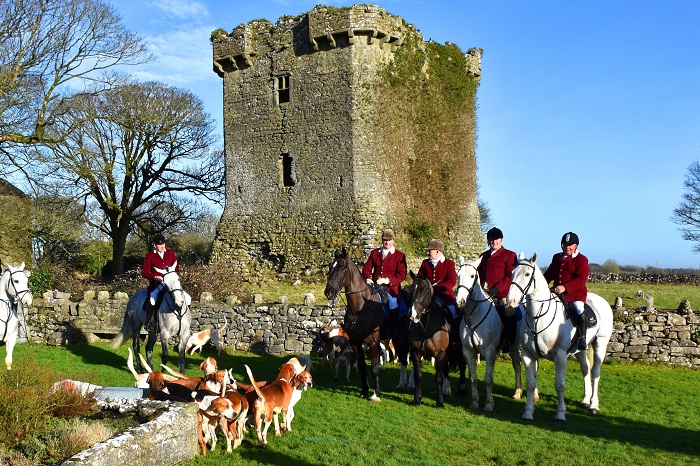
Huntsman David Masterson with Masters Tom McNamara, Michael Lennon, and Jackie Lee with whipper-in Gabriel Slattery at Shrule Castle directly across from TJ Gibbons Pub. Shrule Castle, a Norman keep, was built by the de Burgh family in 1238. / Noel Mullins photo
The hunting country of the North Galway Foxhounds was originally hunted by the Bermingham & North Galway Foxhounds, founded in 1946 by Sir Dermott and Lady Molly Cusack-Smith. Lady Molly had hunted the Galway Blazers during World War II. When the Bermingham and North Galway was disbanded in 1985, the North Galway Foxhounds was formed.
The meet was at TJ Gibbons Pub in Shrule, County Mayo, which has been in the family since 1925 and is now managed by Ronan Gibbons. The Quiet Man, starring John Wayne as Sean Thornton and Maureen O’Hara as Mary Kate, was filmed in nearby Cong and The Neale.
Scarteen Black and Tans at Emly
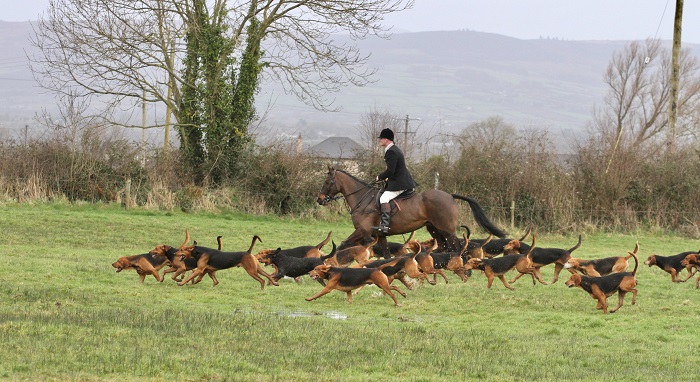
Huntsman Raymond O’Halloran and the hard hunting Kerry Beagles of Scarteen / Catherine Power photo
The earliest records of the Scarteen and the Ryan family goes back to 1640, coming after the flight of the Earls in 1607, another incident in the long history of Irish-British conflict. Around 1820, Daniel O’Connell (the Liberator) disbanded his pack of Kerry Beagles, and his hounds were sent to Scarteen to augment the Scarteen pack. The Ryans of Scarteen were closely related to the O’Connell’s of Caherdaniel. Chris Ryan, now in his thirty-fourth season as Master, is the eight generation of his family to have carried the horn at Scarteen.
The morning of February 11, 2020 at Emly, County Limerick, started with squalls of rain, sleet, and even some snow, but riders were undeterred and a large field gathered just outside the famed and historic village of Emly, where the pent-up excitement was palpable. It may have been the thought of jumping the Emly banks and their attendant trenches, any one of which could swallow up both horse and rider leaving little more than a ripple.
Foxhunting on the English-Scottish Border
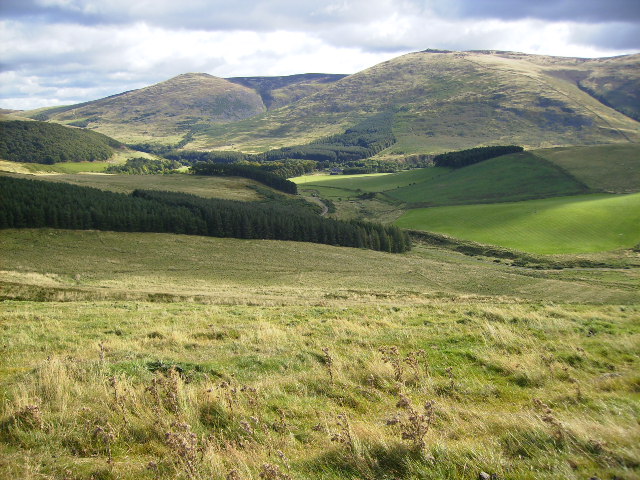
College Valley in North Northumberland
Although I had hunted in England, my education was incomplete according to my friends Matthew Mackay-Smith and Cliff and Laura Hunt. I had never hunted with the English and Scottish Fell packs. To remedy that void in my experience they convinced me to join them on their annual pilgrimage to the Border Country. There I discovered another mode of hunting altogether, and I shall be forever grateful to them, for it was not to be missed.
As an ordinary member of the field, how does your dream hunt unfold? In mine, there’s no Field Master. I jog right up to the huntsman’s side where I can be in close touch with the pack. And if I get ahead of him when hounds are running, he smiles and says, “Go on!” It happens there is such a place, and you don’t have to dream (or die) to get there.
The South Tyrone Foxhounds at Brackaville
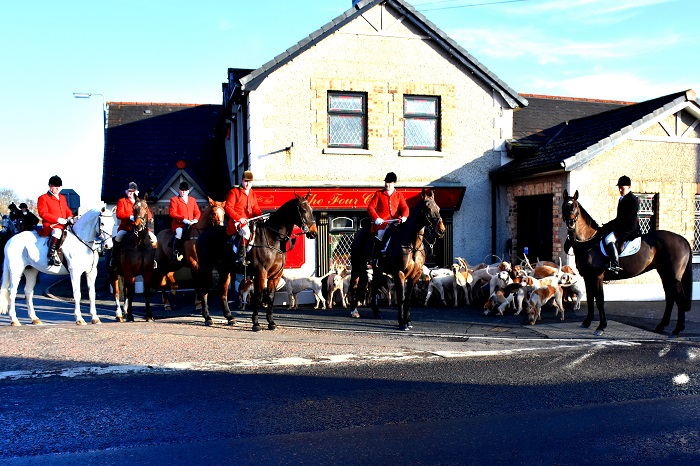
The South Tyrone Foxhounds Joint-Masters Stephen Hutchinson, Andy Oliver, and Tony Weir; huntsman Ryan Carvill; and whippers-in Paddy Considine and Paul Kinane at The Four Corners Inn in Brackaville / Noel Mullins photo
“Don’t open the back door of the horse box,” shouted honorary whipper-in Paul Kinane as I met him on the M1 Motorway heading north to Belfast. “There is a hound of Lord Waterford’s in there, and if he gets out we will be chasing him all over North County Dublin and miss the South Tyrone Foxhounds meet at Brackaville.”
As it transpired it was not a meet to miss as they had the best hunt of the season so far. Paul was bringing the hound up to Ryan Carvill, huntsman of the South Tyrone. Lord Waterford’s hound never made a sound, knowing that he was in good company with two tacked up hunters sharing the accommodation.
North Kerry Harriers at Glin Castle
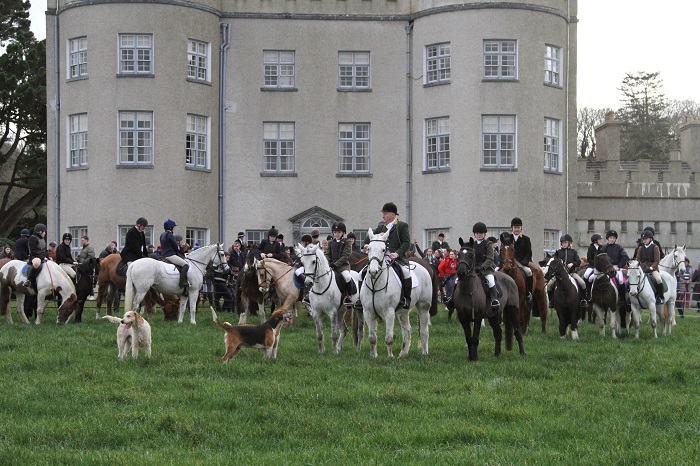
Annual meeting of the North Kerry Harriers at Glin Castle / Catherine Power photo
It has become something of a Christmas tradition for Catherine and me to visit the North Kerry Harriers at their invitation meet at Glin Castle in those days between Christmas and the New Year. This season the day fell on Sunday, December 29, 2019, and the keen, hard working hunt secretary, Shannon O’Mahony, was in overdrive. My computer and phone were in danger of collapse such was the volume of texts, emails, and What’s Apps describing the glory of Glin Castle and especially a sidesaddle day the hunt had organised.