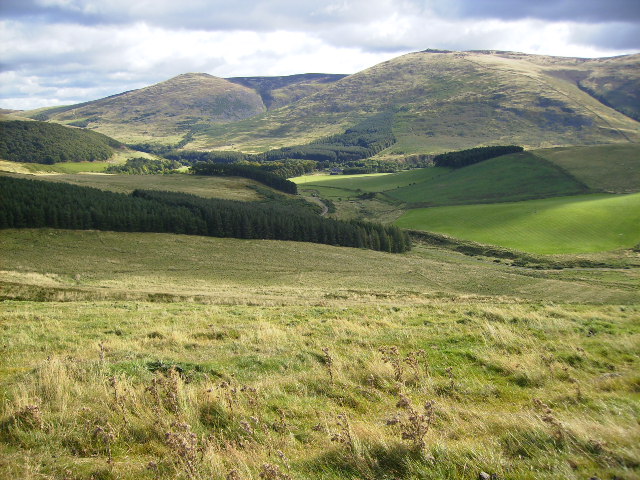
 College Valley in North Northumberland
Although I had hunted in England, my education was incomplete according to my friends Matthew Mackay-Smith and Cliff and Laura Hunt. I had never hunted with the English and Scottish Fell packs. To remedy that void in my experience they convinced me to join them on their annual pilgrimage to the Border Country. There I discovered another mode of hunting altogether, and I shall be forever grateful to them, for it was not to be missed.
As an ordinary member of the field, how does your dream hunt unfold? In mine, there’s no Field Master. I jog right up to the huntsman’s side where I can be in close touch with the pack. And if I get ahead of him when hounds are running, he smiles and says, “Go on!” It happens there is such a place, and you don’t have to dream (or die) to get there.
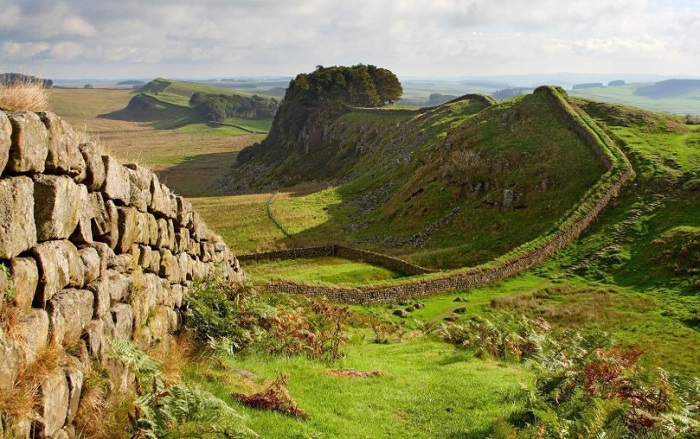 Hadrian’s wall built on the Border by the Romans to protect them from the Scottish reivers.
This most unorthodox hunting takes place in the vast, wild and unspoiled Cheviot Hills in the Border region of England and Scotland, the gritty inhabitants of which stopped even the Roman Empire in its tracks northward. Early in the second century A.D., the Roman Emperor Hadrian built his famous wall of stone from coast to coast, seventy miles long, fifteen feet high and six feet wide, running just south of these hills, to protect his citizens from the northern “Barbarians.”
Later, in the fourteenth century and for a period of almost four hundred lawless years thereafter, the Border region was a scene of thievery, midnight raids, rustling and murder to a degree that renders the American Wild West tame by comparison. Over the very hills where today’s foxhounds run, on dark nights, the Border Reivers, both Scottish and English, rode out on their speedy Hobbies, tough little sprinters bred for racing. Cannily picking their way around the treacherous peat bogs on the tops, clad in leather jerkins and steel helmets and armed with lance and sword, they descended swiftly out of the blackness upon the sleeping inhabitants of a farm, or often upon an unprotected widow, gathered up all they could carry, drove off the sheep and cattle, set fire to what remained, and sped away, hiding their stolen herds in natural bowls between the hills.
Today, the descendants of these ancient families and clans are a sturdy, wiry lot, spare with words and quiet of voice. They hunt a demanding country to which they have been bred for thousands of years. To the newcomer it offers a continuing series of challenges. Though there is little jumping, there are long hills that leave horses gasping and rattling for air, with deep bogs on top and steep descents. Parts of the country offer broad, clean, springy turf for galloping, but there are other parts where no two strides are alike.
Also bred for this demanding country are the Fell hounds. I caught my first glimpse of this old and unspoiled breed as they made their appearance with Michael Hedley, MFH and huntsman of the Border Hunt. My first impression was that I could be looking at a pack of American hounds. They seemed slighter of build than their sturdy English cousins with somewhat slender, but not snipey, noses. I found further evidence of the American look in Daphne Moore’s book, Foxhounds, where she wrote, “… the Fell hound stamp of head, which, in its purest form, has the high occipital bone, resulting in a pronounced dome.”
The Fell hound is independent, wide-ranging, and has a strong voice. Nothing less would answer. The scale of open space on the border country is so vast that hounds must draw widely and often hunt on their own with little help from the huntsman. Great cry is required because hounds may be out of sight behind a hill, and the frequent winds shred lesser sounds inaudible. And this is one hunting country where hound color is important, white hounds being of great value when the huntsman is squinting out over many miles to locate his pack.
I was with a party of American friends: Matthew Mackay-Smith, veterinarian, editor, publisher, and lifelong foxhunter; Ernest Benner, veterinarian and first-time foxhunter; Herb Jonkers and Tom Walker, both businessmen and experienced foxhunters; and Cliff and Laura Hunt, a couple who have devoted their lives to hunting and for years have organized annual trips to the English border where they take up temporary residence in a cottage in the Border Hunt country. Our horses were provided by Johnny and Hilda Wright of the Redesdale Arms hotel in Rochester. They were well-schooled, sure-footed, fit and up to the task. And the tack was good.
The hunting was like no other I have experienced: a combination of unique country—open, hilly, varied, vast; a country that lays out the action—foxes and hounds in full view; an unorthodox style of following, combining the best of hilltopping as well as racing after hounds—rider’s option; smaller fields and a more relaxed attitude than what would be encountered with the more formal English hunts; and finally, extraordinary foxhounds with all the speed, drive, and hunting intensity anyone could hope for. It is a place for those who ride to hunt because accounting for the fox is the purpose—this is sheep farming country—and much of what happens transpires in full view. Those who hunt to ride may find their dream hunt elsewhere. Not that we didn’t have our fine gallops, but much of the country is rough—lumps, bumps, ups, downs, ditches, mud and bog—oftentimes all within a few strides.
The biggest lesson I learned my first day out was how to save my horse. Matthew doesn’t care if his horse stands or fidgets, walks or jigs, so long as when hounds are running the horse has the stamina and heart to keep up over that fatiguing terrain. I soon learned why he was content to put up with his horses’ antics. Hounds had found, and, although we could hear them, we couldn’t see them because fog had settled in. Nevertheless, Matthew was off and running. Ahead of him was Peter, a local fellow who whips-in to Master Hedley. I had been warned of the peat bogs, but I figured it would be safe to follow since Peter was leading the way. I gave the mare her head and we galloped after the music, down one long slope and up the next. The fog was getting thicker, however, and my mare was falling behind.
The next hill undid her entirely, and I began learning how to economize on pace to let her wind return. My pilots, however, had disappeared on ahead. Alone in this unfamiliar, limitless terrain with little visibility, I resolved not to be so quick to follow Matthew again.
Fortunately, the Fell hounds made themselves heard quite adequately, and I was able to keep up by ear. Trotting and sometimes walking up the hills then cantering down, occasionally getting a reassuring glimpse of a horse and rider ahead disappearing into the fog over the next crest, I stayed in the race and finally caught up to Matthew and Peter in a dell between two hills at the edge of a forestry into which fox and hounds had disappeared. Giving this fox best, it was a full thirty minutes before we three saw another soul—time to nibble on a few bits of cheese I had stuffed into my pocket—and another thirty minutes for Master Hedley to collect hounds for the next draw.
Contiguous to the Border Hunt country and hunting over similar terrain on both the English and Scottish sides are the West Percy, College Valley & North Northumberland, Duke of Buccleuch’s and the Jedforest—all excellent packs showing wonderful sport. Highly prized throughout the hunting world, College Valley bloodlines are to be found in many of the best packs in North America as well.
On my final day with the Border, a joint meet with the Ullswater was scheduled. The Ullswater is an ancient and storied foot pack that hunts the Cumbrian Fells in the Lake District. It was a pleasure to see John Harrison again, ex-huntsman of the Toronto and North York Hunt (ON), who had returned home from Canada to become huntsman of the Ullswater. There were perhaps twenty mounted followers for this joint meet, another twenty on bikes and ATVs, and 141 automobiles (somebody counted!) looking like a thin column of ants on the roads below.
As hounds plunged down the slope before us to draw a heathery covert bordering a narrow stream, we meandered up the long open slope above them where, after gaining the top, we had the typical view for this country—forty or fifty miles of more grass, heather and gorse-covered hills and dales all the way to the undulating horizon. No houses or buildings, just scattered flocks of sheep—little white slow-moving dots in the distance—and, in the valleys, ancient stone circular sheep stells with a single opening into which the sheep can escape the occasionally ferocious winds that scour the hillsides.
A fox slipped out of the heather ahead of hounds, scampered along the stream for a way, then made for open country—he had little choice—striking out up the next hill and traversing its length in full view before us. Hounds trailed up to where he had been lying and opened with a roar. We had the option of saving our horses and watching from the hilltop as Master-and-huntsman Hedley was doing, or leaving him behind and careening on down after the hounds. Either way is okay with him. He has radio contact with his mounted whippers-in and with his terrier-men riding mountain bikes and ATVs. He was in no hurry. It was just after eleven a.m., and he wouldn’t be thinking of quitting until about five p.m.
I chose to be patient this time and save my horse, and was rewarded with a fifteen-minute chase that took place in full view of our hillside. The fox maintained a good lead initially, but as the two packs started working as one, they began to press him. Hounds were checking less frequently, and the fox decided to double back. He hurried down the opposite hill toward us and disappeared into the heather fringing the brook. Only momentarily, though, because hounds owned his line and, all together, were gathering speed down the hill toward his sanctuary.
The fox broke out, making for the slope below us, and tore up our hill just barely ahead of the clamor. Hounds had him in sight and had switched to high gear. The lead hounds were no more than fifteen feet behind and closing the gap by a couple of feet with each stride. With only one more stride before being rolled over, the fox darted to his left and, as hounds hurtled past his turn, disappeared into the hole he alone knew was there.
Before the day was done, Michael Hedley and John Harrison would kill five foxes, to the great satisfaction of the sheep farming constituency there.
“I told you this pack was a fox-killing machine,” said Matthew, not so subtly reminding me that he and the Hunts had been urging me for several years to accompany them on their annual visits to this part of the hunting world.
So how does a dream hunt end? With food of course. Where else will you find a horse purveyor furnishing a tailgate tea? As Johnny took the horses from us at the end of each day, Hilda was there with a picnic basket of sandwiches, fried chicken, tea, coffee, homemade shortbread and cake. Just enough to hold us until we got back to the cottage, changed, and went out in search of lamb shanks and Scotch whisky.
Posted February 12, 2020
Republished from Foxhunting Adventures: Chasing the Story, by Norman Fine, The Derrydale Press, 254 pages, illustrated, 2010.