Foxhunting Museum Gallery Open for Holiday Shopping in Middleburg
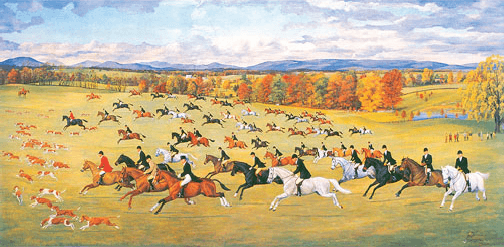
Scurry of the Orange County Hunt by Jean Bowman
A satellite gallery of the Museum of Hounds and Hunting at Morven Park is open in Middleburg for art-minded Christmas shoppers. Sporting art—original paintings, signed prints, and sculptures by contemporary American artists are for sale at prices ranging from $385.00 to $9,600.00 with all sales benefitting the Museum.
Modestly priced items—books, calendars, note cards, and sporting novelties—are also available. Whether or not you are ready to shop, it’s worth a stop if only to see what today’s talented, contemporary artists are producing and to learn more about the Museum, its permanent exhibits, and its programs.
One of the surprising items for sale is the limited edition print of the late Jean Bowman’s brilliant 1989 Scurry of the Orange County Hounds. Four of these prints were recently found safely in storage, Jean Bowman having been a member of the Museum Advisory Committee and a generous supporter. Two of the prints are signed by Ms. Bowman, and the price is still a very reasonable $385.00. The prints come with a key identifying the figures, among them James L. Young, MFH; Governor Bruce Sundlin; Jacqueline Kennedy Onassis; the Hon. Charles Whitehouse; Senator John Warner; Melvin Poe, huntsman; the artist herself; and sixty-six other notable members.
Other artists represented in the benefit sale include Anita Baarns, Cynthia Benitz, Jean Clagett, Mary Coker, Mary Cornish, Teresa Duke, Sandra Forbush, Juli Kirk, Nancy Kleck, Gail Guirrei Maslyk, Alice Porter, Belinda Sillars, Dana Lee Thompson, and Cathy Zimmerman.
The Galloping Whip
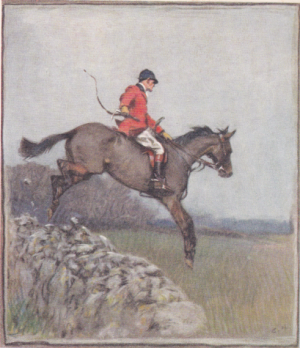
Gilbert Holliday illustrationIf life is a business, existence is fun
When duty and pleasure and sport are in one;
And so he wears ever a smile on his lip–
‘Tis a labour of love to the Galloping Whip.
The moon of September’s his light in the morn,
When the cub’s to be killed and they’ve carried the corn;
The moon of December’s his lamp for the trip,
As home with the pack goes the Galloping Whip.
For hours never vex him, and work cannot tire,
That dapper pink fits on a framework of wire;
He’ll go without sup, and he’ll go without sip
From daylight to dark will the Galloping Whip.
The phiz of bold Reynard is shaped on his mug,
Mouth wide as an oxer, as deep as a jug;
That feature was fashion’d to scream, not to nip,
And the bumper’s no charm for the Galloping Whip.
The last to leave covert, he’ll cheer on the pack;
Twenty couples are out, then away with a crack;
In a mile he has given the quickest the slip–
The wind from their sails takes the Galloping Whip.
Inaugural Sporting Art Auction
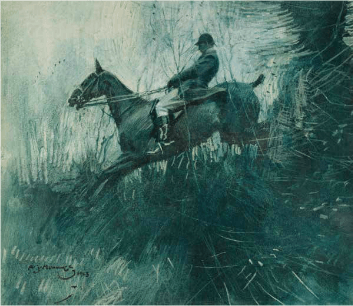
Over the Ditch by Sir Alfred MunningsPut the expertise of the world’s largest Thoroughbred auction house—Keeneland—together with Gregg Ladd’s premier gallery of sporting art—Cross Gate—both located in Lexington, Kentucky, and you get what should turn out to be an exceedingly important auction of sporting art. This inaugural Sporting Art Auction will take place on Wednesday, November 20, 2013 at 4:00 p.m.
To be sold are 174 lots, both paintings and sculptures. The focus is on sporting art by nineteenth and twentieth century American and British artists—realists and impressionists—such as Sir John Frederick Herring, Sir Alfred Munnings, John Emms, Pierre Jules Mene, John Skeaping, Lionel Edwards, Edward Troye, Franklin Voss, Peter Curling, Peter Biegel, Michael Lyne, three generations of Wyeths (N.C., Andrew, and Jamie), Mary Cassatt, and Andre Pater.
A Short History of Foxhunting
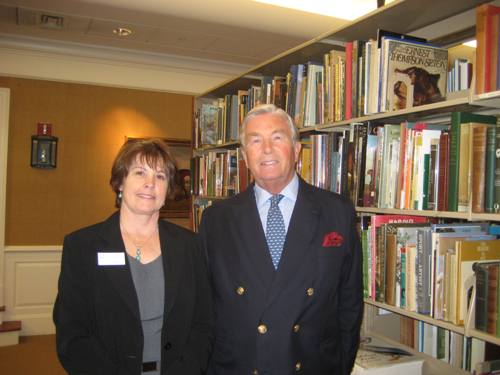
Librarian Lisa Campbell shows Alastair Jackson around the stacks at the National Sporting Library, where the author talked about his new book and signed copies. / Maureen Gustafson photo
Excellent books have been written on the history of foxhunting by such notables as The Duke of Beaufort, Roger Longrigg, and Joe Thomas. However, the operating word in the title of this new book by two contemporary notables—Alastair Jackson and Michael Clayton—is “Short.”
“Michael came to me with the idea,” said Jackson last night at the National Sporting Library in Middleburg, Virginia, where, after wine and appetizers, he talked about his book and signed copies. “There are so many people hunting today that don’t know about our history. We wanted to provide something concise, entertaining, and easy to read rather than the academic and often dry histories that have been published in the past.”
Jackson wrote the text and drew the delightful pen-and-ink illustrations reminiscent of the styles of Eleanor Iselin Mason and Edith Somerville. His sketches accurately capture the attitudes and posture of hounds, horses, people, and quarry in motion with economy of line. Clayton provided his vast experience reviewing and editing the text, and wrote the short verses that provide the lead for each chapter.
The Clipper that Stands in the Stall at the Top
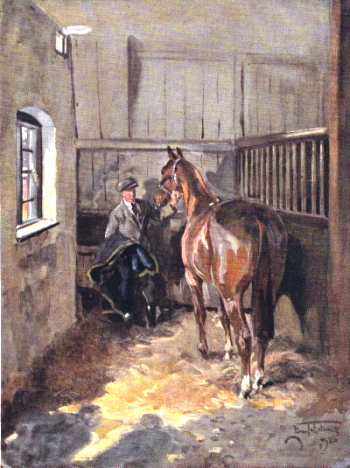
Illustration by Lionel EdwardsNot long ago we polled our readers and were pleased to find that the great majority of you enjoyed reading the classic foxhunting poems. Here’s one such classic that to me best expresses the pride, gratitude, and love the foxhunter feels for that one special horse—the most generous, the most reliable, the most gentlemanly of all we’ve had—that takes us over the day’s obstacles and brings us safely home.
Go strip him, lad! Now, sir, I think you’ll declare
Such a picture you’ve never set eyes on before,
He was bought in at Tatt’s for three hundred I swear,
And he’s worth all the money to look at, and more;
For the pick of the basket, the show of the shop,
Is the Clipper that stands in the stall at the top.
In the records of racing I read their career,
There was none of the sort that could gallop and stay,
At Newmarket his sire was the best of the year,
And the Yorkshiremen boast of his dam to this day;
But never a likelier foal did she drop
Than this Clipper that stands in the stall at the top.
New Book Explores Origins of Mounted Foxhunting
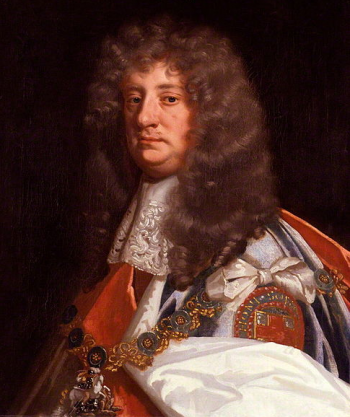
George Villiers, second Duke of Buckingham died of a chill caught while foxhunting. His mother bred some of the earliest Thoroughbred racehorses at Helmsley Stud. Portrait by Peter Lely, courtesy of the National Portrait Gallery.A new book on the beginnings of mounted foxhunting in the English shires—From the Deer to the Fox: The Hunting Transition and the Landscape 1600-1850—has been published by the University of Hertfordshire Press and released on September 15, 2013. Written by Bandy de Belin, the book disputes one commonly-held theory of why English sportsmen shifted from hunting the deer to hunting the fox as the primary quarry.
Traditional theory, according to de Belin, suggests that the disappearing woodlands and increased enclosures of the open space led to the decline of the deer population, so hunts, by necessity, turned to the fox.
The Hounds of Annwn Series: The Ways of Winter and King of the May
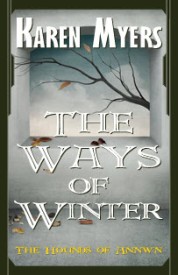
Perkunas Press, 2013
Paperback from Amazon, e-book
from Amazon and the publisher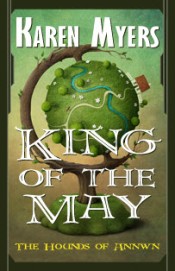 Perkunas Press, 2013
Paperback from Amazon, e-book
from Amazon and the publisherAuthor and avid foxhunter Karen Myers continues the adventures of huntsman George Talbot Traherne of Virginia, who found himself inexplicably pulled into a realm of fae and immortals in her first novel, To Carry the Horn: The Hounds of Annwn.
Her second and third novels, The Ways of Winter and King of the May plunge George deeper into the lives of the fascinating characters who inhabit this mysterious otherworld, where it is not always clear who is friend and who is foe. George discovers that he is related to the rulers of this ancient domain, which seems to have once paralleled that of humans. But he possesses godlike powers that not even the wisest of the fae with their magic and their charms fully understand.
Throughout all three novels, Myers weaves the myth of the Great Hunt and the Hounds of Annwn, which belong to the antlered god, Cernunnos. The hounds, which hunt stag and man, were bestowed by Cernunnos upon George’s kinsman, Gwyn ap Nudd, the Prince of Annwn, and are the secret to the prince’s power. Without the hounds, Gwyn loses all. George discovers magical skills of his own as he struggles to keep his hounds safe so that the Great Hunt on Nos Galan Gaeaf, or All Hallows’ Eve, can take place.
The Voice of Bugle Ann: An Excerpt
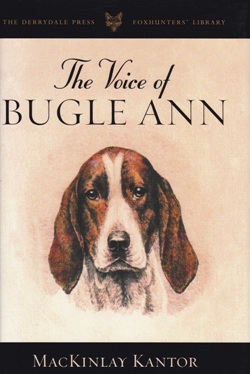
This 1935 foxhound classic, reprinted by
The Derrydale Press in 2001, is cloth bound,
128 pages, $18.95, in the Foxhunting Life Shop.Although we can’t hunt in the summer, we can read about hunting! Here’s an excerpt from a foxhunting classic, the first of two slim novels, the second of which, Daughter of Bugle Ann, we featured six months ago.
Her voice was something to dream about, on any night when she was running through the hills. The first moment she was old enough to boast an individual voice, Springfield Davis swore that she would be a great dog, and within another month he had give her the name she carried so proudly.
One of her great-grandfathers, many generations removed, had followed Spring Davis away from home when he went off to join General Claiborne Jackson and his homespun army among the prickly-orange hedges, so there was logic in the inheritance which put that trumpet in her throat.
From Toy Box to Art Gallery
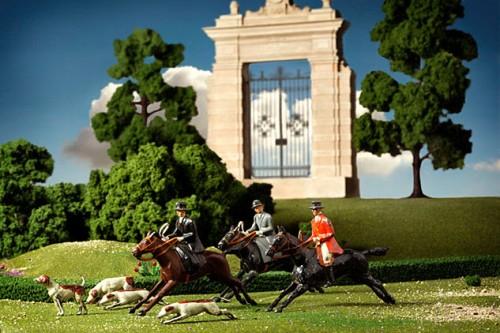
What happens when a noted photographer stumbles across a set of vintage (1930s) British cast lead toy figures of foxhunters and hounds? Award-winning photographer/author/film maker Robert Trachtenberg was captivated by the various poses and old patina on the figures. He placed them into scaled-down landscapes, illuminated them romantically, and produced a suite of seven photographs […]
At Galway Races

William Butler YeatsWith hunt point-to-points kicking off the racing season, we thought it appropriate to elevate our discourse with a little Yeats. There where the course is,Delight makes all of the one mind,The riders upon the galloping horses,The crowd that closes in behind:We, too, had good attendance once,Hearers and hearteners of the work;Aye, horsemen for […]