
 Librarian Lisa Campbell shows Alastair Jackson around the stacks at the National Sporting Library, where the author talked about his new book and signed copies. / Maureen Gustafson photo
Excellent books have been written on the history of foxhunting by such notables as The Duke of Beaufort, Roger Longrigg, and Joe Thomas. However, the operating word in the title of this new book by two contemporary notables—Alastair Jackson and Michael Clayton—is “Short.”
“Michael came to me with the idea,” said Jackson last night at the National Sporting Library in Middleburg, Virginia, where, after wine and appetizers, he talked about his book and signed copies. “There are so many people hunting today that don’t know about our history. We wanted to provide something concise, entertaining, and easy to read rather than the academic and often dry histories that have been published in the past.”
Jackson wrote the text and drew the delightful pen-and-ink illustrations reminiscent of the styles of Eleanor Iselin Mason and Edith Somerville. His sketches accurately capture the attitudes and posture of hounds, horses, people, and quarry in motion with economy of line. Clayton provided his vast experience reviewing and editing the text, and wrote the short verses that provide the lead for each chapter.
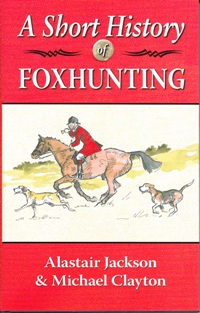 A Short History of Foxhunting by Alastair Jackson and Michael Clayton, 2013, Merlin Unwin Books Ltd, 121 pages, illustrated, hardbound, $23.00Rather than harking back to cave drawings and man’s earliest hunting adventures with dogs, Jackson and Clayton stick to foxhunting and begin their story in 1066 when Norman hounds accompanied William The Conqueror from Normandy to the English shores. The authors take a quick step back to St. Hubert (656 to 727) who concentrated on scenting hounds and developed their breeding to a fine art. Descendants of the St. Hubert hound were taken to Normandy around the tenth century and, known as the Talbot Hound, came to England with the invading forces and hunted the stag and the fox by scent.
Through eighteen short chapters covering 110 pages, the authors bring us from the Norman invasion and the plodding nose-to-the-ground style of hunting, through the social and countryside changes leading to the modern style of hunting with fast hounds and fast horses, through the vicissitudes of two world wars, hunting’s heyday in between, the development of sporting art , literature, and the modern English foxhound, hunting in North America, the road to the Hunting Act of 2004, and hunting’s future.
The fox earns its own chapter from its ancient fabled reputation to its current plight under the hunting ban where, without the management of country by the local hunts it is now shot at and snared throughout the year by farmers to protect their stock. This lack of sensible management of the countryside and indiscriminate pressure has pushed the fox into urban areas unprepared to deal with the influx.
As far as foxhunting goes in England, despite the nuisance factor of anti-hunting monitors that follow hunts, hunting goes on as before. Convictions under the Hunting Act are few because of the difficulty in proving a case, and sportsmen and women are still hopeful of making changes to this despised and poorly-working legislation.
American foxhunters will remember Alastair Jackson from his frequent visits to judge foxhounds at Virginia and Bryn Mawr. Jackson was a longtime Director of the Masters of Foxhounds Association in England; he is a former MFH and huntsman; he has contributed regularly to Horse and Hound; and he has illustrated many books. He is the author of The Great Hunts.
Michael Clayton was editor and hunting correspondent for Horse and Hound for twenty-four years; he is a former editor-in-chief of Country Life and The Field, has been a BBC TV correspondent, and has written more than twenty books on hunting and horses.
For newcomers to the sport as well as experienced foxhunters, A Short History of Foxhunting enlightens and entertains, just as the authors intended. We highly recommend it.
Posted October 23, 2013