Cubbing
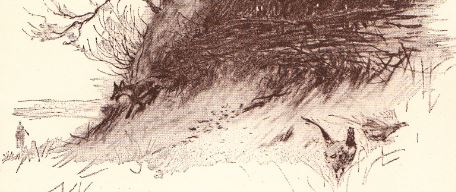
Illustration by Cecil Alden
by Duncan Fife
I wouldn’t change places with any man,
Were he powerful, rich, or wise,
As I stand in the early morning chill
While we wait for the mist to rise.
There are silver threads on the bracken fronds,
And a peaty tang in the air
That goes to the head like a draught of wine,
As we stand by the cover there.
If the creak of leather and clink of bit
Makes me yearn—well I’m not ashamed,
For I’ve got no horse of my own to ride,
And I don’t suppose I’ll be blamed
If I look around with an envious heart
At the satiny coats nearby,
At the twitching ears and the nostrils wide,
And the eagerly watching eye
That seeks to pierce through the curtaining mist
Where it clings to the dripping trees,
Concealing the cubs as they wait, alert,
For a chance to run. Then a breeze
So faint, so soft, that the glittering drops
Which hang on the bramble and thorn,
Are scarcely disturbed, but the low-lying haze
Dissolves at the coming of dawn.
The Hare that Must Be Fox
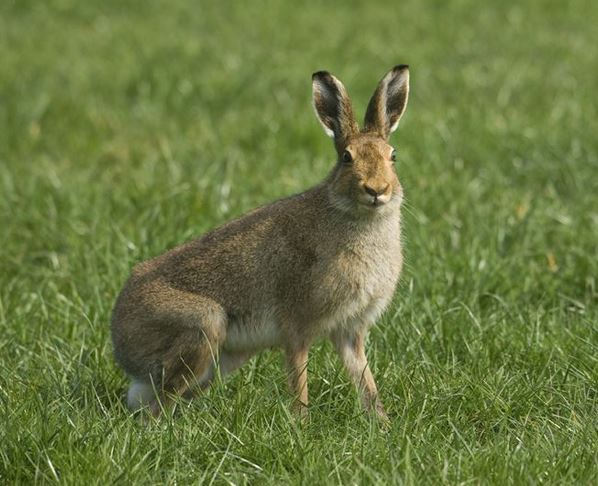
A third condensed installment from We Go Foxhunting Abroad: A First Venture with the Irish Banks and English Downs, Charles D. Lanier’s 1924 account of a father-daughter sporting trip to Ireland and England.
Irish hare
We decided that our new sensation would be a trial of Irish harehunting, so to Watergrass Hill we flivvered, to the meet of Mr. Robert Hall’s private pack of harriers. The Master was a slender, wiry, grey-haired man of seventy years, aquiline of countenance, with a singularly winning eye and smile under his velvet cap. He and his whipper-in were, of course, in green, and a dozen or so of the field of thirty or forty also wore the correct harrier colors.
Mr. Hall had the pride of an Irishman and a sportsman in his fifteen couple of huge Kerry “beagles,” and I think it would have been a hard blow to him if luck had been denied us that day. But it turned out to be a red letter day; I think we enjoyed having it so even more for the intense satisfaction it gave our enthusiastic host than for the sport intrinsically, which was of the very best and a revelation to us, who had not before followed a strong South Irish hare.
Sheep May Safely Graze

Sheep May Safely Graze, L.M. Clancy, 2015, 423 pages, paperback, $14.95, available at AmazonIrish sporting artist Liam Clancy has expanded his repertoire. He’s written a novel.
While foxhunting, prodigious drinking, and sex are well-handled ingredients of Clancy’s story—which takes place mostly in Ireland and England—those ingredients are only a framework upon which hangs a larger story of people, relationships, and the times. Our times: the Millennial, hunt sabs, the pathos of the hoof and mouth epidemic, the runup to the hunting ban, the dagger thrust into the heart of the English countryside by a government focused elsewhere.
If the publishing industry were not in turmoil, as it has been for the last decade at least, and if publishers would give first-time novelists half-a-chance, Clancy’s book could well replace titles by authors with household names that now occupy undeserved spots on the Best Seller lists. His dialog crackles, and his characters are wholly-formed individuals that you will care greatly for. Think of Maeve Binchy on steroids.
Will Ersland’s Style
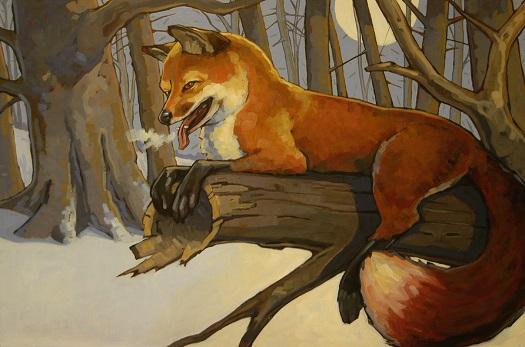
Hunters Moon by Will Ersland, courtesy of Cindy Piper, MFH, Long Lake Hounds (MN) Someone once told Will Ersland, “The horses and people in your paintings have great action—even when they’re standing still!”
Ersland sees himself as a visual journalist. “My paintings record a moment in time,” he says. “They are cropped the way I see the action, and each brush stroke is laid down with confidence and purpose based on my academic background and decades of drawing and painting.”
Ersland’s use of short, flat, planar brush strokes to highlight rounded shapes strikes me as an effective and unique element of his style.
“My style is dictated by the medium—acrylic paints—which dry very fast,” he explained. “I don’t even try to blend them. Instead, I build up form by starting with the darkest values and layering on the lightest values, usually following the form of the object with my brush strokes.
The Second Whip
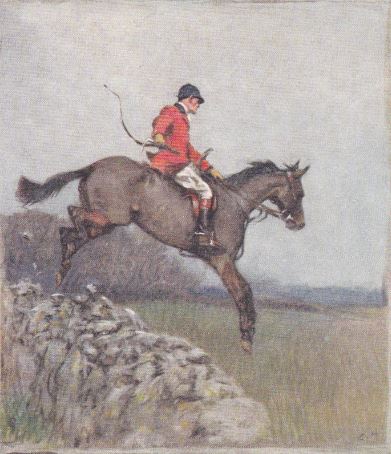
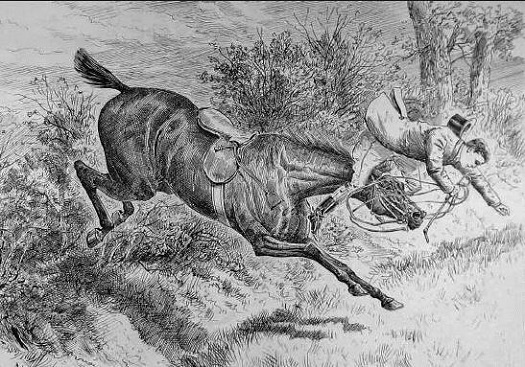
Illustration by Gilbert HollidayOver he goes, with a crash and a rattle,
Hound couples clinking, ’gainst saddle and thigh;
Over he goes, and the light of the battle
Gleams like a spark in his eager young eye.
Twigs of the hawthorn fly backward together,
Meeting again with an ominous swish;
Over he goes, landing light as a feather,
One with his horse and quick as you’d wish.
Kinds and condition of fences don’t matter,
Straight as a ramrod he rides at them all;
Over he goes with a bang and a clatter,
Knocking loose stones off the top of the wall.
Our First Foxhunt Over the Irish Banks
Here’s a second condensed installment from We Go Foxhunting Abroad: A First Venture with the Irish Banks and English Downs, Charles D. Lanier’s 1924 account of a father-daughter sporting trip to Ireland and England.
We put on our hunting things Saturday morning and climbed into the flivver for our first hunt with the United.
B had taken care to remove from her coat the orange collar of our home hunt colors, and I wore the regulation “visiting” dress of American custom—dark Oxford grey coat, cream colored Bedford cord britches, plain black jack boots and hunting bowler. I have never become an authority on the niceties of hunting etiquette and was simply aware one could not go amiss in these unpretentious togs.
Our flivver soon began to overtake people bound for the meet, gentlemen and ladies jogging along on short-tailed beasts with enormous quarters and hocks, grooms leading horses with their riderless saddles carefully protected by slip covers from the showers, which appear in South Ireland without a moment’s notice or a discernable cloud; showers that pass away, generally, as quickly as they come, with no one paying the slightest attention.
Outward Bound
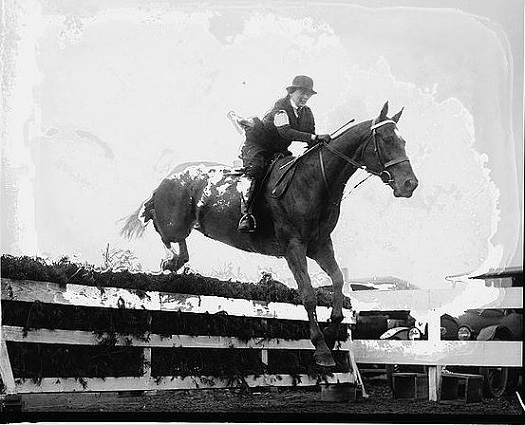
In juxtaposition to these times of fast and affordable air travel to and from England and Ireland for hunting holidays, here’s a look back to a 1924 account of a leisurely (and dramatic) father-daughter sea voyage—their first—to go foxhunting on the other side. It was also a different era for world events, as readers will note.
Author Charles D. Lanier was MFH of the Fairfield County Hounds (later the Fairfield and Westchester Hounds) from 1915 to 1921. His seventeen-year-old daughter, referred to as “B,” was Becky Lanier, later Becky Sharp, MB of the Nantucket Beagles, and still later Joint-MB of the Nantucket-Treweryn Beagles, who, along with her husband Joint-MB David “Bun” Sharp passed away in 1987.
Becky Lanier, 1920
What follows is a condensed version of Chapter 1, “Outward Bound,” from Charles Lanier’s We Go Foxhunting Abroad: A First Venture with the Irish Banks and English Downs published in 1924. Subsequent chapters in condensed form will appear through the remaining summer months.
Maureen Riley and the Zennor Fox
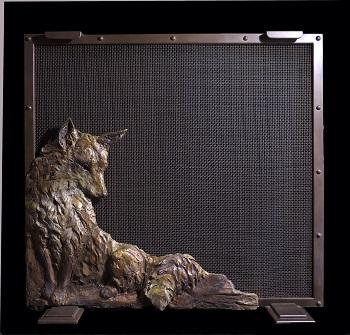
“I felt that the story of the Zennor fox needed to be remembered,” writes Michigan artist Maureen Riley. “It tells the story of a fox, but more than that it tells of a sportsman’s love for a good day of sport and a sense of fair play.”
Maureen Riley is a sculptor and painter who has been steeped in the sporting life from an early age. She learned about gun dogs from her grandfather and about sculpture from his friend, Walter Midener. Shooting, fishing, and horses have always been a part of her life, and country sports are at the root of her art.
From her studios in Michigan, Maureen has exhibited her work at Safari Club events and at international exhibits in both Milan and Portofino, Italy. Her work has also been shown at the Smithsonian. She is a member of the Society of Animal Artists and the National Sculpture Society.
Maureen has just created an interesting new platform from which to present her bronze works—a fireplace screen that serves as a blank canvas for her limited edition and custom relief sculptures. Her first design on this “blank canvas” is titled the “Zennor Fox.” The work was inspired by a 1913 foxhunt with the Western Hounds near Zennor Hill in Cornwall. Here’s the conclusion of the hunt as written by a participant, the renowned English equine artist Sir Alfred J. Munnings.
Country Pursuits: The Mellon Collections
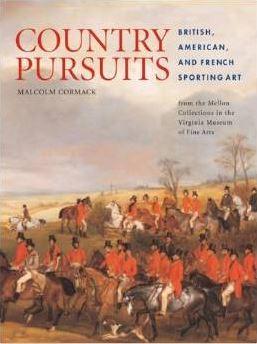
Country Pursuits: British, American and French Sporting Art from the Mellon Collections in the Virginia Museum of Fine Arts, by Malcolm Cormack, Published by the Virginia Museum of Fine Arts in association with the University of Virginia Press, 2007, 474 pages, illustrated, $62.00What a debt we all owe the late philanthropist Paul Mellon, whose love of horses and horse sports was expressed through the fabulous art collections that he so generously shared with us.
The Eclipse Award-winning breeder saddled legendary Thoroughbreds Sea Hero, Arts and Letters, and Mill Reef, just to name a few. His first British art purchase, in 1936, was a painting of a racehorse, “Pumpkin with a Stable-lad” by George Stubbs, said to be his favorite painting by one of his favorite artists. Pumpkin won sixteen out of his twenty-four races at Newmarket turf in the late 1770s and was described as an excellent runner.
“It was my very first purchase of a painting,” Mellon recalled later, “and could be said to be the impetus toward my later, some might say gluttonous, forays into the sporting art field.”
That Stubbs painting was donated to his alma mater, Yale, but the Virginia Museum of Fine Arts was another lucky recipient of Mellon’s “gluttonous” obsession with sporting art. Mellon’s donations are explored in Country Pursuits: British, American and French Sporting Art from the Mellon Collections in the Virginia Museum of Fine Arts by Malcom Cormack. Cormack was the Paul Mellon Curator at the VMFA in 1991 until his retirement in 2004. He also once served as the Curator of Paintings at the Yale Center of British Art established by Mellon.
A Fox in the Family
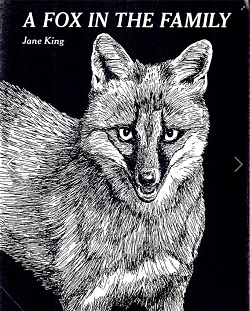
Take two gray fox cubs that need a home and one family of tender-hearted animal lovers. Put them together, and you’ve got a charming menagerie that includes horses, dogs, a grumpy cat, turtles, two little boys, frogs, mice and birds.
A Fox in the Family, Jane King, Xlibris LLC, illustrated, 96 pages, $22.49 (hardcover), $14.40 (softcover), available at Amazon and Barnes and NobleA Fox in the Family is Jane King’s reminiscences about life with a smart, funny, wild animal with loads of personality. Jane and her husband Jim were known for rescuing and rehabbing animals on their farm in Indiana. So when a neighbor salvaging an old barn discovered a family of foxes under the dilapidated structure, he knew whom to call.
The Kings went home with two cubs, promptly named Frisky and Friendly by their young sons. Unfortunately, Friendly did not make it, succumbing to a mysterious malady, but Frisky went on to become a member of the family, accepted by everyone except the cat. Frisky and his best friend, the terrier, Bandit, managed to get into all kinds of trouble, including breaking their legs at the same time in a dust-up with the horses. Their favorite playtime activity was a rousing game of snatch-the-tennis-ball, and they spent hours playing before collapsing together on the sofa to nap.Their other favorite sleeping place was under the covers with the boys.