
Here’s a second condensed installment from We Go Foxhunting Abroad: A First Venture with the Irish Banks and English Downs, Charles D. Lanier’s 1924 account of a father-daughter sporting trip to Ireland and England.
We put on our hunting things Saturday morning and climbed into the flivver for our first hunt with the United.
B had taken care to remove from her coat the orange collar of our home hunt colors, and I wore the regulation “visiting” dress of American custom—dark Oxford grey coat, cream colored Bedford cord britches, plain black jack boots and hunting bowler. I have never become an authority on the niceties of hunting etiquette and was simply aware one could not go amiss in these unpretentious togs.
Our flivver soon began to overtake people bound for the meet, gentlemen and ladies jogging along on short-tailed beasts with enormous quarters and hocks, grooms leading horses with their riderless saddles carefully protected by slip covers from the showers, which appear in South Ireland without a moment’s notice or a discernable cloud; showers that pass away, generally, as quickly as they come, with no one paying the slightest attention.
The meet was at Kerney’s Cross, the word, “cross,” signifying in Ireland crossroads. The inevitable pub and a picturesque low stone cottage or two, with thatched roofs, disgorged their entire population of young and old of both sexes, humans and dogs, to study the proceedings with silent absorption.
The hounds and hunting staff, except the Master, Mr. Russell, were already there. Mounted on a gigantic and powerful white bob-tailed horse with hinderparts that suggested a brewery wagon team, the huntsman, sixty-five-year-old Dinny McCarthy, looked the part, with his ruddy face and snapping keen blue eyes, to absolute perfection. We found later that he was a cracking good huntsman, too, despite his years and a tendency to stoutness.
In a few minutes eighty or ninety men and women had arrived, with something near an equal number of each sex. All the women were on sidesaddles except B. Perhaps fifteen or twenty of the men were turned out complete in pink livery. There were as many farmers, dressed in any fashion, with leggins or boots, some elderly men and boys in mufti and four priests in black, shovel hats and leggins. One of the last, Father S., whom we hunted with frequently during the following month, was seventy years old and had ridden with these hounds for thirty-eight of them. His home was in a distant part of the United’s country, and he often had to hack fourteen miles or more to the meet, and back even farther at times, after hunting furiously all day.
Mr. Russell, the Master, arrived in his car with his wife, and we were introduced to him and pleasantly welcomed. The hunt jogged on about a half a mile to a small covert of gorse, shoulder to head high, on the flank of a “glen,” as the picturesque, treeless ravines are known in Ireland. Hounds were inducted into this prickly thicket to the accompaniment of more whip cracking than would have served to stimulate the hunting eagerness of an American pack; the field taking up positions about where its members chose, in very casual fashion. A fox was immediately on foot and tally-ho’d away a few minutes later, only to be brutally headed by some of the encircling riders. The Master burst out of a narrow ride in the gorse to curse them and their ancestors to high heaven, even unto the third and fourth generation, the culprits moving leisurely back to something like correct position with unashamed grins on their faces.
A second gorse covert was drawn some two miles farther, a thicker, higher growth covering perhaps five or six acres—so tangled that it took hounds some time to bustle out their fox. But just as we were fearing that this fox, too, was a reluctant traveler, “tally-ho away!” sounded; there were bloodcurdling yells from dozens of country folk, “foot people,” who suddenly appeared from nowhere—and ninety men, women and horses, getting away to a good and fair start, saw red and went utterly crazy—oblivious of everything on earth and in life here and to come except, by any means whatsoever, to get forrard and closer to hounds. This was a good fox, one of the best. His line might have been drawn along a straight-edged ruler and the scent was good; no slow hunting and virtuous claims, in check, that one really got just as much pleasure out of seeing hounds work patiently as in riding like the devil. We rode like the devil and “we” means everybody—men and women, farmers and majors, brewers, priests and Yankee nondescripts. Never before or since have I seen ninety people, to a man and woman, in the first flight. There wasn’t any other flight.
The farm fields in the United’s country are small—the smallest we saw anywhere in Ireland or England. They were fenced in this section with big, strong banks, which are safer, as a matter of fact, than crumbly or narrow banks which are difficult for any but a very clever horse to change legs on. I should judge that with the fields so small the banks would run twenty-five to the mile, at least, and this fox made a six-mile point to the nearest moorland. A simple calculation gives a tidy bit of jumping as the result. You sailed, dropped, slid or wallowed down from the top of a bank only to begin, as soon as you were sure you were still in contact with your horse, to study the next obstacle just ahead. If my animal had not had enough of a veteran’s wisdom to check speed in approaching his jumps, I should have been destroyed a dozen times in the instinctive reversion to flippant American onslaughts suitable only for flying stone walls and rails. Over and over again it would seem as if collapse impended on a bank that gave but little footing, only to feel a dextrous change of legs beneath and a successful spring out over the ditch beyond.
There is just one sovereign cure for nervousness as to strange obstacles, and that is a burst like this with a field like the United’s, which was quite the hardest riding lot we saw across the Atlantic, or on our side either, for that matter. It is quite magical to find the emotion of fear vanished entirely, simply forced out by stronger emotions. In thirty crowded minutes one acquires a total disregard of eventualities that could not possibly be achieved by three years of careful schooling in cold blood. In the one case you are proving gloriously, with every nerve at concert pitch, that the thing can be done; in the other, you are learning scientifically, the factors that might prevent the thing from being done.
Five or six miles of the small green farm fields, bank after bank, hounds running as straight as the wild goose flies, and we are riding as straight as banks, boreens and the capabilities of horseflesh would allow—and I begin to notice some wasteland and gorse. Presently we’re galloping on a high, rather level moorland, with no fencing to speak of—only heather and stunted gorse clumps (over which our horses insist on jumping in unexpected and unsettling fashion) and shallow puddles of water. English snipe sc-a-a-ping up at every other stride, and mallards rising out of the little wet places.
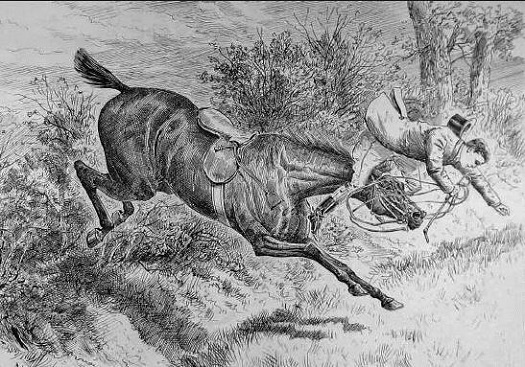
Here on the moorland scent was not so good, and a bit of slow hunting relieved somewhat our steaming horses and selves. I was wet with sweat through to my outer clothing; my new Bedford cords looked as if cattle had been tramping on them in a mudhole; out of my left eye I pried a respectable portion of the ould sod of Erin; a white stock tie had become a polka dot; boots so punctiliously boned by the expert at the Imperial appeared beyond redemption; my patched-up ribs had come loose in a frantic effort to stay with my mount down a deep unforeseen drop before which his hind feet had slipped on the top of the bank in such a manner as to bring him down in a sprawl, but, luckily, right side up. But all of it added to the smile B and I exchanged in commentary on our first Irish foxhunt.
The desultory gallop slowed to a canter and that to a trot as hounds found their difficulties in the moorland scent. They worked up to a thickety depression in the moor and marked this splendid fox to earth. To our great satisfaction, he was not disturbed by terrier or spade. Our first hunt abroad was over; not statistically in minutes or miles an epoch-making run, but thoroughly a soul-satisfying one.
Posted July 7, 2015