A third condensed installment from We Go Foxhunting Abroad: A First Venture with the Irish Banks and English Downs, Charles D. Lanier’s 1924 account of a father-daughter sporting trip to Ireland and England.
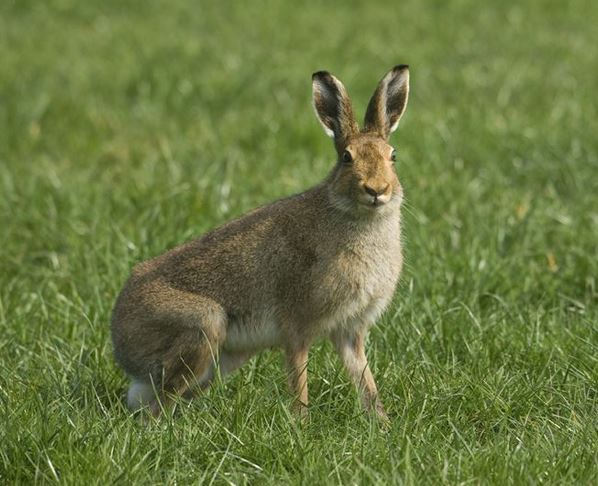 Irish hare
We decided that our new sensation would be a trial of Irish harehunting, so to Watergrass Hill we flivvered, to the meet of Mr. Robert Hall’s private pack of harriers. The Master was a slender, wiry, grey-haired man of seventy years, aquiline of countenance, with a singularly winning eye and smile under his velvet cap. He and his whipper-in were, of course, in green, and a dozen or so of the field of thirty or forty also wore the correct harrier colors.
Mr. Hall had the pride of an Irishman and a sportsman in his fifteen couple of huge Kerry “beagles,” and I think it would have been a hard blow to him if luck had been denied us that day. But it turned out to be a red letter day; I think we enjoyed having it so even more for the intense satisfaction it gave our enthusiastic host than for the sport intrinsically, which was of the very best and a revelation to us, who had not before followed a strong South Irish hare.
The Master made for some low-lying ground where stray rushes bespoke very wet pasture, a favorite place for hares to lie. The field of riders followed in more open order than in foxhunting to cover as much of each field as possible, as puss will often lie in her form and let a cavalcade pass within a few yards without stirring or being seen. The riders also aided the hunt staff by slashing at gorsy patches and other brushy places with their hunting whips, on the chance of startling a hare into action.
Before long we “found,” in the center of an open field of short turf; it was ground on which one could not imagine a ten-pound animal could secrete itself, and at that the hare did not get away from her form until hounds and hunt staff had passed within ten yards of her, jumping up right under the bellies of the horses.
I had enjoyed a bit of harehunting in America at Millbrook with Mr. Oakleigh Thorne’s harriers, and we had made an attempt at it in Greenwich, with the Fairfield and Westchester Hounds. I had always thought that a big jack hare making his initial burst over good, clean, open going, after he had been thoroughly frightened in leaving his form, conveys the most startling impression of speed that one can get from the running of anything of flesh and blood—strikingly more than the smooth, sneaky getaway of the strongest and most ambitious fox—whatever the actual facts of their speed might be.
Certainly this long-eared Irishman, ricocheting over the clean turf, reinforced the opinion. He was disappearing through the gorse covering a distant bank well before the hounds could be cast on his line. The scent was super-perfect, the air was torn with wild yells, the big black and tan “Kerry beagles” lay to it with ecstatic tongue—and we were off.
We were in a good bit of country, “light” as the Irish say, in contradistinction to “heavy” or deep, holding going, of which one strikes fearful examples in some parts of South Ireland.
The banks were not quite so large as in our splendid Saturday foxhunt, but were even more varied, with the insidious “narrow bank” tempting one now and again to “fly” jumping, an indulgence absolutely certain to lead to grief as soon as one finds an unsuspected ditch of respectable proportions on the landing side. A clever horse will often half “fly” such an obstacle, coming to it fast and flippant and jumping without a touch of his forefeet, but with a powerful kick against the bank as he leaves it behind, to give him such added propulsion as will serve for extension over a possible ditch on the landing side.
I made shift, at the kind invitation of Mr. Hall, to follow him. I found my work cut out for me. He was bent on keeping with his hounds, any kind of bank notwithstanding. Cheering them on lustily, his lean but ruddy face flushed with joy and pride and effort, earthly obstacles were to him as if they did not exist. It was all I could do to keep in his wake. The line was straight, the pace was fast and divil a check.
After two miles, perhaps, with hounds still running straight, compact, to a beautiful consistent scent, without a vestige of the pottering and nosing I would look for, now and then, on a hare’s line, I made up my mind confidently that we had changed to fox and a jolly good one at that. But no sooner had I settled this to my satisfaction than our hare was viewed from a hill we galloped over, racing on, a field and a half ahead. Another ten minutes of straight, fierce going and again I became certain that the recently viewed hare was an accident and that we were foxhunting; again I was promptly corrected by the appearance of puss on ahead.
My former experience in harehunting had led me to look confidently for a ringing chase, of smaller or larger diameter, and my suspicions of fox in this point we were making were only refuted, again and again, by plain views of the gallant old Jack who was undeniably giving us this great gallop.
We decided afterward, with the help of Mr. Hall, who knew the country well enough to be authentic, that the point was an honest five miles. It ended on some hill pasture with patches of low gorse scattered about. The hounds were at fault here and if anything could have added to our estimation of the fine old Master of Harriers, it was his decision not to push matters further to any chance there might be of finishing off puss. “She’s too good a hare to kill,” he decided. His hounds were rounded up, their Master beaming on them with such pride as was worth coming a few thousand miles to behold.
This privately printed Charles Lanier book was republished by Kessinger Publishing and is available through Amazon.