Remembering Anthony Trollope
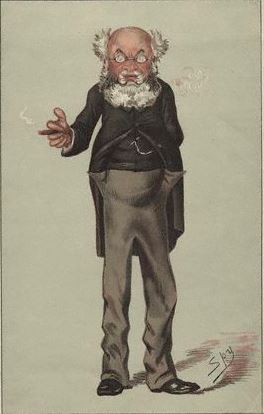
Anthony Trollope by Spy in Vanity FairIn 1971, Michael Hart, a student at the University of Illinois, conceived the most wonderful notion. He had access to a computer that was part of the government-sponsored research network that ultimately became the Internet. He set himself a goal to make the ten thousand most consulted books available to the public, digitally, by the end of the twentieth century. He plucked a copy of the Declaration of Independence from his backpack, and it became the first Project Gutenberg e-text. Hart named the project after the German printer Johannes Gutenberg, who revolutionized the printing press.
Today, there are about forty thousand texts in the Gutenberg collection, including works by Somerville and Ross, G.J. Whyte Melville, and other superb writers of foxhunting stories. Many are in the public domain and may be downloaded and freely reproduced. Periodically, we select a favorite and extract a selection both for your enjoyment and as a reminder of the wealth that Project Gutenberg keeps in store for us.
With this year marking the bicentennial of the birth of Anthony Trollope, a popular English novelist of the Victorian Era who tucked foxhunting scenes into most of his novels, we offer an excerpt from The Duke’s Children (1880), the last volume in his Palliser series.
Seabird
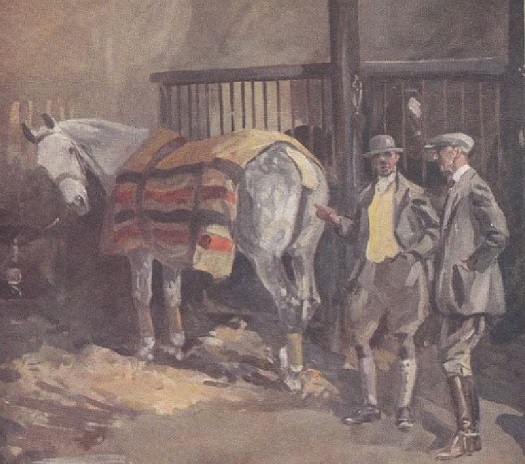
Seabird illustration by Lionel Edwards
by Edric G. Roberts
He’s not very young and he’s not very sound,
He’s not very fast, now, they say,
But nobody knows every inch of the ground
Like Seabird, the dealer’s old grey.
He’s hunted more years than I care to recall,
He’s carried us all in his day,
But no one has ever experienced a fall
On Seabird, the dealer’s old grey.
Hunters’ Moon

With this issue of FHL WEEK appearing the morning after the annual Hunters’ Moon,* we consider this poem especially appropriate!
Illustration by Gilbert Holliday
By Edric G. Roberts
The horizon, sapphire and amethyst,
Pales in the East and soon,
Like a copper shield through the evening mist,
Rises the Hunters’ Moon.
On the turnpike road every hoof-beat sounds
Clear in the frosty air,
As the Whip jogs home with the straggler-hounds
Jostling his weary mare.
The Great Hound Match of 1905: Alexander Henry Higginson, Harry Worcester Smith, and the Rise of Virginia Hunt Country
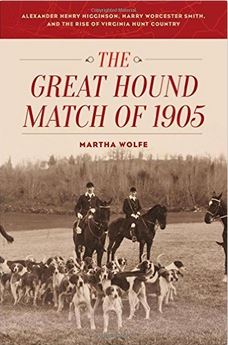
This book will be launched at the National Sporting Library, Middleburg, Virginia, on Sunday, November 8 at 2:00 pm. Author Martha Wolfe will speak and sign books.
Review by Martha A. Woodham
The Great Hound Match of 1905: Alexander Henry Higginson, Harry Worcester Smith, and the Rise of Virginia Hunt Country by Martha Wolfe, Lyons Press, 2015, Hardcover, 224 pages, $22.95Before Virginia became the epicenter of foxhunting in the United States, two men staged a contest to determine which was hound was better suited for hunting in America—the heavy, biddable English hound or the ill-mannered American hound that ran like a screaming banshee.
In The Great Hound Match of 1905: Alexander Henry Higginson, Harry Worcester Smith, and the Rise of Virginia Hunt Country, author Martha Wolfe sets a fictionalized version of this competition against the history of foxhunting in Virginia. She has written a wonderful account of the battle between two wealthy men—Higginson and Smith—with egos to match their fortunes, each adamant that his hounds were the best.
Set in an optimistic America just recovering from the 1893 depression, the match was very much a stuffy Old World versus the brash New. Against this background, Wolfe gives us a portrait of the vastly different men—Higginson, the gentlemanly foxhunter, and Smith, who liked his hounds intuitive, impulsive, independent, and to show “initiative…like any full-blooded American.” According to the author, “Smith and his [Grafton] hounds were mongrels—bold, forward, and independent to a fault. Higginson and his [Middlesex] hounds were the refined, reserved elite—passively aggressive, methodical, accustomed to queuing, happy in a crowd of equals.”
Wild Lone: The Story of a Pytchley Fox
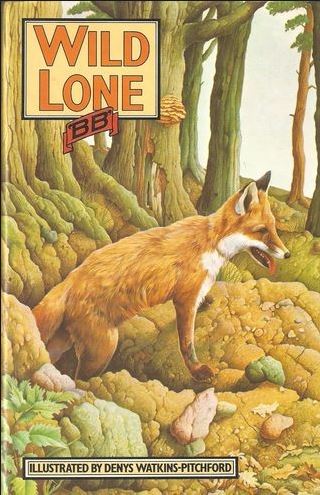
Everyone to whom I have recommended this book loved it. In Wild Lone: The Story of a Pytchley Fox, the reader experiences the sights and sounds of the woodlands by day, and the silence and stealth of the forest by night—not from our usual vantage point in the saddle, five or six feet above the ground, but down low, nearer the earth, where dry stalks of grass brush past our ears and our noses inhale the musky scent of decaying leaves.
Because the reader becomes acquainted with Rufus when he is whelped and gets to know him and his habits intimately, we feel his pain when he becomes caught in the wire snare and we root for him when pushed by foxhounds. We care about him deeply, because we know and respect him. Yet Rufus is an opportunist and kills whenever he can—birds, mice, hedgehogs, rabbits, chickens. He kills so often and so casually that we hardly notice. We feel nothing for these creatures—his quarry—because they are, unlike Rufus, anonymous.
The book’s message is revealed to us by a consummate woodsman: that life and death happen to every creature in the forest, mostly shortly after birth. Nature is harsh, but that is its way. And the pressure put on each species serves to improve the species, for only the best examples (and the luckiest) survive for a fulfilling time—as does Rufus.
The following excerpt, in which the author exercises his full powers of language and imagery, is quite lyrical. Yet, if an adventure story is what you prefer, I promise you won’t be disappointed by Wild Lone.
Cubbing
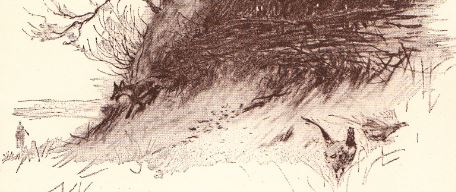
Illustration by Cecil Alden
by Duncan Fife
I wouldn’t change places with any man,
Were he powerful, rich, or wise,
As I stand in the early morning chill
While we wait for the mist to rise.
There are silver threads on the bracken fronds,
And a peaty tang in the air
That goes to the head like a draught of wine,
As we stand by the cover there.
If the creak of leather and clink of bit
Makes me yearn—well I’m not ashamed,
For I’ve got no horse of my own to ride,
And I don’t suppose I’ll be blamed
If I look around with an envious heart
At the satiny coats nearby,
At the twitching ears and the nostrils wide,
And the eagerly watching eye
That seeks to pierce through the curtaining mist
Where it clings to the dripping trees,
Concealing the cubs as they wait, alert,
For a chance to run. Then a breeze
So faint, so soft, that the glittering drops
Which hang on the bramble and thorn,
Are scarcely disturbed, but the low-lying haze
Dissolves at the coming of dawn.
The Hare that Must Be Fox
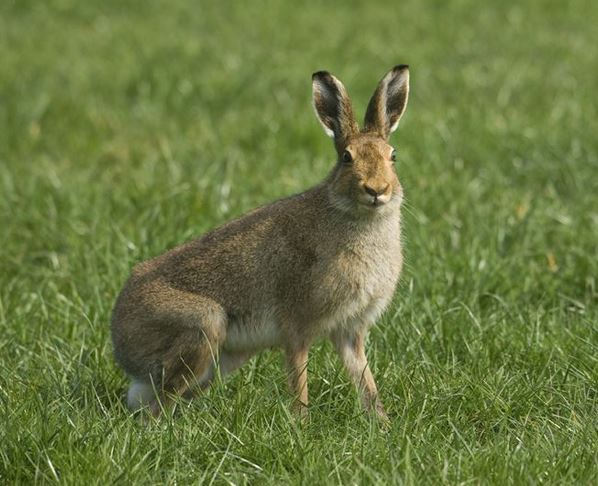
A third condensed installment from We Go Foxhunting Abroad: A First Venture with the Irish Banks and English Downs, Charles D. Lanier’s 1924 account of a father-daughter sporting trip to Ireland and England.
Irish hare
We decided that our new sensation would be a trial of Irish harehunting, so to Watergrass Hill we flivvered, to the meet of Mr. Robert Hall’s private pack of harriers. The Master was a slender, wiry, grey-haired man of seventy years, aquiline of countenance, with a singularly winning eye and smile under his velvet cap. He and his whipper-in were, of course, in green, and a dozen or so of the field of thirty or forty also wore the correct harrier colors.
Mr. Hall had the pride of an Irishman and a sportsman in his fifteen couple of huge Kerry “beagles,” and I think it would have been a hard blow to him if luck had been denied us that day. But it turned out to be a red letter day; I think we enjoyed having it so even more for the intense satisfaction it gave our enthusiastic host than for the sport intrinsically, which was of the very best and a revelation to us, who had not before followed a strong South Irish hare.
Sheep May Safely Graze

Sheep May Safely Graze, L.M. Clancy, 2015, 423 pages, paperback, $14.95, available at AmazonIrish sporting artist Liam Clancy has expanded his repertoire. He’s written a novel.
While foxhunting, prodigious drinking, and sex are well-handled ingredients of Clancy’s story—which takes place mostly in Ireland and England—those ingredients are only a framework upon which hangs a larger story of people, relationships, and the times. Our times: the Millennial, hunt sabs, the pathos of the hoof and mouth epidemic, the runup to the hunting ban, the dagger thrust into the heart of the English countryside by a government focused elsewhere.
If the publishing industry were not in turmoil, as it has been for the last decade at least, and if publishers would give first-time novelists half-a-chance, Clancy’s book could well replace titles by authors with household names that now occupy undeserved spots on the Best Seller lists. His dialog crackles, and his characters are wholly-formed individuals that you will care greatly for. Think of Maeve Binchy on steroids.
The Second Whip
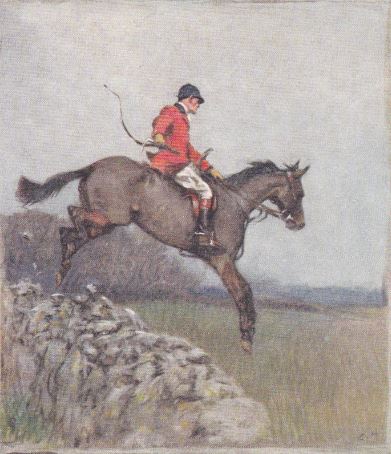
Illustration by Gilbert HollidayOver he goes, with a crash and a rattle,
Hound couples clinking, ’gainst saddle and thigh;
Over he goes, and the light of the battle
Gleams like a spark in his eager young eye.
Twigs of the hawthorn fly backward together,
Meeting again with an ominous swish;
Over he goes, landing light as a feather,
One with his horse and quick as you’d wish.
Kinds and condition of fences don’t matter,
Straight as a ramrod he rides at them all;
Over he goes with a bang and a clatter,
Knocking loose stones off the top of the wall.
Our First Foxhunt Over the Irish Banks
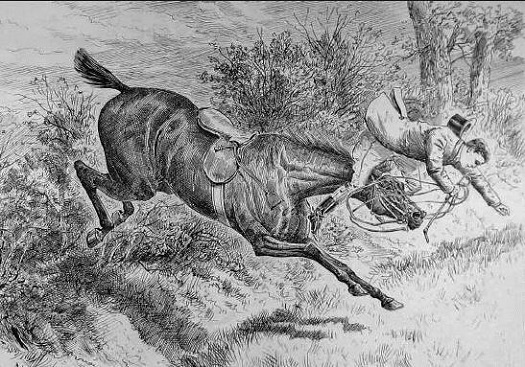
Here’s a second condensed installment from We Go Foxhunting Abroad: A First Venture with the Irish Banks and English Downs, Charles D. Lanier’s 1924 account of a father-daughter sporting trip to Ireland and England.
We put on our hunting things Saturday morning and climbed into the flivver for our first hunt with the United.
B had taken care to remove from her coat the orange collar of our home hunt colors, and I wore the regulation “visiting” dress of American custom—dark Oxford grey coat, cream colored Bedford cord britches, plain black jack boots and hunting bowler. I have never become an authority on the niceties of hunting etiquette and was simply aware one could not go amiss in these unpretentious togs.
Our flivver soon began to overtake people bound for the meet, gentlemen and ladies jogging along on short-tailed beasts with enormous quarters and hocks, grooms leading horses with their riderless saddles carefully protected by slip covers from the showers, which appear in South Ireland without a moment’s notice or a discernable cloud; showers that pass away, generally, as quickly as they come, with no one paying the slightest attention.