
Prophet of Paradise
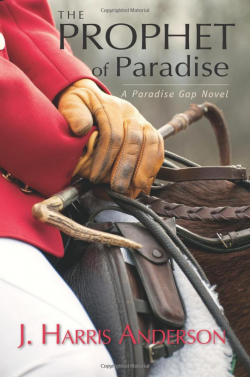
Prophet of Paradise, J. Harris Anderson, Blue Cardinal Press, 2013, paper, 483 pages, $22.95With foxhunting’s rites and traditions, its vestments and rich history, and even its own patron saint, it was but a short leap for author J. Harris Anderson to christen the chase as a religion in “The Prophet of Paradise,” his novel about sects and sex in the Virginia Hunt Country.
Ryman McKendrick, Joint-Master of Montfair Hunt, takes a tumble when his horse is startled by a large buck with something glowing in its rack. McKendrick is convinced that the illuminated object is a cross, and when the Montfair begins to see the best foxhunting—and sex—in Virginia, McKendrick is sure that he is the chosen one to spread the word about venery. He founds the Ancient and Venerable Church of Ars Venatica and is soon leading hunt members in prayer and preaching from “The Foxhunter’s Faith” before each meet.
To the Grey Hunter
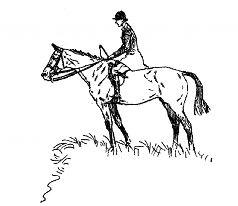
Here’s an excerpt from Tad Shepperd’s book of foxhunting and racing poems, Pack and Paddock, published by the Derrydale Press, New York, in 1938. Illustrated by Paul Brown, it was regarded by Derrydale founder Eugene Connett as one of his most handsome publications. Nine hundred-fifty copies were printed. The pages were gilt-edged on top and deckle-edged, untrimmed fore and bottom. The book was bound in red cloth with gilt lettering and boxed. Original price: $10.00.
Well did your sire know the feel
Of battling for the rail,
Of track dust flung from a driving heel,
Of thunder upon his tail!
Well did he know the cheering throng
That shivered the heaven’s dome.
Well did he know the jockey’s song,
In the desp’rate drive for home.
Well did he know the hail of mud,
The burn of the flaying goad.
For under his girth there pulsed the blood
Of the noble Roi Herode.
Aye, and well did your grandam know
The feel of the collar’s brace,
The weight of the wagon, creaking, slow,
The tug of the leathern trace.
Wise your dam to the hazy sweep
Of the moorlands, lush and rich.
Well did she know the slide-and-leap
Of the Irish bank-and-ditch.
Wise to the horn’s resounding skirl,
The hounds on the russet rogue.
Well did she know, “Hup-up, me gur-r-l!”
In a laughing Irish brogue.
Excerpt from “Reynard the Fox”

This joyful image of foxhounds arriving at the meet, conscious all the while of the attentive whipper-in, is an excerpt from the chapter, Hounds, in John Masefield’s epic poem, Reynard the Fox, written in 1919. John Masefield was Poet Laureate of the United Kingdom from 1930 to 1967. [Note: Dansey is the whipper-in, and Maroon is his horse.]
There was a general turn of faces,
The men and horses shifted places,
And around the corner came the hunt,
Those feathery things, the hounds, in front,
Intent, wise, dipping, trotting, straying,
Smiling at people, shoving, playing,
Nosing to children’s faces, waving
Their feathery sterns, and all behaving,
One eye to Dansey on Maroon.
Outrageous Fortune
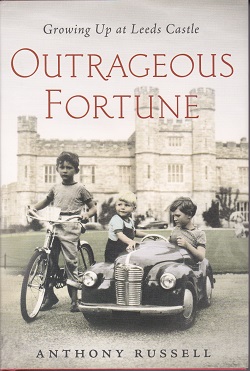
Outrageous Fortune: Growing Up at Leeds Castle, Anthony Russell, St. Martin’s Press, New York, 2013, 306 pages, Illustrated, $26.99Imagine having two grandmothers who both live in their own castles. Anthony Russell, a writer, musician, and composer in Los Angeles, comes from a family that served England’s kings and queens for five hundred years, which left them very, very wealthy…wealthy enough for his grandmums to purchase castles in England and Ireland.
Russell tells the story of a childhood at the highest levels of British aristocracy in Outrageous Fortune: Growing Up at Leeds Castle. His father, Lord Ampthill, was Prince Philip’s roommate at boarding school. Lord Ampthill also was known as “the Russell baby,” whose paternity and conception were at the heart of a sensational divorce case in the 1920s and a court challenge to his right to the title.
Lord Amptill’s mother (Lady Ampthill, she of the castle in Ireland) swore that he was the son of her husband, despite the fact that their marriage was never fully consummated. (It all had something to do with a bath sponge.)
Lady Ampthill (the author’s grandmother) was a well-recognized figure hunting with the County Galway Foxhounds (the Blazers). She rode side saddle well into her later years, until suffering a fatal accident in the hunting field in 1976.
Mr. Stewart’s Cheshire Foxhounds: A History

Scarlet on Scarlet: 100 Years of Hunting with Mr. Stewart’s Cheshire Foxhounds 1912-2012, Prue Draper Osborn, 278 pages, Illustrated, color, $100.00 (benefits The Cheshire Hunt Conservancy)
As many of our North American hunts reach their hundredth anniversary milestone, some have produced history books rich with photos and other memorabilia to tell their stories. One of the best is Scarlet on Scarlet: 100 Years of Hunting with Mr. Stewart’s Cheshire Foxhounds 1912-2012 by Prue Draper Osborn. This handsome coffee-table book is not only the history of the legendary hunt, but it’s also the story of the many families who have hunted with the Cheshire Foxhounds, often through three and four generations.
The history of Mr. Stewart’s Cheshire Foxhounds could be divided into three phases: its founding by Plunkett Stewart in 1912; its five-plus decades under the leadership of the late Nancy Penn Smith Hannum; and the latest and perhaps most controversial, the transformation from an all-English pack to a Crossbred pack.
A Story Lately Told

A Story Lately Told: Coming of Age in Ireland, London and New York, Anjelica Huston, Scribner, 2013, 253 pp, ill., $25.00Anjelica Huston seemed to have it all—a famous and talented father whose wealth gave her an idyllic childhood in Ireland and whose many contacts exposed her to some of the world’s most exciting people; a beautiful mother; success as a model; fox hunting with the Galway Blazers. But her memoir, A Story Lately Told: Coming of Age in Ireland, London and New York, reveals the dark detours her life took after her parents separated and her thirty-nine-year-old mother was killed in a car crash.
Huston eventually followed her father, renowned director John Huston (Joint-MFH of the Galway Blazers), and her grandfather, actor Walter Huston, in finding success as an actress and a director. The American actress became the first third generation winner of an Academy Award, for her performance in the 1985 film, Prizzi’s Honor.
But acting was not a path she originally wanted to take, she reveals in this memoir. She adored her father, yet feared him, too, resisting his domineering attempts to push her into becoming an actress. Instead, she opted for a modeling career, knowing it would displease him. And she fell into a relationship at age eighteen with a brilliant but troubled fashion photographer twenty-four years her senior.
Hark! Old Horse
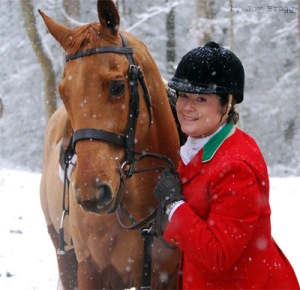
Carla Hawkinson, MFH with her soulmate, Forty-One, her inspiration for the poem / Joy Bragg photoThis wonderful poem recently appeared on This poem recently appeared on FaceBook under the credit line, Author Unknown. We must correct that! The author is Carla Hawkinson, MFH of the Tennessee Valley Hunt.
“Hark! Old Horse” was published in the Summer, 2008 issue of Covertside when I was editor of that magazine. It surely deserves to be re-published, and Foxhunting Life is proud to do it…with appropriate credit. -Ed.
Hark! Old horse.
Please meet me at the gate.
Hounds are leaving kennels soon,
And we will not be late.
Step up. Old horse.
Carry me to the meet.
Our years together count for much,
Though you’re no longer fleet.
Trot on. Old horse.
I know you hear the horn.
The hounds are in the valley now,
The fox is in the corn!
The Galloping Whip
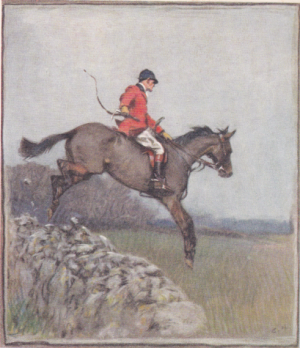
Gilbert Holliday illustrationIf life is a business, existence is fun
When duty and pleasure and sport are in one;
And so he wears ever a smile on his lip–
‘Tis a labour of love to the Galloping Whip.
The moon of September’s his light in the morn,
When the cub’s to be killed and they’ve carried the corn;
The moon of December’s his lamp for the trip,
As home with the pack goes the Galloping Whip.
For hours never vex him, and work cannot tire,
That dapper pink fits on a framework of wire;
He’ll go without sup, and he’ll go without sip
From daylight to dark will the Galloping Whip.
The phiz of bold Reynard is shaped on his mug,
Mouth wide as an oxer, as deep as a jug;
That feature was fashion’d to scream, not to nip,
And the bumper’s no charm for the Galloping Whip.
The last to leave covert, he’ll cheer on the pack;
Twenty couples are out, then away with a crack;
In a mile he has given the quickest the slip–
The wind from their sails takes the Galloping Whip.
A Short History of Foxhunting
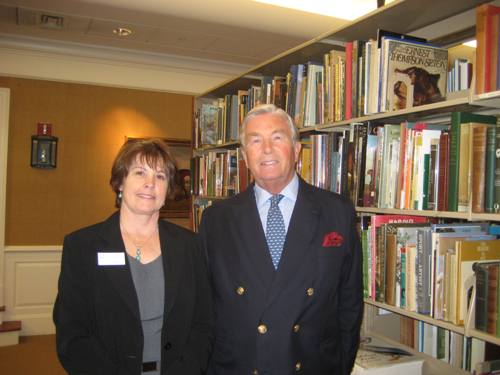
Librarian Lisa Campbell shows Alastair Jackson around the stacks at the National Sporting Library, where the author talked about his new book and signed copies. / Maureen Gustafson photo
Excellent books have been written on the history of foxhunting by such notables as The Duke of Beaufort, Roger Longrigg, and Joe Thomas. However, the operating word in the title of this new book by two contemporary notables—Alastair Jackson and Michael Clayton—is “Short.”
“Michael came to me with the idea,” said Jackson last night at the National Sporting Library in Middleburg, Virginia, where, after wine and appetizers, he talked about his book and signed copies. “There are so many people hunting today that don’t know about our history. We wanted to provide something concise, entertaining, and easy to read rather than the academic and often dry histories that have been published in the past.”
Jackson wrote the text and drew the delightful pen-and-ink illustrations reminiscent of the styles of Eleanor Iselin Mason and Edith Somerville. His sketches accurately capture the attitudes and posture of hounds, horses, people, and quarry in motion with economy of line. Clayton provided his vast experience reviewing and editing the text, and wrote the short verses that provide the lead for each chapter.
The Clipper that Stands in the Stall at the Top
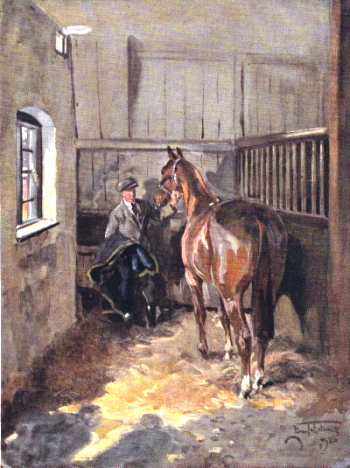
Illustration by Lionel EdwardsNot long ago we polled our readers and were pleased to find that the great majority of you enjoyed reading the classic foxhunting poems. Here’s one such classic that to me best expresses the pride, gratitude, and love the foxhunter feels for that one special horse—the most generous, the most reliable, the most gentlemanly of all we’ve had—that takes us over the day’s obstacles and brings us safely home.
Go strip him, lad! Now, sir, I think you’ll declare
Such a picture you’ve never set eyes on before,
He was bought in at Tatt’s for three hundred I swear,
And he’s worth all the money to look at, and more;
For the pick of the basket, the show of the shop,
Is the Clipper that stands in the stall at the top.
In the records of racing I read their career,
There was none of the sort that could gallop and stay,
At Newmarket his sire was the best of the year,
And the Yorkshiremen boast of his dam to this day;
But never a likelier foal did she drop
Than this Clipper that stands in the stall at the top.