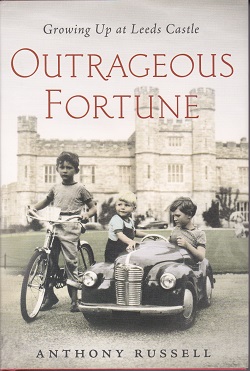
 Outrageous Fortune: Growing Up at Leeds Castle, Anthony Russell, St. Martin’s Press, New York, 2013, 306 pages, Illustrated, $26.99Imagine having two grandmothers who both live in their own castles. Anthony Russell, a writer, musician, and composer in Los Angeles, comes from a family that served England’s kings and queens for five hundred years, which left them very, very wealthy…wealthy enough for his grandmums to purchase castles in England and Ireland.
Russell tells the story of a childhood at the highest levels of British aristocracy in Outrageous Fortune: Growing Up at Leeds Castle. His father, Lord Ampthill, was Prince Philip’s roommate at boarding school. Lord Ampthill also was known as “the Russell baby,” whose paternity and conception were at the heart of a sensational divorce case in the 1920s and a court challenge to his right to the title.
Lord Amptill’s mother (Lady Ampthill, she of the castle in Ireland) swore that he was the son of her husband, despite the fact that their marriage was never fully consummated. (It all had something to do with a bath sponge.)
Lady Ampthill (the author’s grandmother) was a well-recognized figure hunting with the County Galway Foxhounds (the Blazers). She rode side saddle well into her later years, until suffering a fatal accident in the hunting field in 1976.
Russell spent most of his childhood at Leeds Castle, considered one of the finest edifices in England. Despite the grandeur, Russell seems to have spent much of the time in the nursery with his nanny. It may have been the 1950s, but the English upper crust still believed in children being seen and not heard, which still rankles with Russell.
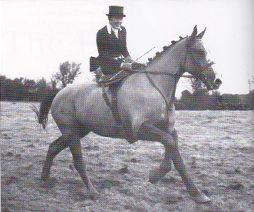 Lady Ampthill hunting with the Galway Blazers / Frank Meads photoOf course, young Russell took the prerequisite riding and shooting lessons, but his writing barely touches on that. His only mention of a fox hunt was his first, with his Irish grandmother, Lady Amptill. In a chapter entitled, “Terror at the Gallop,” Russell recalls being mounted on a rather incredible pony who kept up with the horses over huge stone walls. Finally young Russell landed on his head after a drop jump. Retrieving his pony, “who had been kind enough not to disappear,” Russell caught up with the hunt an hour and a half later—after first making a stop at a public house where he had a Coca-Cola.
Today, the magnificently decorated Leeds Castle, once home to royalty, is open to the public and owned by a foundation—his grandmother’s means of avoiding Great Britain’s crippling death taxes. (Leeds Castle was also the birthplace of Thomas, Sixth Lord Fairfax, who came with his foxhounds to the Colony of Virginia in the early 1700s to take control of his inheritance of five million acres—the entire Northern Neck of Virginia.) The castle in Ireland, Dunguaire Castle, is also a tourist attraction now, though the 16th-century tower house on the shore of Galway Bay is nowhere near as swank as Leeds Castle, which has a moat.
Russell’s memoir is the tale of a poor little rich boy who is cossetted in life by what he calls “the castle way” and a large trust fund. His grandmother turned Leeds into her own fiefdom, and its moat symbolically kept out the world.
Posted April 6, 2014