Our First Foxhunt Over the Irish Banks
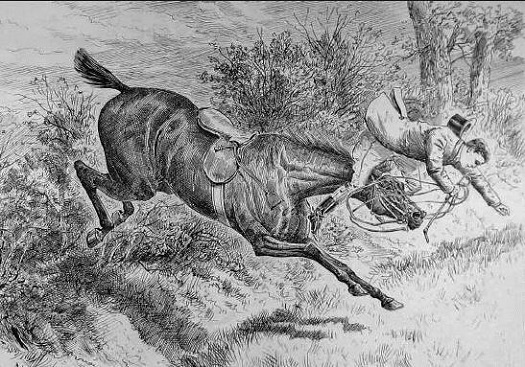
Here’s a second condensed installment from We Go Foxhunting Abroad: A First Venture with the Irish Banks and English Downs, Charles D. Lanier’s 1924 account of a father-daughter sporting trip to Ireland and England.
We put on our hunting things Saturday morning and climbed into the flivver for our first hunt with the United.
B had taken care to remove from her coat the orange collar of our home hunt colors, and I wore the regulation “visiting” dress of American custom—dark Oxford grey coat, cream colored Bedford cord britches, plain black jack boots and hunting bowler. I have never become an authority on the niceties of hunting etiquette and was simply aware one could not go amiss in these unpretentious togs.
Our flivver soon began to overtake people bound for the meet, gentlemen and ladies jogging along on short-tailed beasts with enormous quarters and hocks, grooms leading horses with their riderless saddles carefully protected by slip covers from the showers, which appear in South Ireland without a moment’s notice or a discernable cloud; showers that pass away, generally, as quickly as they come, with no one paying the slightest attention.
Foxhunting Is Part of the Curriculum at the Elms School
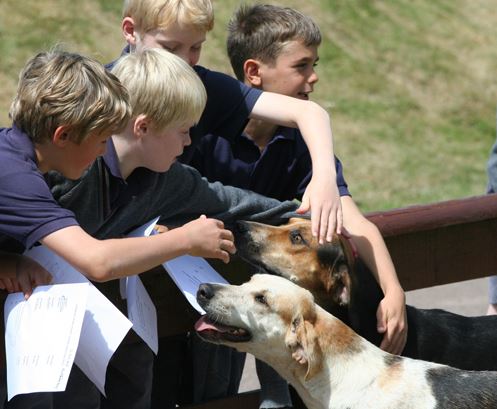
The Elms students at the kennels of the Ledbury Foxhounds (UK)
Mrs. Austen, a teacher at The Elms School, Malvern, UK, wrote to the Countryside Alliance to report on last season’s student hunting activities.
“We had a total of fifty-two different children aged from six to thirteen out hunting last season,” Mrs. Austen wrote. “We hunted on sixteen days with the Ledbury in groups, and had three visiting days—the Heythrop, the Croome and West Warwickshire, and the South Herefordshire. We had the whole gang out at our own Ledbury meet at the school.
Foxhunting Life in Print?
We have an idea, but only you—Foxhunting Life readers—can tell us whether it’s a good one. Hence, we’re asking you to take a very short survey of no more than three yes-or-no questions. For the past few years, we have been emailing our twice-monthly e-magazine, FHL WEEK, in electronic form. We know many of you […]
T&NY Littermates Dominate Grand Champion Class at Canadian
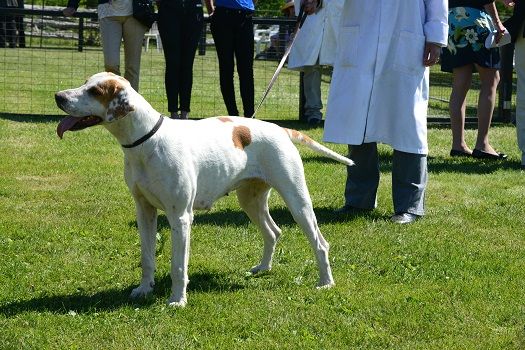
Canadian Grand Champion of Show is Toronto and North York Cleopatra 2012 / Mary Raphael photo
Two Toronto and North York littermates have dominated the Grand Champion and Reserve awards at the Canadian Foxhound Show for two years running. The only difference this year was that the dog hound graciously swapped places with his litter sister. On June 6, 2015, in a reversal of fortune, Toronto and North York Cleopatra 2012, last year’s Reserve Grand Champion, was crowned Grand Champion of Show, while her litter brother Clarence, last year’s Grand Champion, settled for Reserve.
The show judges were Major Tim Easby, Director, Masters of Foxhounds Association (UK) and ex-MFH and huntsman of the Middleton and West Yore Foxhounds and Lt. Col. Robert Ferrer, USMC-Retired and MFH, Caroline Hunt (VA).
Cleopatra’s sire is Blue Ridge Barnfield 2010 by Duke of Beaufort’s Bailey 2003. If Bailey sounds familiar, have a look at the article about this year’s Bryn Mawr Grand Champion, New Market-Middleton Valley Widget, crowned just one week earlier. Widget’s sire was Green Spring Valley Bailey by Duke of Beaufort’s Bailey. That makes two Grand Champions in two weeks whose grand sire is Duke of Beaufort’s Bailey!
Rupert Isaacson’s Horse boy
Rupert Isaacson is a horseman. He was an avid foxhunter until other life matters intruded. He is a gifted writer as well. But Rupert’s principal gift to humanity is a mind set that is constitutionally unable to accept limits on what is possible. No challenge, no matter the odds, is hopeless to Isaacson. Time and again he has tilted at the windmills of conventional wisdom and accomplished astonishing results.
Rupert was born in England and roamed the world as a travel and environmental writer, specializing in Africa. It was there that he came upon a cause that captured him totally—the displacement and removal of the Bushmen of the Kalahari from their traditional hunting grounds by their own government. He became a vigorous activist for the Bushmen, gave speeches, wrote a book about their plight, and arranged for the Bushmen to appear before the United Nations to plead their case. They won.
At about that time, Rupert and his wife, then living in Texas, discovered that their infant son Rowan was autistic. Conventional treatment protocols—and they tried many—were unable to improve the boy’s most troubling behavioral problems, and Rupert immersed himself into finding alternate solutions. He discovered that horseback riding while holding his son in front of him in the saddle was therapeutic for the boy. But only temporarily.
Haight, White, Barclay Inducted into the Huntsmen’s Room
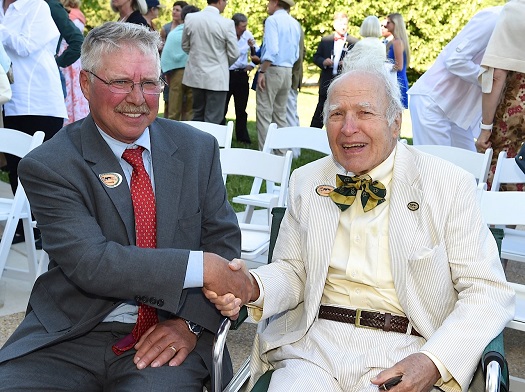
Andrew Barclay (left) and Sherman Haight congratulate eachother on the occasion of their mutual induction into The Huntsmen’s Room at the Museum of Hounds and Hunting. / Douglas Lees photo
Three huntsmen, two living and one deceased, were honored the day before the Virginia Foxhound Show for their uncommon skill as huntsmen and for their contributions to foxhunting in North American. Sherman P. Haight, Jr., ex-MFH; William John White, Jr.; and Andrew T. Barclay were inducted into The Huntsmen’s Room of the Museum of Hounds and Hunting in ceremonies held at Morven Park on Saturday, May 23, 2015.
While recognized by this honor for their achievements in handling hounds in the field and producing the highest level of sport, each of these three men of disparate backgrounds contributed uniquely to our sport. Their stories are just as uniquely fascinating.
Hillsboro Hounds: Home of Grand Champions!
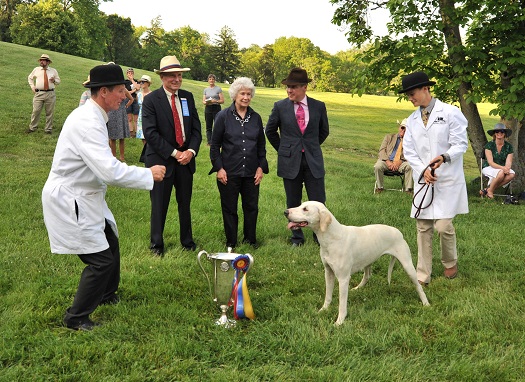
Huntsman John Gray and professional whipper-in Leilani Hrisko show Virginia Grand Champion Hillsboro Siskin ’14. Looking on (l-r) are Judge J.W.Y. “Duck” Martin, Virginia Foxhound Club Co-Chairman Mrs. Richard Jones, and huntsman John Holliday, Belvoir Foxhounds (UK). / Lauren Giannini photo
Virginia Foxhound Show, Morven Park, May 24, 2015: Okay, says Hillsboro huntsman John Gray, if you don’t like Graphic, I’ll show you Siskin!
On May 9, 2015 at the Carolinas Hound Show, Hillsboro Graphic ’14 was judge Tony Leahy’s pick for Grand Champion of Show. Two weeks later, at the Virginia Foxhound Show, Leahy, judging in the Crossbred ring, chose un-entered Midland Striker over Graphic for the Crossbred Championship.
It proved but a minor setback for Hillsboro. In the final class of the day in the English ring, Judge Charles Frampton chose Hillsboro Siskin ‘14 as the Champion English Foxhound. So when the very last class of the day rolled around—Grand Champion of Show—English Champion Siskin faced off against Crossbred Champion Midland Striker, who had just beaten Siskin’s kennel mate, Carolinas Grand Champion Graphic, for the breed championship.
The other formidable opponents in the ring were un-entered American Champion, Orange County Kermit and Penn-Marydel Champion, De La Brooke Tullamoore ’11. But Hillsboro was not to be denied. Judge J.W.Y. “Duck” Martin crowned Hillsboro Siskin ’14 Grand Champion of Show. Crossbred Champion Midland Striker was Reserve, and Hillsboro leaves town with two Grand Champion foxhounds in the last two hound shows!.
Hillsboro Graphic Is Grand Champion at Carolinas
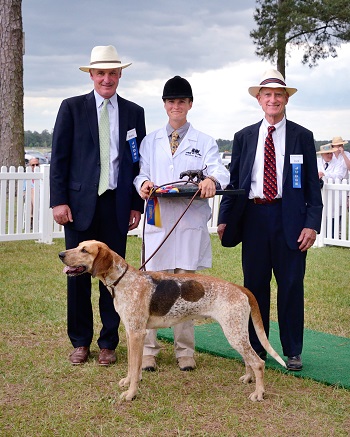
Grand Champion Hillsboro Graphic ’14 with professional whipper-in Leilani Hrisko. Judges (l-r) are MFHs Tony Leahy and Dr. Jack Van Nagell / David Traxler photoHillsboro Graphic ’14 was judged Grand Champion of Show at the thirty-ninth annual Carolinas Hound Show held at the Springdale Race Course in Camden, South Carolina on May 8 and 9, 2015.
Whelped to royal bloodlines—American on the sire’s side and English on the dam’s side—it should have been no surprise to see Graphic garner top honors. Her sire is Hillsboro Jethro ’08, son of the magnificent Potomac Jefferson ’05, Grand Champion Foxhound at Virginia in the year of the MFHA Centennial celebration, 2007.
On the dam’s side, Graphic goes back in tail female to North Cotswold Grapefruit ’95, a Peterborough Champion and dam of several influential foxhounds in North America including Iroquois Grundy ’98, Master Jerry Miller’s all-time favorite foxhound, and Mid-Devon Grocer ’00, sire of Virginia and Bryn Mawr champion hounds from Blue Ridge.
Foxhounds from fourteen hunts and five states trod the flags at Carolinas: Aiken, Camden, DeLa Brooke, Green Creek, Hillsboro, Keswick, Lowcountry, Moore County, Red Mountain, Sedgefield, Tennessee Valley, Tryon, Whiskey Road, and Why Worry.
Maureen Riley and the Zennor Fox
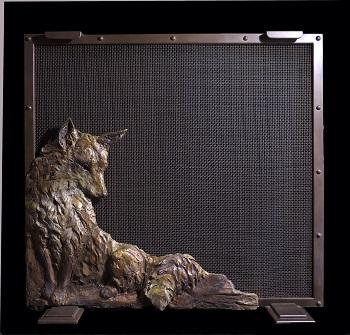
“I felt that the story of the Zennor fox needed to be remembered,” writes Michigan artist Maureen Riley. “It tells the story of a fox, but more than that it tells of a sportsman’s love for a good day of sport and a sense of fair play.”
Maureen Riley is a sculptor and painter who has been steeped in the sporting life from an early age. She learned about gun dogs from her grandfather and about sculpture from his friend, Walter Midener. Shooting, fishing, and horses have always been a part of her life, and country sports are at the root of her art.
From her studios in Michigan, Maureen has exhibited her work at Safari Club events and at international exhibits in both Milan and Portofino, Italy. Her work has also been shown at the Smithsonian. She is a member of the Society of Animal Artists and the National Sculpture Society.
Maureen has just created an interesting new platform from which to present her bronze works—a fireplace screen that serves as a blank canvas for her limited edition and custom relief sculptures. Her first design on this “blank canvas” is titled the “Zennor Fox.” The work was inspired by a 1913 foxhunt with the Western Hounds near Zennor Hill in Cornwall. Here’s the conclusion of the hunt as written by a participant, the renowned English equine artist Sir Alfred J. Munnings.
Advice From a Junior Whipper-In
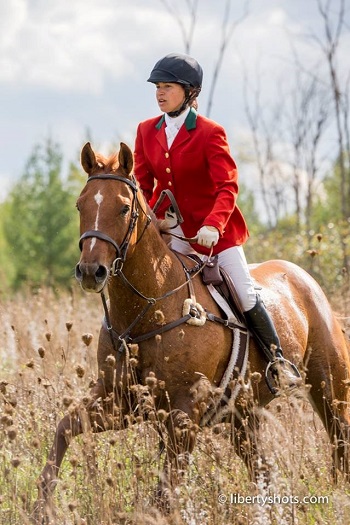
Here’s astute, peer-to-peer advice for juniors aspiring to become honorary hunt staff. I can’t help but wonder how many huntsmen out there would love to have Carmen on his/her staff!
We, juniors, are the future of foxhunting. It is our responsibility to be knowledgeable and to keep this fantastic sport alive and traditional.
Have you ever peered past the first Field Master at those tiny white specs in the distance—the hounds—and wondered what’s going on up there, what that blast of the horn meant, where that scarlet-clad rider is galloping off to in such a hurry? Ever think about whipping-in?
What to Think About Before You Decide to Whip-In
Whipping-in can be the most exhilarating, amazing adventure ever, or it can be the most terrifying, stressful experience ever. It largely depends on how you handle the thrills and horrors that being a whip sends your way.
Whipping-in doesn’t only take place on your horse in the hunt field. It takes place in the kennels, in the stables, at home with a mountain of books, and in the mud on your backside watching your mount vanish into the distance.