
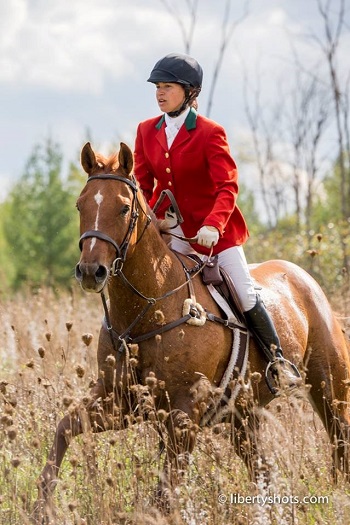
 Here’s astute, peer-to-peer advice for juniors aspiring to become honorary hunt staff. I can’t help but wonder how many huntsmen out there would love to have Carmen on his/her staff!
We, juniors, are the future of foxhunting. It is our responsibility to be knowledgeable and to keep this fantastic sport alive and traditional.
Have you ever peered past the first Field Master at those tiny white specs in the distance—the hounds—and wondered what’s going on up there, what that blast of the horn meant, where that scarlet-clad rider is galloping off to in such a hurry? Ever think about whipping-in?
What to Think About Before You Decide to Whip-In
Whipping-in can be the most exhilarating, amazing adventure ever, or it can be the most terrifying, stressful experience ever. It largely depends on how you handle the thrills and horrors that being a whip sends your way.
Whipping-in doesn’t only take place on your horse in the hunt field. It takes place in the kennels, in the stables, at home with a mountain of books, and in the mud on your backside watching your mount vanish into the distance.
You have to be realistic and ask yourself a few questions. Do I have the time to do this? Is my horse physically capable of galloping two hours straight? Am I?
Being a whipper-in is stressful, but being huntsman is doubly so. As a whip you have to realize this and allow for it, understanding if the huntsman is a bit touchy. You must be able to take correction and learn from it.
Why Whip-In?
I started whipping-in two years ago when I was thirteen, and so far it’s been a blast. You couldn’t hope for a more exciting experience. But understand that one minute you’ll be up front riding hard to keep up with hounds in full cry, and the next you’ll be out in the middle of nowhere, you and your horse the only living things on earth, looking for half the blasted pack which has mysteriously disappeared. Then three blasts of the horn cut the silence—”Whips return!”—and you must fly back to your huntsman—walls, fences, ditches, hedges all taken, all cleared.
Getting Noticed
Go out every hunting day you can. (If you’re keen, you’ll be doing this anyway, without being told).
Always put effort into your appearance and that of your horse.
Help out wherever you can: stables, kennels, clubhouse kitchens.
Talk to other members (at appropriate times!) while you’re riding. Listen to what people have to say; try and learn something; make an effort to remember what you learn. Don’t just wait for them to finish talking so you can tell them about your latest exploits.
Be interested in everything having to do with hunting.
Be brave (not stupid); ride hard.
Getting Promoted
Okay, you have done your homework, you’ve talked to your huntsman a bit, you’ve even started to memorize some of the hounds’ names. Now how do you approach the subject of wanting to whip-in? Do you just ask outright? Do you get someone—a parent, a friend—to breach the question for you? Or do you continue doing what you’re doing and hope to get invited?
That, I think, depends on your situation. If the huntsman is already looking to get another whipper-in then you might stand a good chance of getting invited, depending on how many other people in your hunt fit the bill for whipper-in. If you’re not sure whether your huntsman needs more whips or not, count how many he has. Four whips are generally considered maximum for most hunts, two or three are normal. If your huntsman only has one whip, then he probably wants another.
Letting your huntsman know that you’ll be happy to help out in the kennels if he’s ever short-handed is always ans acceptable way to open the subject.
First Day Whipping-In
You’ll most likely be paired with an experienced whipper-in to start. Ask your partner-for-the-day as many questions as you can. What’s that hound’s name? Where are we going? What did the huntsman say? Where are we now? What’s that hound’s name again? You should be okay to do this for a few days, until you are confident enough to set out on your own.
Getting Yelled At
Some huntsmen yell more than others, but one way or another you will get yelled at. The only way to not let it bother you is just that; don’t let it bother you. Yelling back doesn’t help; sulking doesn’t help; you have to listen to it, accept it, and get over it. Don’t spend your time trying not to get yelled at. There’s no time for hesitation in the hunt field; if the huntsman’s yelling instructions, you’d better move your backside.
Difficulties
If your huntsman is shouting at you from across a hundred-acre field, sometimes in a heavy foreign accent, it can be quite hard to figure out what he’s saying. You know he must want you to do something different from what you’re doing; the trick is to determine what exactly? The first thing to do is to look at and listen to the hounds. (This is what you should have been doing in the first place, but gauging by the considerable racket the huntsman’s making, you were more likely daydreaming about that big wall you jumped and wondering if so-and-so saw.) Are hounds heading into a danger zone? Road? Cows? Lawn? Has the pack split? Are they running riot? What are the other whips, if there are any, doing? These must be split second observations. Then you have to (very quickly) make a plan, cover any danger zone, retrieve hounds, call back/cut off pack. Now you can put your plan into action. Even if it’s the wrong one, the worst thing you can do (almost) is nothing.
Rules to Live By
The huntsman is always right, even when he isn’t.
“Sorry” catches no prey; do it right the next time.
Don’t talk back to your huntsman.
Never get between the hounds and your huntsman.
What happens in the hunt field, stays in the hunt field.
Just because you don’t know where you are doesn’t mean you’re lost.
Posted May 19, 2015
The author is a fifteen-year-old honorary whipper-in for the Ottawa Valley Hunt (ON).