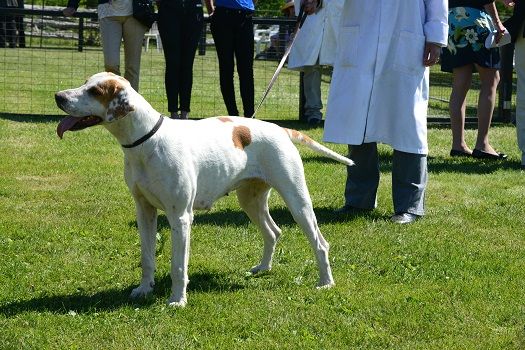
 Canadian Grand Champion of Show is Toronto and North York Cleopatra 2012 / Mary Raphael photo
Two Toronto and North York littermates have dominated the Grand Champion and Reserve awards at the Canadian Foxhound Show for two years running. The only difference this year was that the dog hound graciously swapped places with his litter sister. On June 6, 2015, in a reversal of fortune, Toronto and North York Cleopatra 2012, last year’s Reserve Grand Champion, was crowned Grand Champion of Show, while her litter brother Clarence, last year’s Grand Champion, settled for Reserve.
The show judges were Major Tim Easby, Director, Masters of Foxhounds Association (UK) and ex-MFH and huntsman of the Middleton and West Yore Foxhounds and Lt. Col. Robert Ferrer, USMC-Retired and MFH, Caroline Hunt (VA).
Cleopatra’s sire is Blue Ridge Barnfield 2010 by Duke of Beaufort’s Bailey 2003. If Bailey sounds familiar, have a look at the article about this year’s Bryn Mawr Grand Champion, New Market-Middleton Valley Widget, crowned just one week earlier. Widget’s sire was Green Spring Valley Bailey by Duke of Beaufort’s Bailey. That makes two Grand Champions in two weeks whose grand sire is Duke of Beaufort’s Bailey!
Over the past fifteen years, Bailey has been considered one of England’s most influential stallion hounds, according to Martin Scott, ex-MFH, one of England’s leading breeders and judges of foxhounds. Scott notes that Bailey’s male line also goes back to Heythrop Busby 1996, another very influential sire in his time, as well as to College Valley/North Northumberland Grafter 1989 from one of the most influential hill hound kennels in England, regarded as an outcross and valued highly in his work.
Cleopatra is an English foxhound based on the high percentage of English bloodlines in her pedigree. She goes back in tail female to Midland Crossbred lines through her dam, Toronto and North York Clinic 2006. Cleopatra’s sire’s (Barnfield’s) tail female line is one of the strongest Crossbred female lines in the Blue Ridge kennels.
“Cleopatra was the first of all the C-litter hounds to impress me in the hunting field,” said Toronto and North York huntsman John Harrison, who has had only one season to evaluate the pack he inherited upon his arrival. “She’s a very sharp bi-ch,* always busy and working.”
Harrison will surely breed from Cleopatra, but he refrained from using Clarence as a stallion hound last year despite his Grand Championship win. Harrison’s hunting country gives him few opportunities to see hounds working in the open, and his insists on his hounds proving themselves in the field before breeding them.
Harrison was huntsman at the Toronto and North York Hunt from 1989 to 1996. During those years, he bred a number of outstanding hounds and won many championships at the Virginia Foxhound Shows and elsewhere. In 1996 he left Ontario and returned to his birthplace, the Cumbrian Lake District of England, to take over one of the most storied and respected of the fell foot packs, the Ullswater Foxhounds (est. 1873), where he had hunted in his youth.
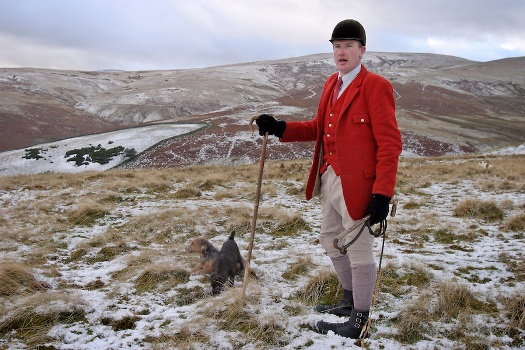 Between stints as huntsman at Toronto and North York, John Harrison spent 18 years as huntsman of the Ullswater Foxhounds in his native Cumbria.
Hunting is in the genes in Cumbria, but the country is so rough, horses cannot be used. The literature of foxhunting is replete with accounts of grueling days with the famous foot packs of the area, climbing and descending the scree-strewn crags and struggling to snow-filled borrans. The terrain is mountainous and arduous, and Harrison hunted the Ullswater for the next eighteen years.
Harrison returned to Toronto and North York just last season to take over the pack once again. “It’s nice to win the trophy,” he admits, “but I didn’t breed these hounds.” Harrison gives credit for the success to the breeding of his predecessors, Antony Gaylard and Mark Powell.
“The nice part for me, though, is that they go back to hounds I bred in the 1990s—Crafty in particular,” Harrison recalls. “Hers was one of the most beautiful litters I ever bred.”
Harrison also derived great satisfaction this year showing some of the pure fell un-entered hounds that he brought back with him from the Ullswater to Ontario. “Fell hounds aren’t the fashion in England,” he said, “and I wasn’t sure how they would do before an English judge. There was an American judge in the ring, though, and I thought he might appreciate them.”
To my eye, fell hounds look more like American hounds than English, so I understood Harrison’s reservations, however unwarranted. Both judges surely liked them; Harrison’s fell hounds won all the un-entered classes.
Fell hounds have been bred for centuries specifically for their immense and mountainous country. They need big voices and an independent hunting style because their huntsman is often one or more ridges and valleys distant. Harrison believes these characteristics will be useful in his Ontario country and plans to introduce these fell bloodlines into the pack. “I love their fox sense!” he says.
Posted June 29, 2015
* In the world of mass-mailed e-publishing we cannot use the b-word when referring to that gender of dogs and hounds without running the risk of having our mailings automatically blocked by spam filters.