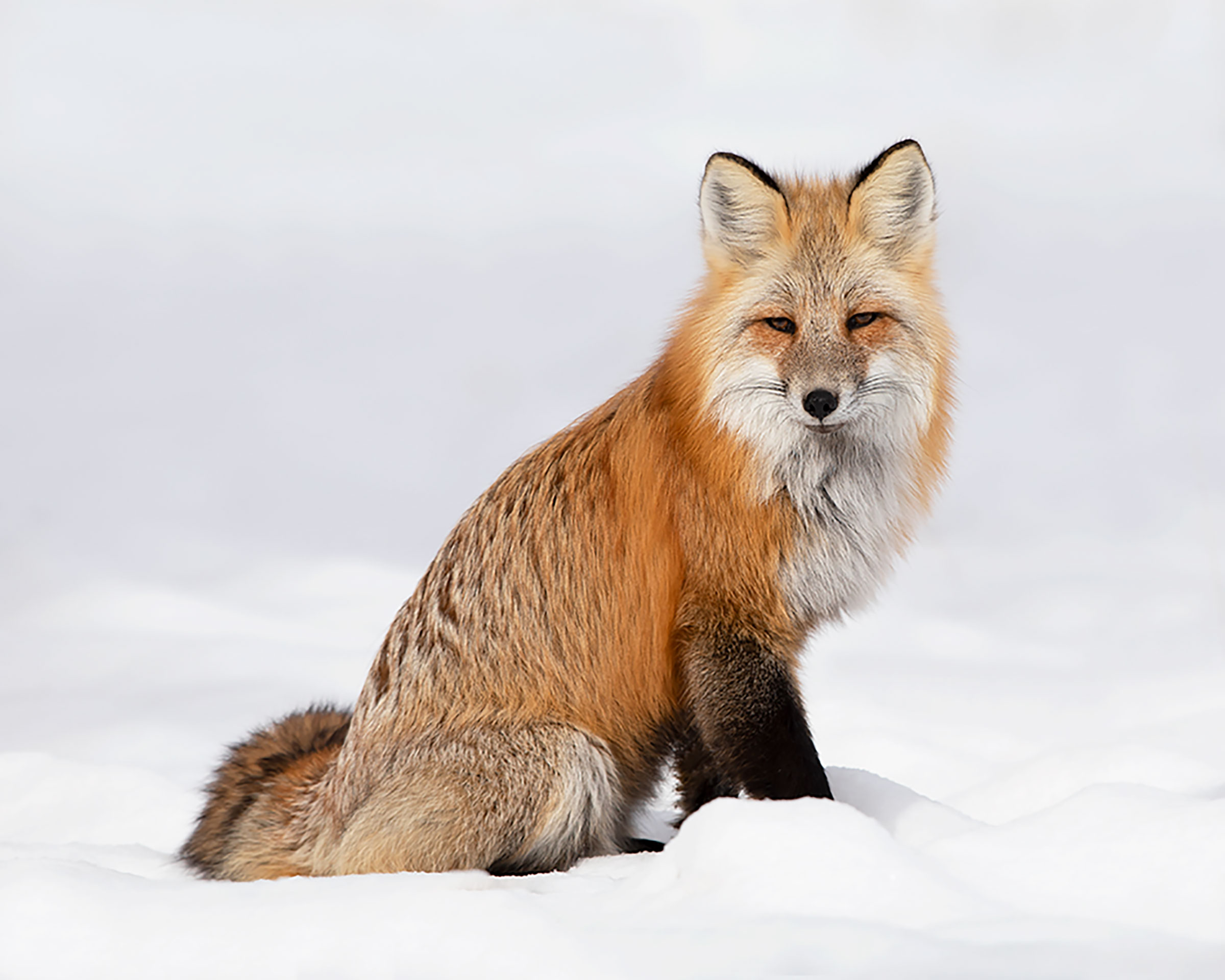
 The last frame of the day! Photographed in Yellowstone National Park by Mike Roberts with Canon EOS 5D Mark IV camera fitted with Canon 600mm lens. Tripod Head: Wimberly WH-200 (with quick release plate). Tripod: Gitzo Mountaineer (carbon fiber).
Click image for a larger view.
As a naturalist I’ve never considered anthropomorphism an appropriate concept. Yet, even in my mind, the red fox has long worn the mask of a humanistic villain. English literature and folklore is littered with fox personifications, as is Native American culture. With eyes that can stare into the depths of one’s soul, and those downright sneaky behavioral traits, Vulpes vulpes remains one of my favorite, but most difficult subjects to photograph in the wilds of America. So lay another seasoned chunk of oak on the andirons, pour a steaming cup of tea, pull up a chair, and allow me to share this paramount photography adventure.
As Yellowstone mornings go, November 11th, 2020, was not unlike scores of other late-autumn mornings experienced there through the years. Passing beneath the Roosevelt Arch outside of Gardiner, Montana, the cornerstone laid by Teddy himself, goose-down-sized snowflakes concealed the monument’s inscription: “For the Benefit and Enjoyment of the People.” But I knew it by heart!
With several inches of freshly fallen snow having white-washed the hills and mountains surrounding Mammoth Hot Springs, and temperatures flat-lined at zero, the park was a wildlife photographer’s paradise: 2.2 million acres, few people, predators hunting, and prey animals doing their best to avoid appearing on the menu.
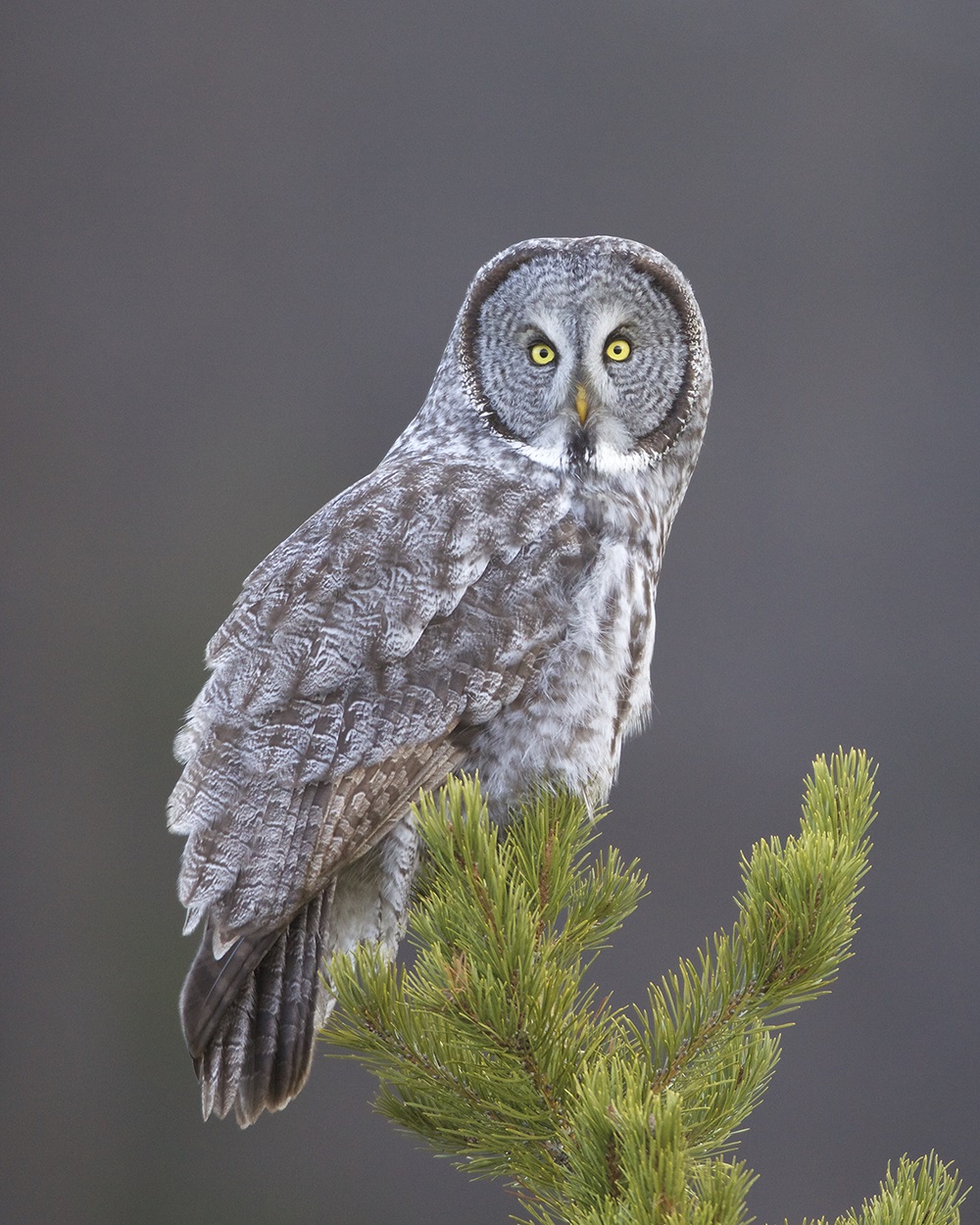
No doubt elk were still on their feet and pawing to uncover dried bunchgrass, while bison were using their massive heads to bulldoze down to the same forage. On the high ridges, bighorn rams were likely testing each other for primordial rights to tend the ewes during the upcoming December rut. In lower elevations, heavy-antlered mule deer bucks trailed does already in estrus. Along the grassy margins of some dark, lodgepole pine forest, a pair of great gray owls was perched in patient vigilance to ambush voles scampering through their hidden, oxbowed tunnels. Dressed appropriately for the weather, and with a new CF card installed and both camera batteries fully charged, I was ready for a walk in the park.
Even as an opportunistic photographer, I had a specific goal on this bitter, snowy morning. On each of the three, previous, sunny days, it had been an unexpected pleasure to have observed red foxes in several locations. And while the few shots taken passed the acid test, hopes were to relocate at least one of the crafty critters hunting in the snow. In my opinion, some of the most captivating wildlife images are portraits of red foxes painted against snow-white, distraction-free backgrounds. Optimism!
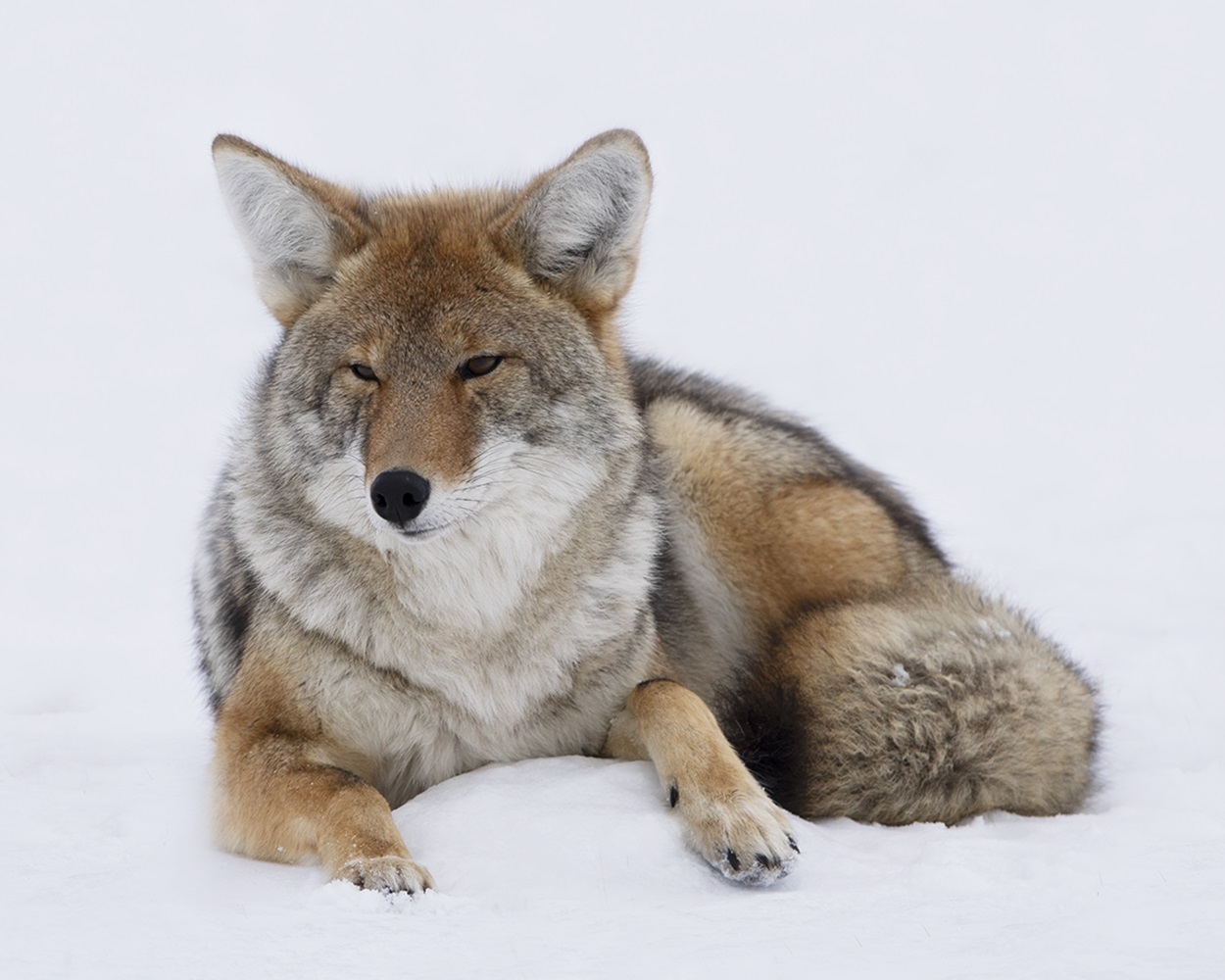
The first targeted area, a small, grassy meadow, turned out to be a disappointment. Overnight, the Wapiti Lake wolf pack had killed a cow elk in the willows. Ravens, magpies, and a trio of coyotes were busy scavenging the bare rib cage. There would be no red fox photography here today; wolves, coyotes, and foxes are mortal enemies and do not mix company. Bad news for the foxes, they take up the space at the bottom of that canid hierarchy.
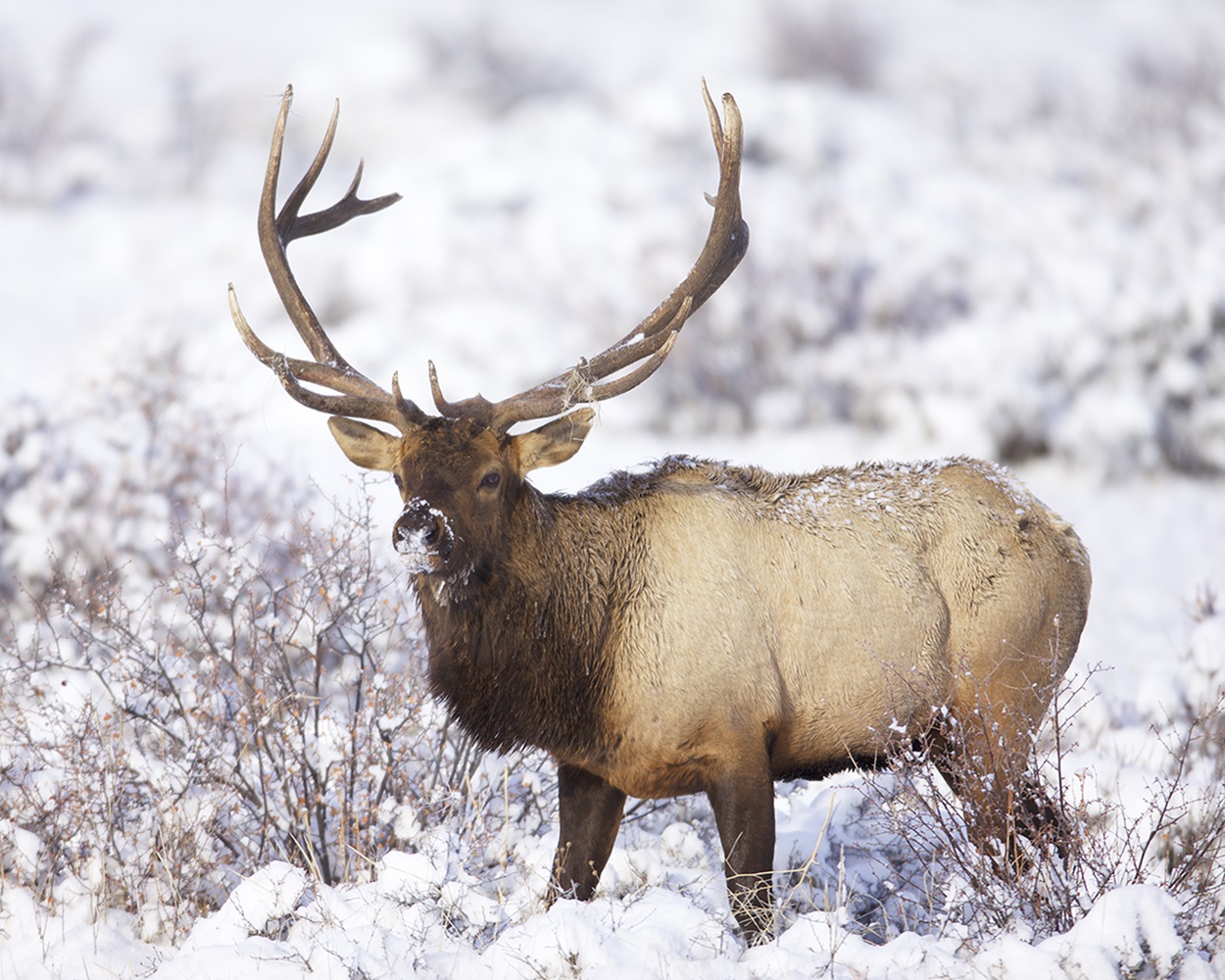
The next glitch in my plans occurred less than a mile beyond the kill site. Driving carefully on the icy, park road, my eyes caught sight of a huge, 7-point bull elk feeding 100 yards or so off the asphalt. There was no way I could pass up a stag of his magnitude to “hopefully” find a red fox. The next hour was spent trudging around through knee-deep snow positioning myself to capture what might be the image of the day. After the bull bedded and began chewing his cud, a somewhat less than desirable pose, the decision was made to move on to Lamar Valley.
Nearly two hours later, and after several half-hearted attempts to photograph coyotes, dippers, bald eagles, and such, I finally reached my destination—an extensive grassy field bordering Soda Butte Creek. Upon approach, it was obvious the two long-lens photographers parked in a pullover were busy working something in the field. A hundred yards out, a handsome, male, red fox was preoccupied chasing voles, but he was moving away toward a distant, willow thicket. Soon after he was out of sight, the photographers packed up and drove away. I stayed put with high expectations of the predator’s return.
Within fifteen minutes the fox reappeared and began trotting in my direction. By then, several other photographers and wildlife watchers had arrived on the scene. As he approached, camera shutters were clicking eight to ten frames per second—including mine!
When the fox crossed the pavement, an inconsiderate photographer violated the fox’s flight zone’s invisible boundaries. Enough was enough; the cautious animal melted into the adjacent conifer forest. The anxious crowd quickly dispersed to search for another, more cooperative subject. Slipping a bottle of water, a chocolate bar, and a canister of bear spray into my coat pocket, and after shouldering over forty pounds of photography gear, I struck out through the lodgepole pines in an attempt to track him to one of his more isolated hunting areas.
Following the line of footprints through the snowy woods, it soon became obvious the fox was doubling back to the field across the roadway. Realizing the tracks would eventually lead to a red fox that had slowed his stride to hunt, there was no reason to hurry. Besides, the snow had stopped and a thin layer of clouds filtered the midday light. Conditions were ideal!
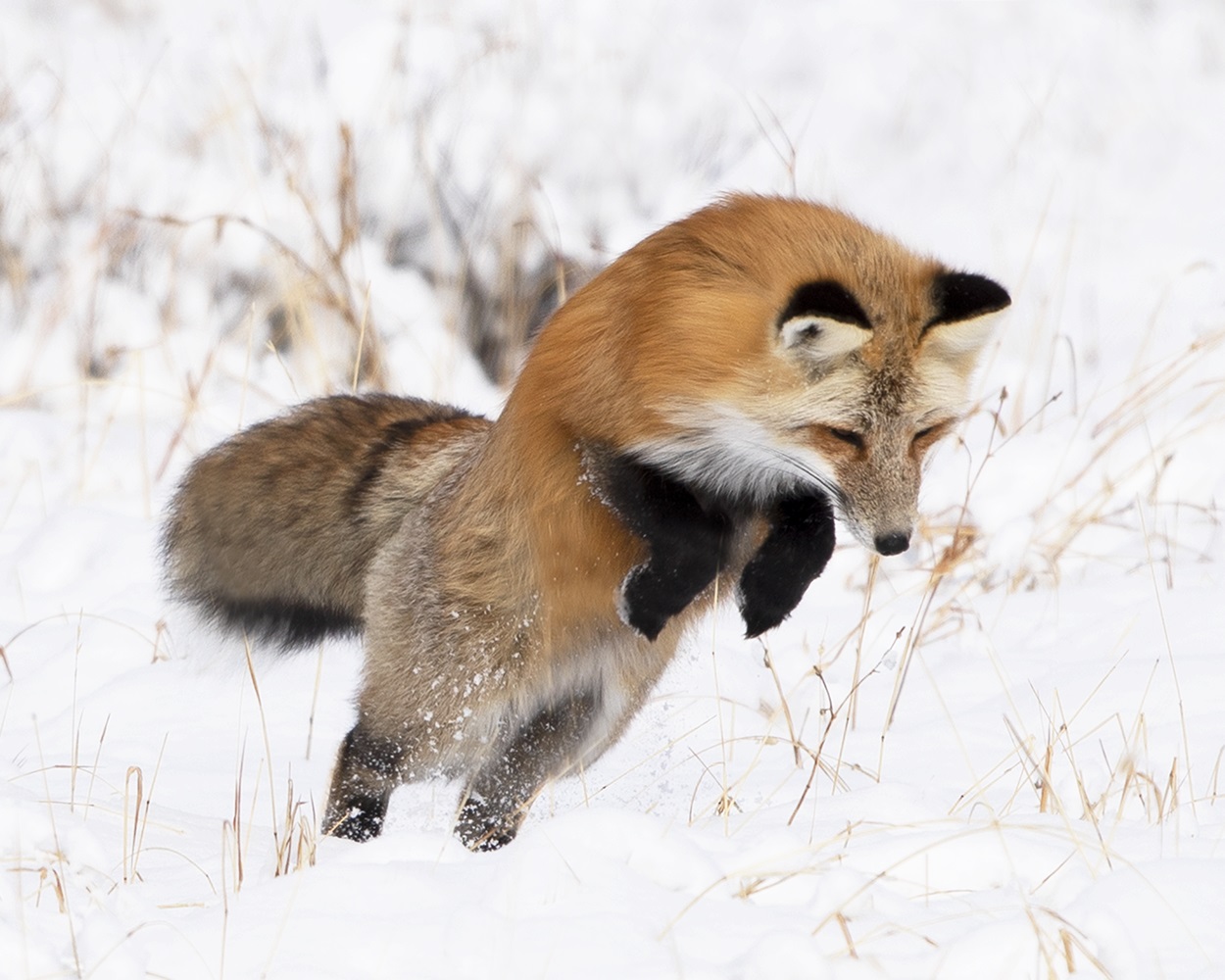
A half-mile into the pursuit I spotted the fox crouching in a patch of weed stalks less than fifty yards away. With head cocked and ears erect, he was locked in on an unsuspecting rodent. After quickly setting up the tripod and positioning the 600mm lens, I increased the camera’s shutter speed for that anticipated flurry of action shots. In an instant, the fox pounced three feet off the ground and dived, headfirst, into the snow. Click, click, click!
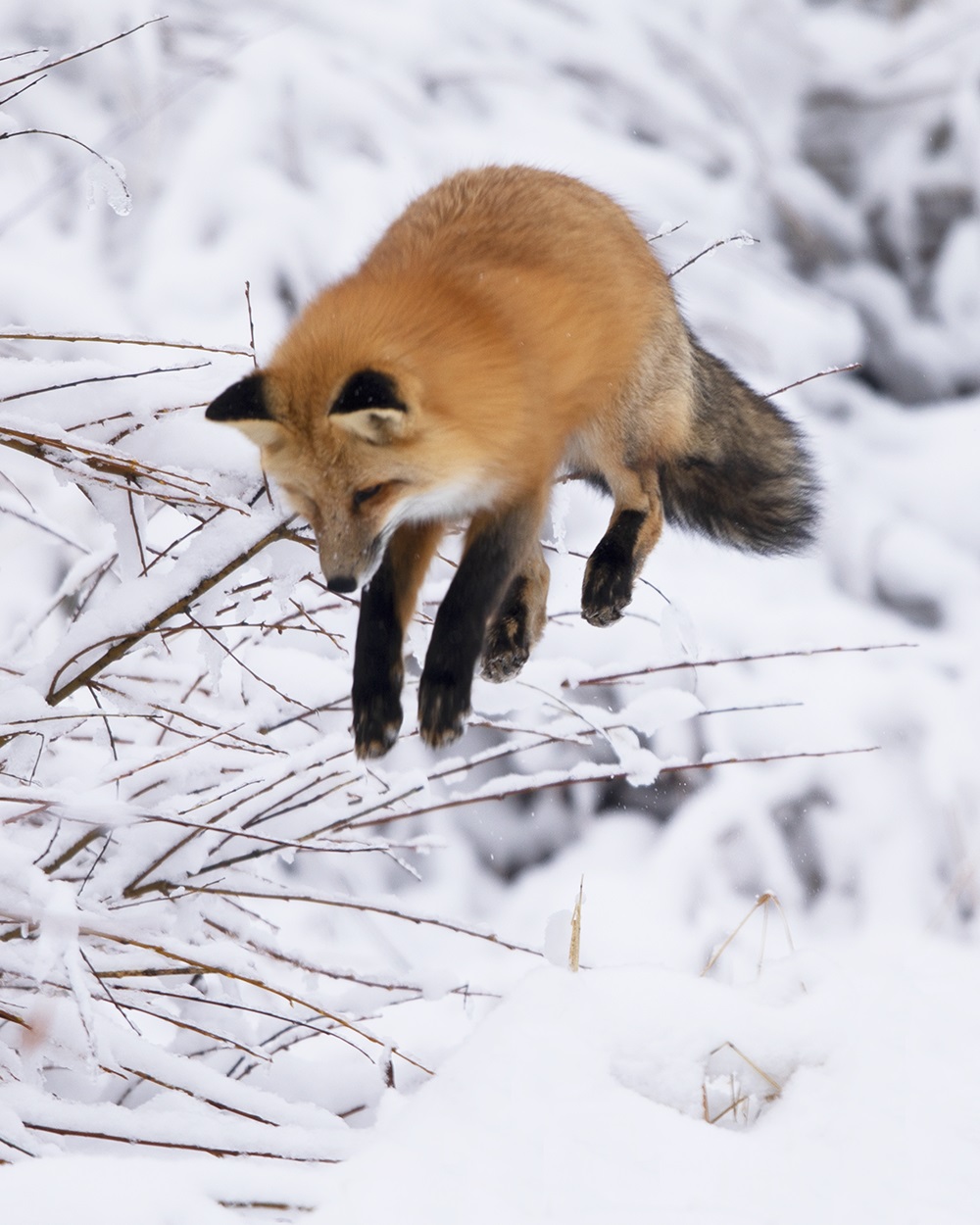
As is often the case, the vole escaped unscathed, leaving the flustered fox with a snow-covered muzzle. Turning his head to briefly stare at me, he showed no sign of objection to my presence. Unlike the wild-eyed vixen the day before. This is why I prefer photographing in national parks, where wild animals are more tolerant of humans. Photographing predators going about their routine behavior is practically impossible in areas where they are hunted. Not to mention, as nocturnal mammals, the majority of feeding activity occurs under the cover of darkness.
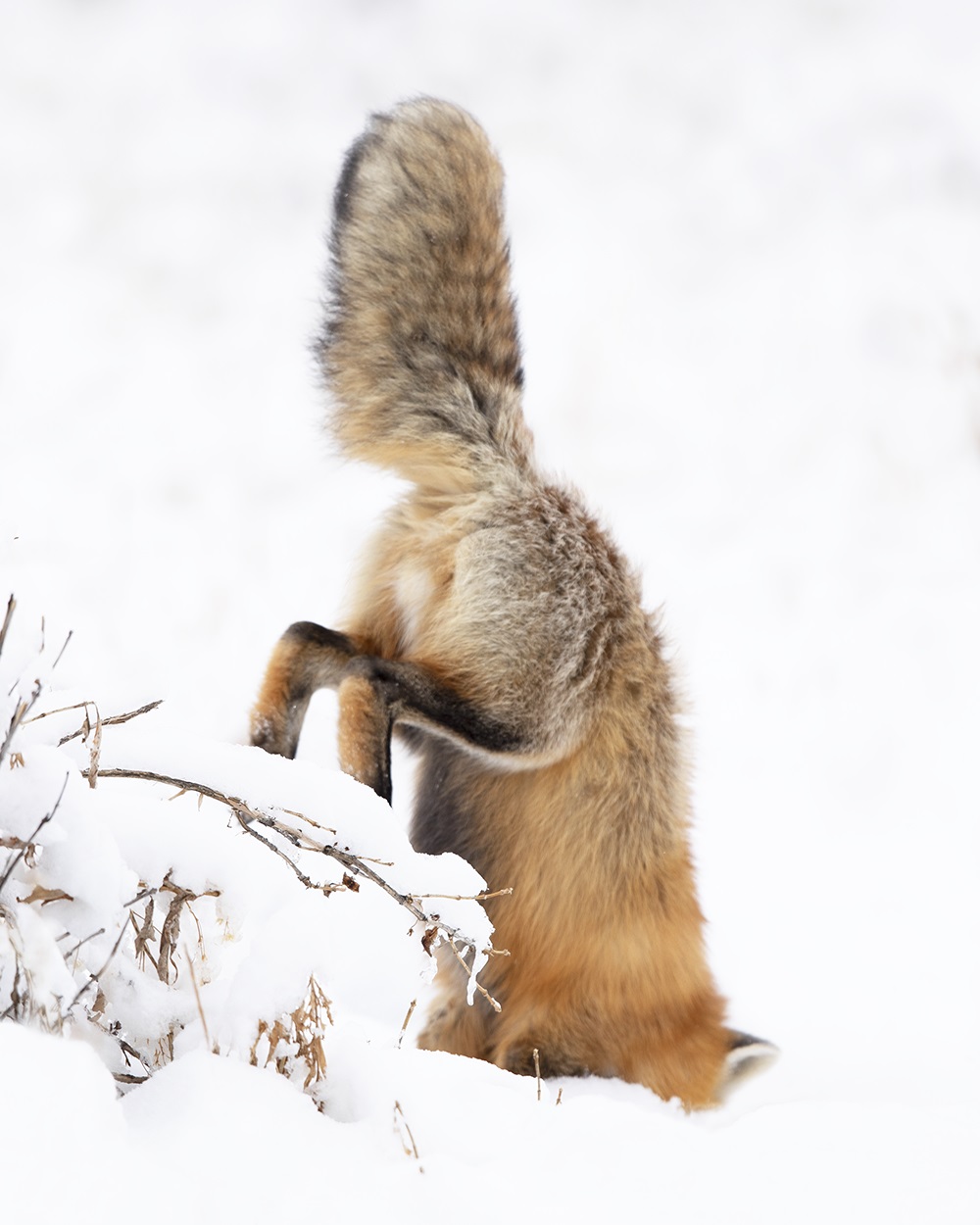
In a matter of moments the fox was on the move again, pausing along the way to investigate clumps of grass, weeds, and moose-browsed willows. A change in body language and ear position telegraphed that one of the animal’s exceptional sensory systems had intercepted some audible signal or molecule of scent, which was the clue to ready my index finger on the camera’s shutter button. On occasion the motionless fox became so intensely focused on something under the blanket of snow that he closed his eyes as if to block out all visual distractions.
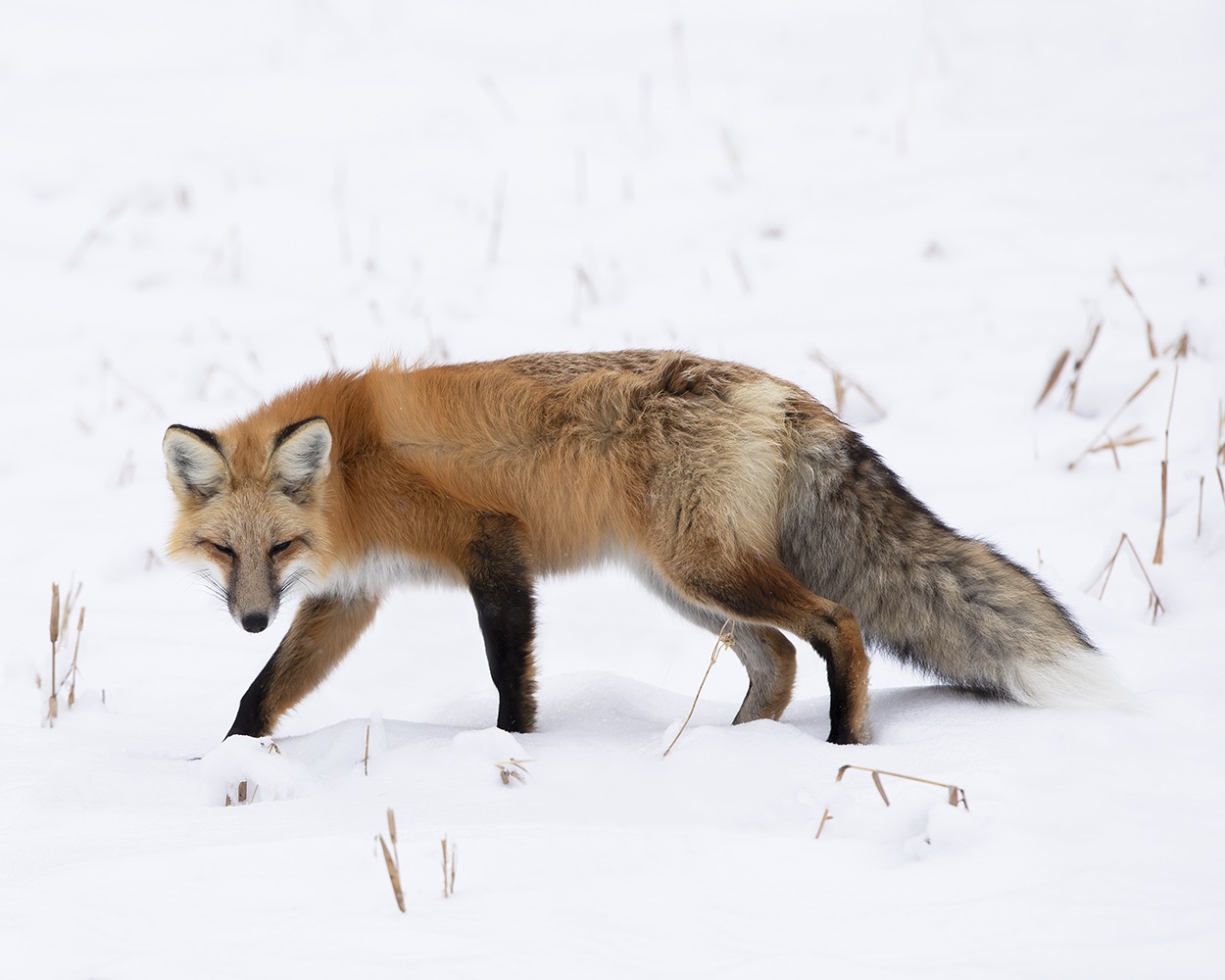
Each time the fox sensed active prey, his demeanor immediately changed from a hunter to that of a ruthless assassin. While creeping forward he would cautiously raise a foot and, in fluid, super slow motion, lower it silently into the soft snow. When his ears had triangulated a vole’s exact location, the tense predator would crouch and, seemingly using every muscle in his lean body, launch himself forward in an explosion of mammalian energy.
Not every attempt ended in success, but during the two hours spent trailing this fellow, nearly a dozen small rodents fell victim to his polished skills. Most were consumed on the spot, but a few were cached, in typical fox fashion, as emergency rations for surviving the harsh conditions Yellowstone bestows upon its wild residents during winter. Several times that day, the red fox dug up and ate the frozen remains of prey buried during previous hunts. I suspected coyotes, and even other red foxes, had benefitted, too.
Like all outdoor adventures, this fantastic Yellowstone experience came to an end. The fox simply picked up the pace and discretely set course for a place I would not be privileged to visit. With a full belly, he likely needed solitude and time to curl up for a well deserved afternoon nap.
Ecstatic over the hundreds of images taken of the beautiful mammal, not to mention the first-hand biology lesson, I prepared myself for the mile-long trek back to the vehicle. Turning around for one last look, I was surprised to see the fox sitting on his haunches and observing me—a role reversal of sorts. It was the one photograph desired more than any other, but would he hold that position long enough for me to close the distance?
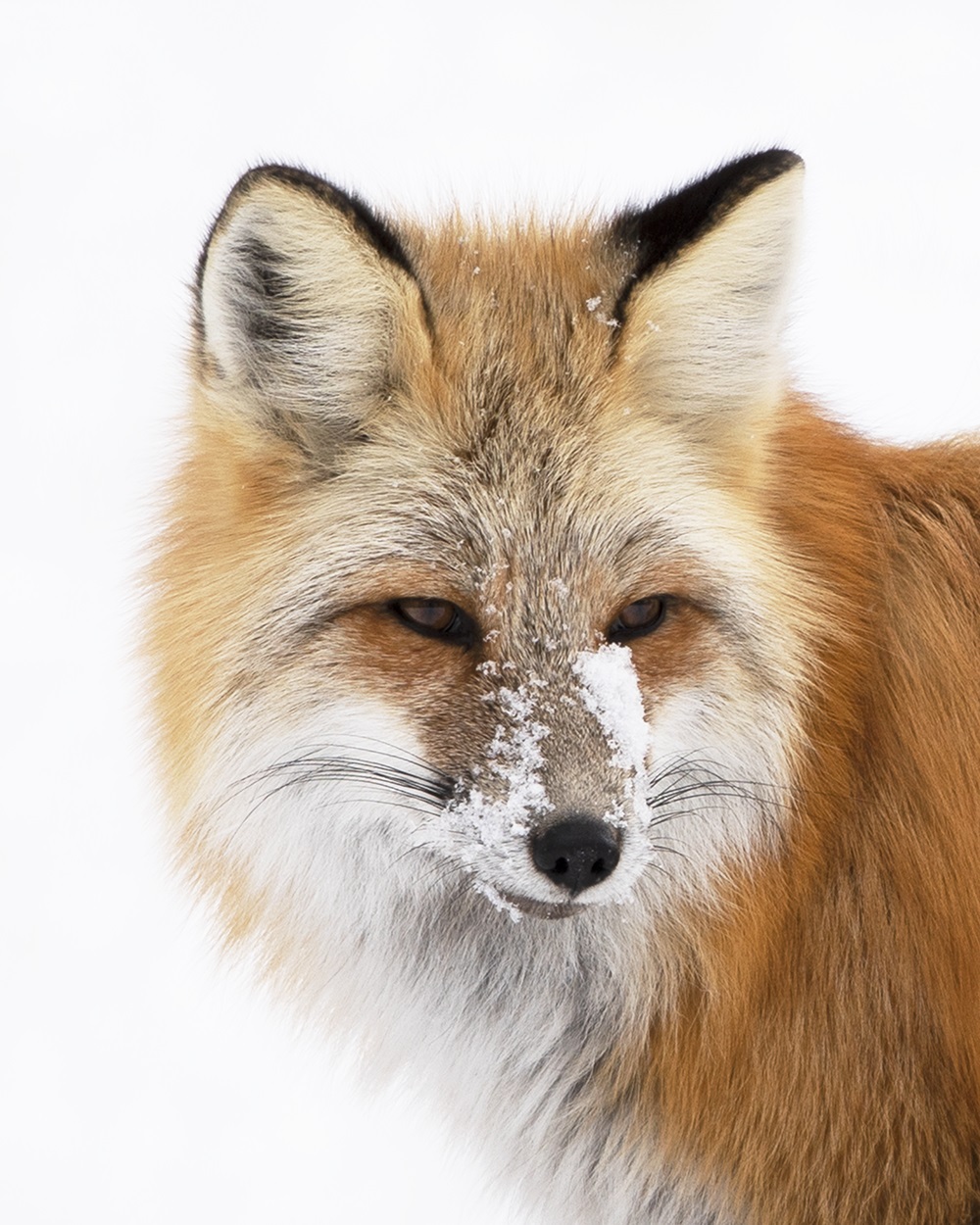
When I topped the ridge crest, the fox was still sitting in the snow watching a bison bull feeding further up the hillside. In a fraction of a second, the camera screen’s focal point picked out that wet, black nose. Must have been the shutter noise that snared his attention, because he turned and made eye contact just before standing and fox-trotting off toward the pines. As he disappeared in the shadows, I smiled and tipped my cap!
Ah, the last frame of the day!
Posted December 26, 2020
Mike Roberts is a naturalist, educator, wildlife photographer and writer. He was befriended and mentored early in life by Leonard Lee Rue, III—one of America’s leading authorities on nature, a distinguished author, and this country’s most published wildlife photographer. Roberts considers his own writings and photography to be a continuation of Rue’s passionate approach to teaching others about the importance of the natural environment.
After retiring from a career in the nuclear fuel industry, Roberts founded a non-profit educational organization called Return to Nature, Inc. He traveled on a full-time basis to classrooms across Virginia, teaching students about natural resource conservation and stewardship responsibilities. Over a period of twelve years he reached more than 350,000 students and teachers with his unique blend of science and resource conservation talks.
More recently, Roberts has worked as the naturalist and outdoor educator for the Ward Burton Wildlife Foundation in Halifax, Virginia. During summers, he serves as the naturalist for the Thomas Road Outpost, a youth outreach ministry located near the Peaks of Otter in Bedford County.
Although he has traveled throughout much of North America and parts of Africa to capture images of wildlife, Yellowstone National Park remains his favorite destination in the world.
In addition to feature articles, Mike Roberts is the author of a regular column entitled “A Walk in the Woods” for Virginia Wildlife magazine.