
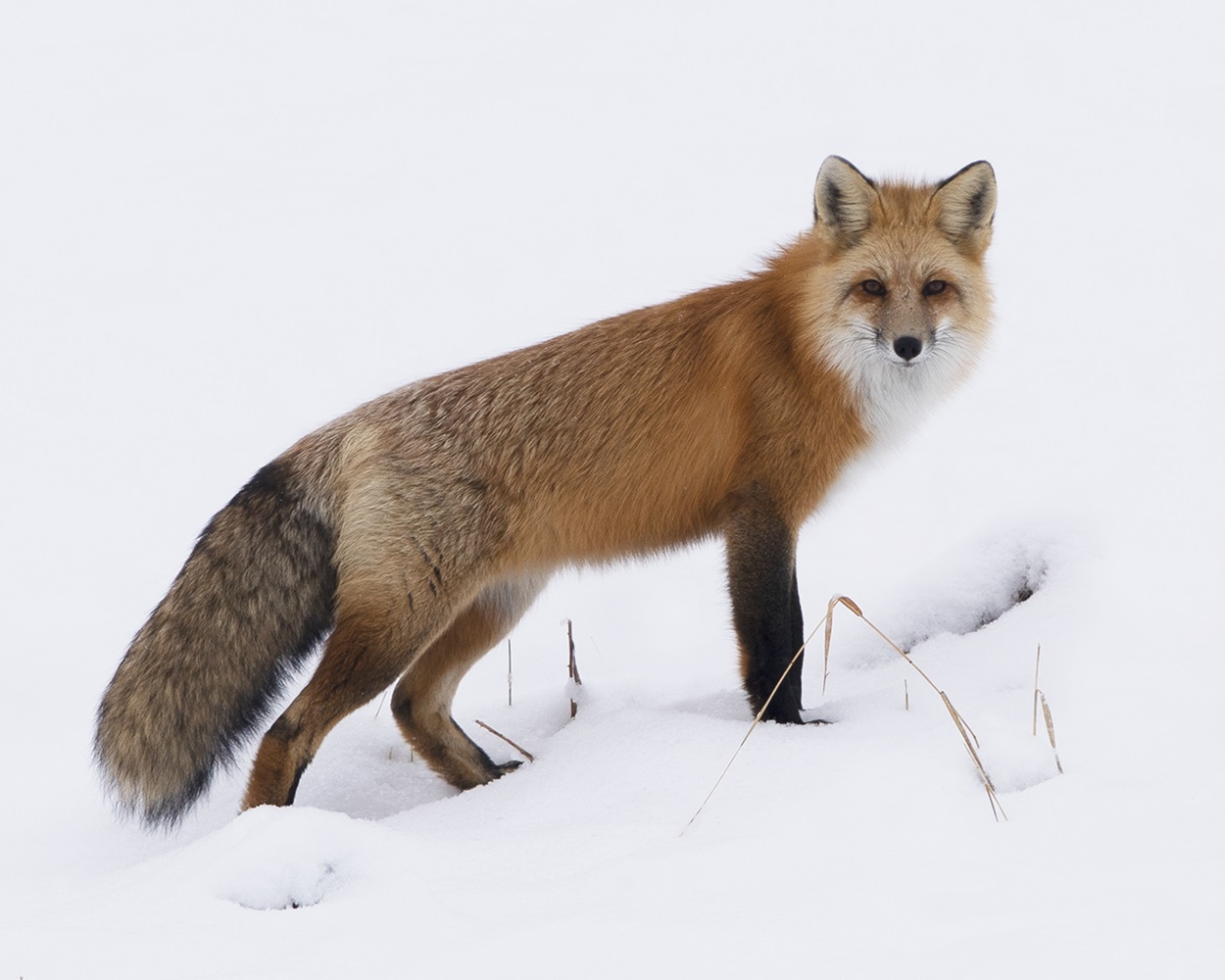
 Red Fox / Mike Roberts photo
A recent study reveals that wild mammals—even big predators—are getting portions of up to half of their diet from human leavings, crops, or smaller mammals that live near people. The study included wolves, mountain lions, bobcats, coyote, foxes, fishers, and martens across the country.
These wild animals are relying less and less on foods found naturally, as human population spreads and presents wildlife with domestic dietary alternatives. The outcome naturally puts wild creatures in conflict with one another, and leads to more human-carnivore encounters in territorial boundary areas and suburban backyards.
Researchers at the University of Wisconsin–Madison and the University of New Mexico used hair, fur, and bone samples to identify the dietary composition of numerous carnivore species ranging geographically from the outskirts of Albany, New York, westward to Minnesota forest land. Chemical tracers showed that the animals were relying on human food sources either directly—raiding crops or trash bins—or indirectly by preying on smaller mammals such as mice, rabbits, or sometimes even pets that live in closer contact with people.
Wired.com quotes Philip Manlick, a postdoctoral fellow at the University of New Mexico and lead author of the study published recently in the Proceedings of the National Academy of Sciences. “These species are eating human food,” said Manlick. “In some cases, up to half of their diets are coming from humans. It might be garbage, or corn residue, or house cats and pets. This is bad news for carnivores, because people don’t want predators eating their pets—and generally speaking, people don’t like carnivores in their backyard.”
Not only are these carnivores coming into contact with people more frequently, but they are also competing with other carnivores for food, Manlick says. That leads to increased predation by wild mammals against each other, on down the hierarchical chain.
The researchers found that foxes were the most likely to eat from human food sources, getting about half their food by eating domesticated animals or by foraging in suburban areas. Consumption of human food sources among wolves and bobcats amounted to less than five percent.
To determine these statistics, the team used chemical isotopes of carbon taken from the animals’ fur and bone samples. “Human foods look like corn, because we give corn to everything,” Manlick says. Corn syrup is an ingredient of many processed foods, and corn grain is fed to beef, chicken, and pork that humans eat. Corn is easily distinguishable in lab analysis.
A previous study published in 2018 in the journal, Science, looked at fifty-seven mammal species around the world and found they are moving around less and hunting smaller ranges than before. The behavioral changes are thought to be due more to fragmentation of habitat and/or new dietary opportunities that accompany the ever expanding footprint of human settlement. Some species feel safer to forage near humans by dark and are becoming more nocturnal. It is not yet clear which species will be able to adapt and which will not. These changes in the habits and diets of wild mammals are expected to benefit some species and probably harm others.
Other than securing our garbage and keeping small pets in at night, there’s not much hope in reversing these trends. Wild animals are evolving in various ways to adapt to cities, suburbs, and farms, and the increasing availability of human food is modifying the lives of creatures in the wild.
Click for the complete article in Wired.com.
Posted January 18, 2021