James Barclay was born to foxhunting. He, his sister, two brothers, mother, father, grandfather, and great-grandfather all served as Masters of Foxhounds—a family way of life that began in 1896. James served as Master of five hunts from 1983 to 2012: the Essex and Suffolk, Fitzwilliam, Cottesmore, South Wold, and Grove and Rufford. Click for a fuller introduction to James Barclay in Norm Fine’s Blog.
With over two hundred years involvement with various packs and types of hounds under our belt, you will understand it was and always will be the number one rule in the Barclay family to have the greatest respect for our quarry species, be it the fox, deer, or hare. The pleasure they give us is immense, and this comes from not only close observation on a hunting day but during the summer months when they are all, in their own distinctive ways, equally fascinating.
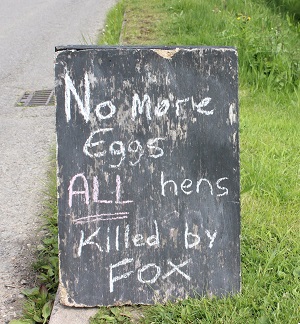
It is the fox, however, that has taken up a very large part of my life, and hardly a day passes when he doesn’t enter my mind in one way or another. And more than likely he will be discussed at some point, especially when he is being blamed for eating someone’s prime poultry! Whenever foxes are talked about, however, it is generally with a large degree of affection, except of course on the day a heinous crime has been committed in his role as the ruthless killer!
My pleasure in writing this has come from looking back and remembering moments when my vulpine friends have behaved in ways that remain etched on my mind. In the past, I have recollected their somewhat strange habits after the death of a particularly well-loved character. This enters another realm, although there are places where both realms meet and it is then when it really does become all the more fascinating!
Growing up in Hertfordshire at Brent Pelham was not only an experience, it was a privilege. It was a place where we learnt so much. The Puckeridge hounds played an all-absorbing part of my life, as did the farm and everything that went with it. It was during harvest as the combines rolled, that my father enjoyed taking us to strategic places where we would count the foxes flying out of his fields of wheat, beans, or whatever other crop it happened to be, and then watch carefully as they dispersed in all directions!
At the end of each day, the drivers were always asked what they had seen, and it was then that a reckoning would take place as to what was about and where they were likely to have gone. This was not through any blood lust; it was simply a dedicated interest in an animal that played an important part in our lives. At night when the hounds were not singing in kennels, more often it would be the foxes keeping us awake by barking away around the house. At breakfast the next morning it was always a point for discussion about who had heard what. So with this sort of upbringing, the vulpine species, you will understand, has been deeply engrained in the thinking of many of the Barclay family for many years.
One of my first experiences that still stands out happened whilst I was with Clarence Webster at the Warwickshire, working as a rather inefficient kennel boy in the 1970s. It was early February, and there had been a light fall of snow during the night. We had gone into the kennels as usual at six and washed down. Clarence always walked the doghounds and the bitches out separately, so it was on this particular morning that we went into the back field with the old boys. After half an hour we were back and getting ready to take out the next lot when Clarence asked if I would nip back up to the slaughterhouse and get some flesh for the first feed. When I got there I could scarcely believe my eyes. There on a mound, no more than twenty yards from me was a fox mooching about the area we had just come through without a care in the world. Not only that, wherever the old doghounds had cocked their legs, he was doing the same.
It was in my very early days at the Essex and Suffolk that an enthusiastic shooting farmer rang me up to say he had found a litter of cubs, and would I like to pop over, have some supper with him, and go out and watch them for a while. This we did. On arriving at the spot, there they all were, lying out on the winter wheat. Within a second of hearing us they were gone, and for the next forty minutes nothing appeared, despite our being in exactly the right place for the wind. Who could blame them? It seemed as though we were not likely to witness any further action, when suddenly a well-grown cub appeared, followed by another and another until all five were no more than twenty yards away from where we were sitting.
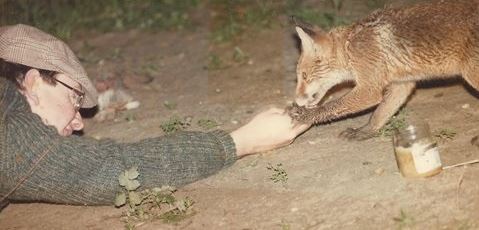
Then the old vixen decided to make herself known to us by trotting right out onto the open ground, almost as though she was surveying the scene before she trotted into the shadows, whilst all the time keeping a more than careful eye on her offspring and what they were up to. After witnessing all the rough and tumble of these young foxes at play, my farmer friend Alfred suddenly put a pot of honey in my hand and whispered to me to go down flat on the ground and squeak like a rabbit in distress.
I did as he instructed. A cub advanced cautiously towards me. I suddenly felt the weight of his pad on my hand and saw him looking at me straight in the eye whilst he licked the honey off my finger. What an experience! I would have never imagined it to be remotely possible. These were wild foxes that hardly had seen a human being before, and for one to actually do this, was extraordinary.
Billy Shipp, the farmer that organised the experience was a true countryman in the finest sense, as was his colleague Alfred Jennings, a neighbouring farmer who was with us that night. They both gave up shooting to partake in the activities of the Essex and Suffolk Hunt, and it was through them the word balance became so important to me, not only in creating an understanding of the fox but to find ways for the two sports to work together. Sadly, the pair of them have gone on to the great hunting country in the sky. However, they sure had an impact on me in how to run a pack of hounds, in a country where shooting was and still is a popular activity.
It was when I joined the Fitzwilliam Mastership, and my wife Lucy and I moved into our first marital home in Milton Park, near Peterborough, that the next fascinating happenings began to occur. Milton at the time was the home of the Fitzwilliam family and is now in the hands of their relations and successors, the Naylor Leylands. The hounds are the descendants of those many famous ones that were there before, the breeding of which goes back to the mid-1700s and beyond.
To see foxes in the Park was not unusual, particularly around the kennels; however, on one particular night, I was awoken by two animals fighting under our bedroom window. Lucy had a rather large ginger cat at the time, and my immediate thought was it was the neighbouring Tom who had come up for a scrap. Not a bit of it! There, just under the window, were two foxes locked in battle and going for it like nobody’s business. I put my head out and asked them in quite a loud voice what they were doing waking us up like this. At first, it made not the slightest bit of difference, but after a while, they drew back from one another, looked up at the window, and started cackling at me. This unusual behaviour went on for a good three minutes or so, before the pair of them decided to slink quietly away into the covert beside the house, and were gone. They certainly had their minds on other things, and the cackling was probably a sign of their displeasure at being disturbed!
A few years later we moved to the village of Southorpe, not many miles from Milton. Our two sons were growing up fast, and a little more room was needed. It was on our very first night there that we were woken again by a similar and very recognisable noise. This time though, it was a bit more muffled. So, heaving oneself out of bed with torch in hand, I proceeded to shine it down onto the drive below. I could hardly believe my eyes! There were three old foxes all piling into each other in what I can only describe as the mother and father of all battles. They took not the slightest notice of me, so I decided after a while to go back to bed and leave them to it. The next morning, the Head Keeper from the Walcot Estate, Jeff Davey, appeared on the doorstep. “Brought the foxes with you then, have you?” he laughed. He had been on night watch duty and had witnessed just what I had, except when he stopped and shone the headlights on them they cleared off in all different directions.
On leaving the Fitzwilliam after twelve very happy seasons, a move to the Cottesmore came next. We decided to build a house on a derelict piece of land in the old railway village of Little Bytham, just north of Stamford. As the works came to an end there was a considerable amount of topsoil left over, so we decided to bank it up and plant it with shrubs, bulbs, and the like. It was a Sunday morning, and I was busy digging away when something caught my eye. A hundred yards away, under the gate to the top paddock came “Charlie.” Down the field he trotted until he was five yards away from me, and that is where he stopped. He was not about to move. So we stood and stared at each other. My ancient old sheepdog-cross lay on the bank beside me and never once made a move to see him off. This was strange to say the least. After what seemed about five minutes, the fox decided to make his move, not away from me but to come over to within a yard of me! He then suddenly put his nose in the air, made his way up the field again, and was gone!
After Lucy’s first horrific accident, we sadly had to move in the village, as adapting the house would not have been possible. So off to the middle of Lincolnshire it was to take on the South Wold Hounds. We found a nice old-fashioned farmhouse in the village of Stixwould near Woodhall Spa. It would seem as though we had not been there five minutes when there was a knock at the door. It was our immediate neighbour. He proceeded to tell me that he and his wife could not believe what they had seen the night before. They were on their way home late in the evening when standing in the middle of the road, right outside our gate, was a very large fox who on being disturbed decided to trot straight up our drive virtually to the back door. This I have to say was extraordinary as foxes at that time were a rare sight in this part of Lincolnshire. However, it is what followed on from that occasion that makes these happenings all the more peculiar, whether at home at Stixwould or elsewhere.
Close encounters continued to take place, and on the 19th November 2013 there was one incident that brought it all close to home and is where these two realms of fox activity—the real and the surreal—come together. I had traveled down to Brent Pelham for a ninetieth birthday party, arriving in the village at half-past three in the afternoon. As I turned down beside the Church to go to the Puckeridge Kennels, there was a fox sitting perfectly calmly on the verge, beside the graves of my father, mother, and many of our forebears. Nothing unusual in that one might say, but where he was sitting happened to be in exactly the same place where my sister and I had stopped with the Puckeridge Hounds just a month or two before to remember both our parents.
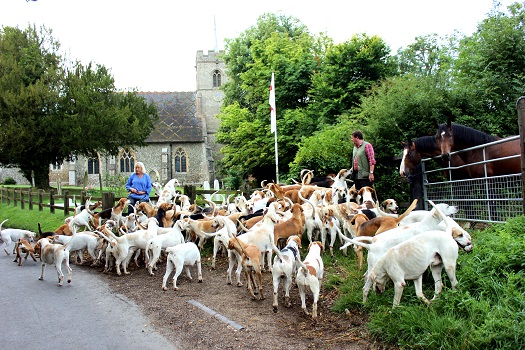 The fox was sitting by the family graves precisely where Barclay and his sister had stopped with the Puckeridge foxhounds in remembrance.
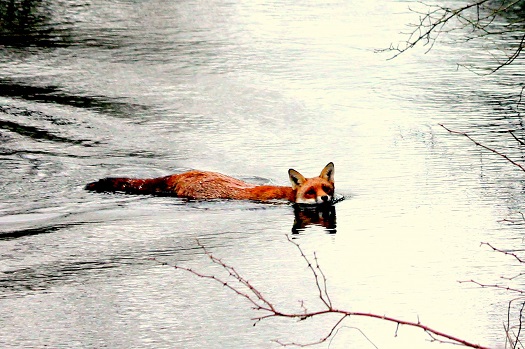
In February of this year the Blankney met at Lake Farm, Washingborough, near Lincoln, and with birds of prey* in place, the hounds went up to draw a thick patch of thorns above a large expanse of black fenland. The covert is largely surrounded by a moat. I made my way through to a spot where I hoped I might see some action and sure enough it wasn’t long before everything began to materialise right in front of me. I went to stand with Philip Stubbings, the huntsman. After a while, he suddenly pointed towards the water’s edge. There was the fox, just in the middle of launching himself into the water. Luckily, with camera in hand, I managed to take five shots of him in full flow, the last of which was probably one of the most special I have ever have taken. As he was about three or four yards from landing he suddenly changed direction and literally swam straight towards us. Then seemingly treading water for a few seconds he turned away, landed on the opposite bank, shook himself, and again like all the others, was gone. I never took another photograph again that day!
For many years I had a wonderful terrier called Murphy who would go out at night, and if there was a fox about, he would bark at it until it would disappear. Sadly, Murphy died in March 2014 and was buried under our bedroom window. A few days later the South Wold Hounds met here for the last day of the season, and I asked their Master and Huntsman if he would just stand beside where he is buried and blow for the old dog. After all, Murphy and I had done many a mile together hunting with numerous packs of hounds around the country and it felt most appropriate.
Late in the evening a few weeks later, Murphy’s son Poiteen, named after the lethal Irish potato liquor, shot out the door and started barking madly. I went round the corner of the house, and there under the outside light were two of our vulpine friends fighting on the old dog’s grave. They were soon seen off, but over the next two hours kept returning to bate the young fellow. Eventually, all three of them ended up piling into each other outside the front door. Three weeks later they were back, and the same scene was played out all over again, this time though keeping me on my toes until after half-past three in the morning.
A very well-known Country Vicar and an Imam from Inner City Nottingham have both told me that an animal, either wild or domesticated, will always sense the soul of the departed person, and that it is a sure sign that all is well. That is fascinating in itself, but I haven’t gone yet! Maybe we are in the same scenario as the late Duke of Beaufort when only a few days before his death, he was worried to see foxes playing on his father’s grave in Badminton Churchyard. I am not saying I am in any way as important as His Grace, but when you study true stories such as these and experience something not too dissimilar, one’s mind really begins to work overtime. Especially as only yesterday evening well before dark, and the very night before finishing this piece, there again was a fox by the back door and in the very same vicinity of my old dog’s grave!
Whilst there will be many who have experienced similar incidents, these have been absolutely extraordinary to me, personally, and represent one undeniable fact: that there must be something out there that makes this all happen. Can it all be just coincidence? I would love to hear the experiences and opinions of others.
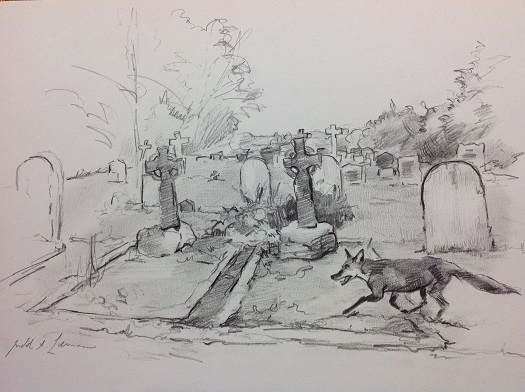 Illustration by Judith Leman
*******
* Under the Hunting Act of 2004 which bans the traditional practice of foxhunting, foxhounds may either follow a drag or flush a fox to birds of prey. The law forbids the intentional chasing of foxes with hounds.
Re-Posted November 8, 2021