
As the month of March advances to its close, we all know that newly-whelped fox cubs are at this very moment huddled out of sight and underground, not yet having seen nor felt the light of day. We wait and watch, hoping for a sight of them, but more likely contenting ourselves with occasional daylight views of the vixen or dog fox now working overtime day-shifts to feed a voracious and growing family. ―Ed.
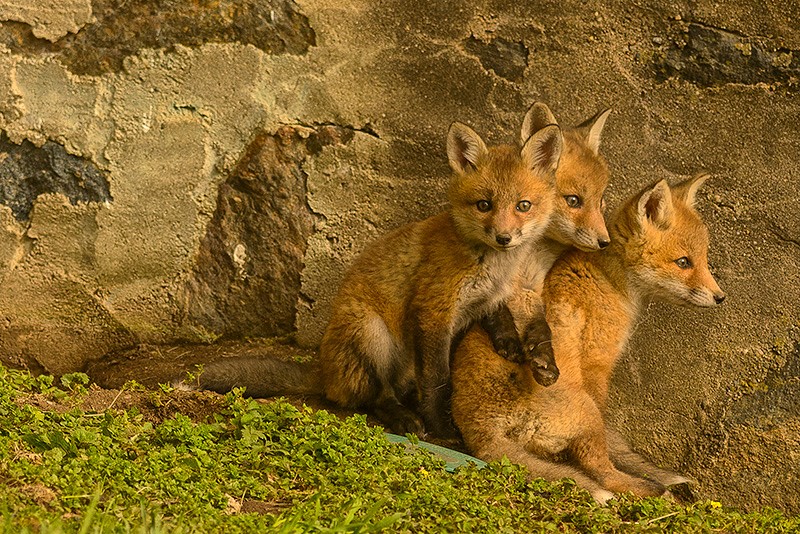 Jim Graham photo
Yesterday I visited a Fort. It was one of the many great, circular, centuries-old Danish structures that are so numerous in this eastern part of County Cavan, Ireland. Its ramparts and fosses are still well-defined despite the ravages of ages. The inhabitants used it as their home in times of peace, and as their stockyard and stronghold when invasion threatened. The inhabitants evidently disliked isolation, and their fortress was erected on such well-chosen eminence that they were in full view of their neighbours on some adjoining hill; indeed it is a local belief that seven neighbouring forts are visible from any particular one.
Although their human inhabitants have long since departed, these forts are not untenanted. The dense local bird sanctuaries: the tangled bracken that drapes the sweep of their buttresses, choking their fosses, is a paradise for rabbits; and the deep-tunneled, impregnable earths that can defy the stoutest terrier provide the safest of breeding grounds for foxes.
It was to see a litter of fox-cubs that I visited this fort.
On an expedition of this nature, one must approach as noiselessly as a shadow and be as inconspicuous as possible. Foxes have to live by their wits, and a nursing vixen knows only too well that the presence of a human being in the vicinity of her earth heralds trouble for herself and her family.
I was beginning to congratulate myself on the cleverness of my approach when a rabbit, startled from his evening feed, cocked his ear, poised a moment on his legs, made a quick decision, and acted on it instantly. Like a scout of old on outpost duty at the fort, he slipped away to inform the garrison of the presence of an intruder. Soon the slow double tap-tap, tap-tap throbbed underground, as his hocks beat the floor of his borough and sent out the message of warning to the entire rabbit population in the vicinity. Now that my presence had been detected, it was best to pass on, reach my objective, then lie still and wait. Up through an opening in the undergrowth, I crawled, climbing to the top of the highest rampart, moving noiselessly all the while and hoping the foxes had not heard my approach. I argued that the young cubs might be so engrossed in their play that they might not have heard the rabbit’s signals, or, hearing them from such a timorous neighbor, might have treated them with contemptuous scorn. Whether they had heard my approach or not I cannot say, but when I slowly raised my head above the rampart not a single cub was in sight.
It was probably too early for their evening frolics. From my position I commanded an excellent view of the playground on the inside of the opposite rampart. The wind was in my favour, the light was still good, so making myself comfortable behind a sheltering blackthorn, I made a close-up examination of their haunt with field glasses.
Inside the fort, the ground was as bare as a badly-worn tennis court. Here and there were patches of brown earth, with not a blade of grass showing. These were connected by well-worn paths through the less-worn grass. One path led directly toward me to a small brown mound in the center of the fort. After a careful examination of the evidence of partly-consumed meals and their discarded offal, I came to the conclusion that the vixen must order her poultry in dozens. The ground was littered with wings, feathers, and legs. They were not all the produce of the farmyard either; the feet of a moor-hen were unmistakable, and I was delighted to see the wings of rascally magpies.
Soon a sharp-snouted brown head, with ears erect, poke suddenly through the opening in the undergrowth that rimmed the outer edge of the opposite rampart. It glanced to the left and right, waited listening, then glided out onto the well-worn playground. Soon another brown shape appeared; then a third, then a fourth, but no sign of the vixen. When they satisfied themselves that there was no likelihood of their evening being interrupted they began to enjoy themselves. They chased one another up and down the well-worn paths, out and back to the brown mound in the centre of the fort. Tumbled and tossed, frolicked and gamboled, hither and thither. Their antics were the acme of agility and would make the movements of the most playful kittens appear like the solemn actions of rheumatism-ridden old cats.
The sun had gone down long ago behind the distant hills leaving the fort shrouded in a purpling dusk that was gradually deepening into the shadows of the night. The cubs suddenly ceased their play, listened a moment, sniffed the air, and glided away to the top of the rampart. Like eager children anxiously awaiting the arrival of some relative from a train, they crowded together, all gazing in the same direction. The object of their interest soon became apparent. They were awaiting the arrival of the vixen with their supper. What that supper had been originally, I am unable to say, but in the scrimmage that followed on the rim of the darkening rampart, table manners were flung to the wind; and with them floated off a cloud of gleaming black feathers.
―From Echoes of the Hunting Horn by Stanislaus Lynch.
Posted March 22, 2022