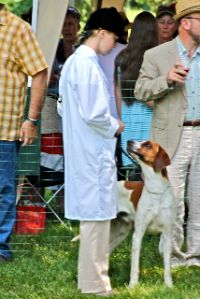
 R.K. Mellon’s great-granddaughter Kendra McBroom, showing her hound in the Junior Handlers Class at the VIrginia Foxhound ShowFrom the founding family—the Mellons—to the professional huntsman’s family—the Stickleys—the Rolling Rock Hunt nourishes its family connections.
Today, two Rolling Rock Masters represent the founding family: Mrs. Armour (Sophie) Mellon and Christina Henderson, granddaughter of hunt founder Richard King Mellon. Christina’s daughter, Kendra, thirteen, helped with hounds at the Virginia Foxhound Show this year and showed in the Junior Handlers Class—a fourth generation of the Mellon family involved in the hunt.
Mark Stickley, the current Rolling Rock huntsman, whipped-in to his father Lovell Stickley, who came to Rolling Rock as kennel huntsman in 1956 and carried the horn from 1961 to 1977. Today, Mark’s daughter Virginia whips-in to Mark and worked side-by-side with her dad showing hounds at the Virginia Foxhound Show—a third generation of Stickleys working with hounds at Rolling Rock.
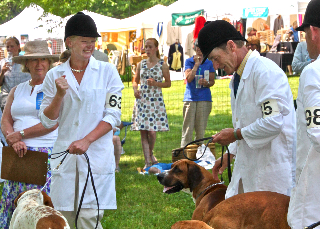 Father and daughter — huntsman Mark Stickley and whipper-in Virginia — represent a second and third generation of Stickleys working with hounds at Rolling Rock.The Rolling Rock hounds had a big day at Virginia, collecting five trophies and earning ribbons in every class entered. Rolling Rock Kaiser wound up American Un-entered Dog Hound Champion, and Rolling Rock Mallard finished his day as Reserve Champion American Foxhound.
Team Stickley was undecided whether or not to show in the pack class. The last time Rolling Rock won a pack class was in the 1970s when Lovell Stickley was huntsman. They showed…and won!
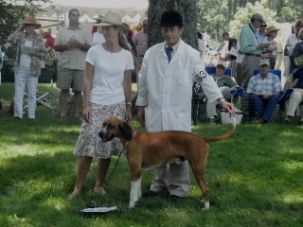 Sophie Mellon, MFH and huntsman Mark Stickley with Rolling Rock Mallard, Reserve Champion American Dog Hound at Virginia“Many flashbacks and happy tears were amongst the Rolling Rock hunt members and staff,” wrote Virginia. “My father has worked hard to get the Rolling Rock Hunt back on the map, and he has done an incredible job with these hounds in such a short time.
“Foxhunting is not just a part of my life, but it’s in my blood,” Virginia concluded.
Apparently it’s in Kendra’s blood as well. Both youngsters have an institutional heritage of which to be proud.
The Rolling Rock Hunt
It was in the early years of the twentieth century that Richard Beatty Mellon (R.K.’s father) discovered a sportsman’s paradise in a gentle and fertile valley midst the Allegheny Mountains of western Pennsylvania. R.B. Mellon found the Ligonier Valley alive with game, and as he dreamed of building his country retreat he slowly acquired farms in the valley.
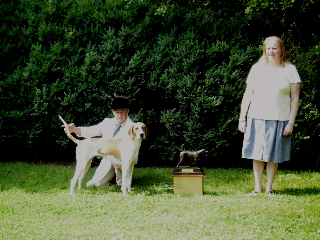 Huntsman Mark Stickley and R.K. Mellon’s granddaughter, Christina Henderson, MFH with Rolling Rock Kaiser, Champion American Unentered Dog Hound at VirginiaHe wanted a facility where his friends could join him for shooting or fishing, but he didn’t want to embarrass them with invitations they might be unable to reciprocate; so he decided to establish a club which, upon his invitation, they could join and come to whenever they wished. A real estate agent showing him additional acreage solved his problem for the club’s name.
“It’s up there where the water comes rolling over the rocks,” said the agent. The Rolling Rock Club, situated on the grounds of the Rolling Rock Farms, was incorporated in 1917.
There were no shortcuts or compromises. Every building represented the finest of the stonemason’s art, and the people employed were selected to bring the utmost talent to their job. Since shooting was the most popular activity, R.B. Mellon engaged John Lazear, an outstanding wildlife authority, as his first chairman of the Club’s Game Committee. Lazear, when grouse shooting, would start out for his legal limit of two birds with only two shells in his pocket. It is said that he always came back with his full bag!
R.B. Mellon’s son, Richard King Mellon, was an equally enthusiastic sportsman with shotgun, rifle, or rod, but he liked horse sports as well and decided to try foxhunting on a small scale. In 1920, he obtained two-and-a-half couple of American foxhounds from William Skinker, MFH and breeder of the Orange County hounds in The Plains, Virginia. R.K. Mellon and his friends hunted this modest pack both live and drag. Apparently they enjoyed themselves sufficiently, for next, they invited the Westmoreland Hunt (PA) to bring their hounds for a drag hunt. The results from this pack of well trained and adeptly hunted hounds were so superior to the Rolling Rock effort, and the enthusiasm was so high, that R.K. Mellon decided to establish a proper hunt.
As before, there were no shortcuts or compromises. Mellon’s mentor in America was W. Plunket Stewart, MFH of the Cheshire Foxhounds in eastern Pennsylvania, who had developed the finest pack of English hounds in the country. His mentor in England was George Evans, MFH of the Hampshire Hunt, secretary of the British MFHA and four-time judge at Peterborough.
In 1921, R.K. Mellon sailed to England seeking Evans’ help in obtaining his own pack of English foxhounds. He returned with eight-and-a-half couple of hounds from the finest hunts in England. While at Brown’s Hotel in London, he happened to see a booklet from the Racquet and Tennis Club of New York. The booklet’s scarlet and blue cover appealed to him, and he adopted those colors for his new hunt’s livery.
The Rolling Rock Hunt was established in 1921, the same year that the Rolling Rock Club opened. The hunt was recognized and the country recorded in 1924.
“Starting with the best bloodlines from the leading English kennels, Richard King Mellon bred and developed one of the finest and most level packs of English foxhounds this country has ever known…. The whole Rolling Rock ‘show’ came as near to true English foxhunting as any Hunt in the U.S.” (The Story of Rolling Rock by J. Blan van Urk, Charles Scribner’s Sons, New York, 1950)
R.K. Mellon’s horses were soon the talk of sportsmen here and abroad, whether showing, hunting or racing, and he judged hunter classes at top horse shows around the country. R.K. Mellon and the Rolling Rock Hunt were at the pinnacle of American sport throughout the 1920s and 1930s.
World War II was the first watershed event to alter the course of the Rolling Rock, as it did so many other hunts. After the war’s end, R.K. Mellon found it impractical to reassemble his pack of English hounds, because no hunts, whether in England or the U.S. could spare any. Instead, he obtained American hounds for the 1946-1947 season—mostly Walker and Penn-Marydel—and switched to drag hunting. With the peacetime economy getting back into gear, businessmen had no time for puttering around hoping to find a fox. They wanted a predictable schedule for their sport, a guarantee of a good gallop, then back to the office.
In 1948, after 28 years of leadership, Richard King Mellon stepped down as MFH, but continued to maintain his involvement in and influence over the hunt and its activities. The fall Rolling Rock Races were the sine qua non of the racing season, according to the late James L. Young, MFH, whose first appointment as a race steward was at Rolling Rock. “It was a solid week of black tie parties, and they raised $150,000 for charity each year,” said Young. Racing continued at Rolling Rock until 1982.
A short period of decline in the hunt’s affairs transpired until 1997, at which time Sophie Mellon was induced to accept the Mastership, and the hunt once again came under the care of the Mellon family. Christina was appointed Master in 2008, and two avid Ligonier sportsmen—Fritz Teroerde and Dr. Richard Raizman—were appointed in 2008 and 2009 respectively. With a culture that encourages family involvement, and with a fourth-generation Mellon and a third-generation Stickley active in hunt affairs, the future appears bright!
Posted June 20, 2012 (with thanks to our friend Bev Evans for suggesting this story)
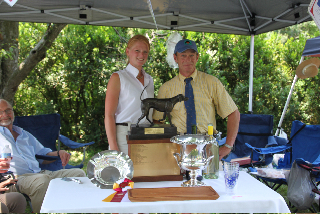 Proud staff members of the Rolling Rock Hunt: father and daughter, huntsman and whipper-in. And they won the Pack Class, too!