
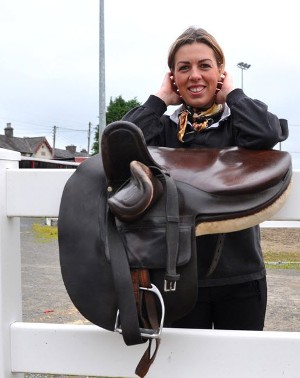
 Susan Oakes and saddle, the provenance of which includes the training of ceremonial horses for Queen Elizabeth IILongtime foxhunter Susan Oakes will attempt to set a new world record for the side saddle high jump at Aintree’s Annual National Show on July 28, 2012. The record of six feet, six inches was set by Mrs. Esther M. Stace at the Royal Sydney Easter Show, Australia, in 1915.
Susan Oakes hails from County Meath, where her parents Clare and Oliver and her sister Elizabeth are all involved in horses. Since childhood she has pony clubbed and hunted with the Meath Foxhounds, Tara Harriers and the Ward Union Staghounds, often riding side saddle. She also campaigns her point-to-point horses Parson’s Pistol and O’Muircheartaigh. She is also a show judge of hunters and side saddle, and an accomplished show rider winning the first ever coloured horse class at the RDS with Cisco Kid, and the coloured cob class with Crowboy JJ.
Side saddle riding—on the increase in Ireland through the activities of the Side Saddle Association of Ireland—has been through various transitions over the centuries with the earliest images appearing on Greek vases and Celtic stones. One of the first functioning side saddles was used by Anne of Bohemia (1366-1394). An improved side saddle design followed, which Catherine de’ Medici (1519-1589) rode in, before the two pommel saddle was developed by Jules Pellier in the 1830s.
There is a painting in the Royal Dublin Society (RDS) of the Empress of Austria hunting side saddle with the Ward Union Staghounds. The two lady authors Edith Somerville from Cork and Violet Martin from Galway hunted also in a side saddle. Some years ago Mrs. Valentine hunted side saddle with Mr. Stewart’s Cheshire Foxhounds (PA) and the Scarteen in Ireland, and Mrs. Johnson Lady Amptill hunted side saddle with the Galway Blazers. But two of the best known of the present day ladies hunting side saddle are Jonah ‘Jonny’ Wragg and Susan Oakes.
Riding side saddle requires the correct posture for balance. Ideally the rider should sit squarely, with the line of the rider’s spine centred over the spine of the horse. It was not until the early twentieth century, with the progress of the Women’s Suffragette Movement, that it became acceptable for women to ride astride.
The Horse
When Susan saw the advertisement for the Leaping Ladies Side Saddle competition in Aintree she decided, why not go for the world record? At first she was going to use her hunter, but after contacting friends Amy Fitzgerald and Paul Kinane about taking on the record, Paul suggested that she needed a horse that had showjumped, as it is a very different discipline. Within a few hours he offered her one of his horses Crannagh Clover (Irish Sport Horse), by a son of Clover Hill (RID) Gerry’s Clover, out of Crannagh Tunes.
The Trainer
To prepare properly for the record, Kinane and Fitzgerald put Susan in contact with experienced showjumping trainer Padraic Geraghty from Ballinasloe, County Galway. He will coach her and set out a realistic training schedule. Geraghty has competed on the Irish showjumping circuit for twenty-five years and in the administration of showjumping as a former chairman of training and national competition, and as chairmen of the last International Affairs Committee for the Irish Showjumping Association. He was an advisor to team manager Robert Splaine and was deputised as Chef d’Equippe with the developmental team and the second teams when Robert was unavailable. Following that he went to work for the Turkish Equestrian Federation and was their team manager and Chef d Equipe in 2011 when they were attempting to qualify for the London Olympics, as they had never jumped at that level before.
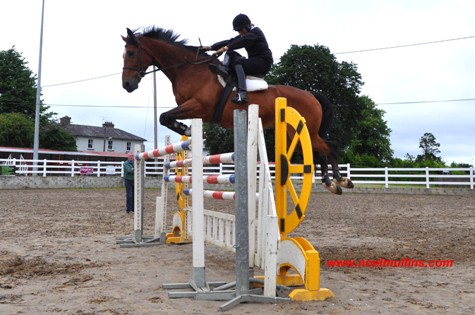 Susan Oakes clears 5 feet, 4 inches on Crannagh Clover with trainer Padraig Geraghty.
The Program
Ballinasloe Show Committee allowed Oakes and Geraghty the full use of their schooling facilities in the show grounds, but they have had to commission new seven-foot-high wings to allow Susan to train for the height.
Susan’s experience in the hunting field and point-to-point racing meant that she could see a stride at a fast gallop, but jumping a high, vertical requires a different approach altogether.
“Jumping a vertical showjumping fence is very different insofar as I have to sit up and hold the horse, and wait for the stride, all the time getting the horse balanced under me, as riding in a side saddle I have no use of my right leg,” explains Susan.
“I have to get the horse to believe in me. That’s what we are working on at the moment—having the patience to sit and wait and to ride to my contact. The horse is carrying me to the fence once I turn and line up to the fence, and that the momentum and the rhythm is a good rhythm so that when I get to the fence he is able to jump it. Padraic is doing a great job getting me to jump off both reins at different angles, different turns, so that no matter what I meet in Aintree, please God, I will get up over the height.”
Geraghty explains what he wants to achieve: “In showjumping you are trying to get a horse’s front end and back end as near together as possible so he can jump higher, as the bascule of the jump or the height of the jump is over the middle of the jump. That’s the highest point. It is just a different way of riding compared to hunting and point-to-pointing. Susan has to keep the horse more balanced, and keep him together and jumping off his hocks. You can’t jump height off his forehand. Susan found it difficult at the start, but in the last few weeks she has turned the corner, and she is really getting into the system. It helps that she is a natural horsewoman, so it’s easy to train her. She has to avoid reverting to going long and flat and keep a hold of the horse a bit more and keep him balanced going to the fence, especially jumping high. She can’t just let him gallop down to the fence. That is a big change for someone who is used to hunting and steeplechase racing, but she has adapted very well.”
The Side Saddle
As a part of her preparation for the world record attempt after a busy hunting season—when Susan hunted side saddle for twenty-two of the forty-six days that she hunted—she decided to have her side saddle checked over. It was found to be broken in five places! Gina Galvin who is chairman of the Irish Side Saddle Association loaned Susan her side saddle. In addition Jonah ‘Johnny’ Wragg who is a familiar face hunting side saddle with the Tipperary Foxhounds for many years offered her an old side saddle which was originally owned by Miss Doreen Archer-Hublan who schooled all of Queen Elizabeth II horses before going on parade in events such as The Trooping of the Colour.
“It is a forward cut side saddle which is fairly unique so when I get to the record height it will not pitch me forward, so it is very comfortable to ride in,” said Susan.
Messages of Support
The news of Susan’s attempt on the world record has generated messages of support from around the world. One example was from cowgirl in Alberta, Canada, who wrote, ”I am so excited about this, me a cowgirl from the back of beyond can personally cheer you on as you change the history books with your riding. Please accept my best wishes for you Susan, and just know that we girls from all around the world are cheering you and your splendid horse on.”
Posted July 15, 2012
Foxhunter/photojournalist Noel Mullins, who lives in County Galway, Ireland, is a frequent contributor to Foxhunting Life. Visit his website for more stories and booklist.