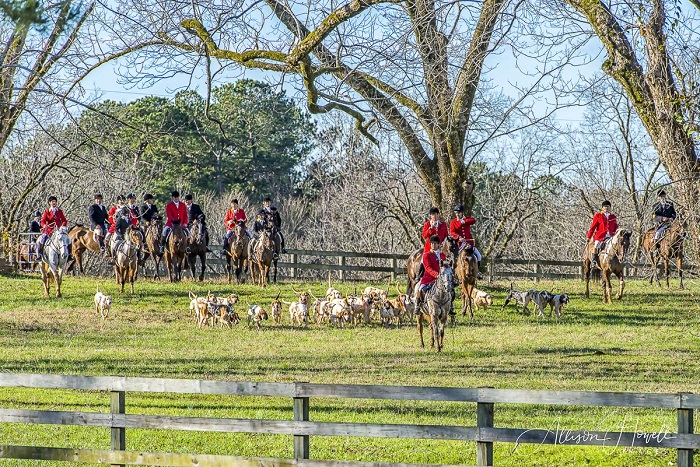
 Coming through the pecan grove at the Larry Knox summer house / Allison Howell photo
Three foxhounds from the Shawnee Hounds (IL) finished among the overall top ten scorers (out of twenty-four hounds that completed the trials) propelling Shawnee to first place among the six other competing hunts. Following Shawnee, in order of finish, were Hillsboro Hounds (TN) second and Tennessee Valley Hunt (TN) third. Other competing hunts were Belle Meade Hunt (GA), Midland Foxhounds (GA), Mission Valley Hunt Club (KS), and Bull Run Hunt (VA). The trials were hosted by Belle Meade in their Thomson, Georgia country on January 17-18, 2020.
Shawnee supporters were ecstatic as the results were announced. Not bad for first-season huntsman Kalie Wallace! Shawnee Master and former huntsman Dr. Mark Smith, who has been the brains behind the hunt’s breeding program, handed the horn over to Kalie at the start of this season.
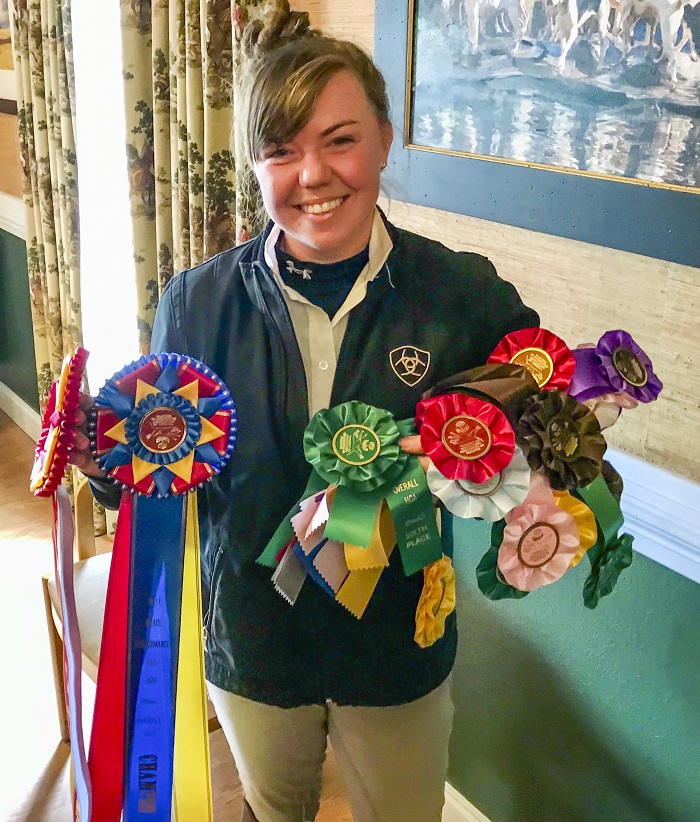 First year huntsman Kalie Wallace, rightly proud of her Shawnee hounds / Allison Howell photo
Kalie whipped-in to Mark for six seasons and served as kennelman for two seasons. She is also a recent graduate of the MFHA’s Professional Development Program. Her success is a credit both to her, Master Mark, and the MFHA program, which was developed more than a dozen years ago by current MFHA President Tony Leahy. Andrew Barclay, retired huntsman from the Green Spring Valley Hunt (MD), is the instructor for the program. Barclay, a 2015 inductee to the venerated Huntsman’s Room at the Museum of Hounds and Hunting at Morven Park, was an inspired choice for the instructor’s position.
Kalie has been hunting since the age of nine and according to Mark simply “got it” right from the start. “She always had horse sense—she trains and makes field hunters—and when she became kennelman it was clear to me that she also had hound sense,” Mark said.
She was proud and overwhelmed by the scores her hounds had racked up in competition against the other top-flight hunts. The overall top scoring individual foxhound was Hillsboro Gigolo, number 49, but Shawnee Jamie, number 65, was second in overall individual scoring. Multiple Shawnee hounds placed among the top ten hounds in every scoring category—hunting, trailing, full cry, marking and endurance—icing on the cake and an emotional few moments for Kalie as the scores were announced. Marking scores especially are rare in these trails, but Judge Rosie Campbell, MFH, Bull Run Hunt was there when the coyote was accounted for, and she was able to record the first-tier marking hounds.
“Do you want to enter hounds in the upcoming Belle Meade Performance Trials,” Mark had asked of Kalie weeks before.
“Sure, why not?” she replied immediately. Then came the time after arriving at Belle Meade on Friday when she actually saw the other hounds arriving from all these top hunts. What she had so blithely bargained for began to sink in, and the nerves hit, she admitted. But all of Mark’s hard work with her and her own work with the hounds began to reveal itself, she said.
“It was beautiful to watch our hounds fit in here with the others. We knew they were good hard workers, but to see them fit right into the pack and go to work like we knew they could was so rewarding,” she said.
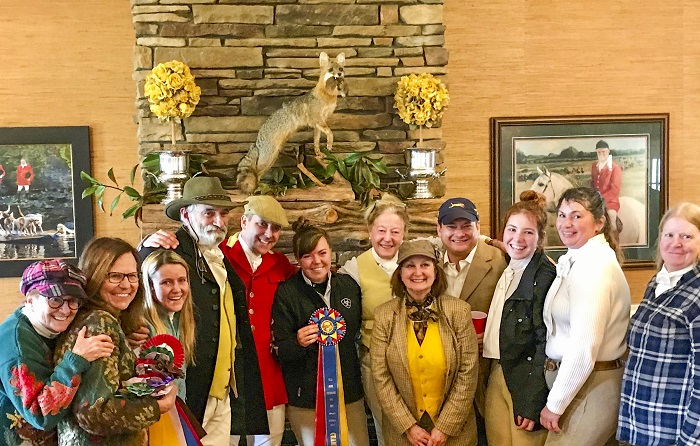 Shawnee supporters happily surround (l-r) Dr. Mark Smith, MFH; Trial Huntman Chad Wilkes, Shawnee huntsman Kalie Wallace, Belle Meade Field Master and stirrup cup hostess Jean Derrick, and scoring program guru Bud Eichel (rear). / Allison Howell photo
If there was a cloud that passed over this particular performance trial it was the deer problem on the first run of the first day’s hunting. No huntsman wants to see it happen for fear of influencing his or her own hounds adversely, but one has to realize that every individual hound in the combined pack at the outset knows only three other voices. The rest of the pack are strangers, which is often upsetting to many hounds in the first hour of the first day. If a nervous hound hears a familiar voice that for whatever reason has spoken to riot, he well may speak, induce others to speak, and before any staff member sees the actual quarry a full-fledged riot may be in progress.
And like the individual hound who recognizes only three other voices at this moment, huntsman and staff—who at home know which reliable hounds to look to for reassurance if they are unsure—don’t have that advantage at a performance trial. What follows is a report by Epp Wilson, MFH, Belle Meade, who was one of the judges. He explains how the deer running problem was handled by the judges, reports on the aftermath of that first day, and the excellent day’s hunting that followed. Epp rode up with Trial Huntsman Chad Wilkes, and his report comes from the front lines.
Epp’s Report
Handling the deer running was tough. Deer running problems happen here every few years. And this was one of those years. Hound number 14 started trailing in George’s Woods, the first covert. He led the trailing, followed by three or four others, all the way across the Dove Field and into the woods. We were suspicious as my dogs were not trailing, just looking back at me.
Had they all been mine I would have stopped them then. But we figured…hoped…they were just getting used to each other. We wanted to give them the benefit of the doubt. About a half mile later about 10 hounds were speaking, the others just following along not sure what to do.
A deer was seen close to the line the hounds were following, but that whipper-in was reluctant to say for sure…couldn’t say for sure…that they were running the deer. This happened two more times. We were very suspicious but didn’t want to stop them until we were absolutely sure. Then two deer crossed Wrightsboro Road in front of a dozen people—including people from multiple hunts—and John Eaton and David Raley, who know what is what. The pack was on the line for sure. The people had been there long enough to be almost positive that a coyote had not crossed in front of the deer.
So, we tried to stop the pack. Unfortunately, the people on the road did not immediately try to stop them. Several hounds kept going—four hounds, I think. We scratched them and confirmed the numbers with the road whips and with GPS signals showing they were continuing on north. We immediately drew away from that area. Hounds found about ten minutes later. Again, they did not sound right. About a half mile later we caught them red-handed again at the Brick Crossing and stopped them. The three that tried like hell to keep going…we scratched them, too.
By then everyone was on extra high alert for deer running. Chad and I got some dirty looks from a couple of folks for scratching their hounds. We got one angry comment from one huntsman. That huntsman apologized to me profusely later. Apology accepted. Heat of the moment. No harm done.
All scores for all hounds prior to 9:23 AM were thrown out. We had started hunting at 8:00. Three more hounds were scratched in the judges’ room once we gathered and confirmed all the notes from the deer running part of the day.
Getting back to the hunt, next we drew fresh territory. John Lemon, one of my whippers-in, viewed a coyote at Saundra Maxwell’s Coop, about 200 yards east of where we were drawing. We immediately harked hounds to it, they hit the line, and some split almost immediately onto a second coyote. It got a bit messy; each of the two groups were running correct game but scent was dicey and both groups were speaking off and on, struggling with the poor scent.
Two coyotes were viewed by John Eaton near Stage Coach Road, one going south and the other west. West was a good direction. We tried to gather the hounds off both the difficult lines and hark to the fresh view. We had about half the pack when they hit the line and they ran it a little better across two fields then struggled in the woods. More hounds joined us. The coyote was viewed again and we got a little closer to him. Hounds were following the line better. We finally got going in the right place, and hounds took the line across the pecan grove, a beautiful sight—sort of fast trailing or slow full cry. We were told a coyote had been viewed right where we and the hounds were working. Then someone else said it was only a hound. Hours later we heard that both a coyote and a hound had crossed there.
John Eaton thought the hounds were trailing heel on the line of the coyote he had seen running south about fifteen minutes before. Chad and I discussed it and decided to leave the hounds alone. When in doubt, that is the best thing to do ninety-five percent of the time. At least they weren’t running a damn deer. At that point we were happy to run a coyote heel the rest of the day, if that was in fact what we were doing! Hounds continued forward into the Pennsylvania woods, going along the line of the westward running coyote from twenty minutes before. Again, Chad and I didn’t care if we were working that line a second time; it was a whole lot better than running a deer. Hounds continued on and turned NW. Ha! Different line after all. Good line and scent was improving a bit.
Long story short: we spent the rest of the day running coyotes. At a long check at 10:45 we gathered hounds and had a beer and water break. Chad and I suggested that we hunt on as we had “lost” the first hour running deer. The other Masters and huntsmen agreed. Some more enthusiastically than others. Most of the field went in. We found another good coyote and ran him, rather trotted him, but scent still wasn’t great. Hounds almost broke down completely when the coyote went by the Hilltoppers who were headed home. Glad for the view, but we got some bad info as to the precise location of the view and wasted several minutes drawing in the wrong place. Hounds eventually sorted it out and scent improved. We ran him across the Dove Field and west toward the Brick Crossing, then across the Rhododendron Trail to the windswept clear-cut hill at the top of Grand Canyon. Crossing the creek at the base of the hill, whipper-in Anna Highsmith had viewed the coyote only thirty seconds ahead of the pack. Chad and I thought/hoped we were about to catch him. The wind proved too much. Hounds checked, circled, and circled some more. We drew around the huge piles of logging debris. No luck. We think he went to ground in one of those piles, but we will never know for sure. We were about a half-mile from the kennel, so it was time to go home.
Bad start to the day, but a great finish!
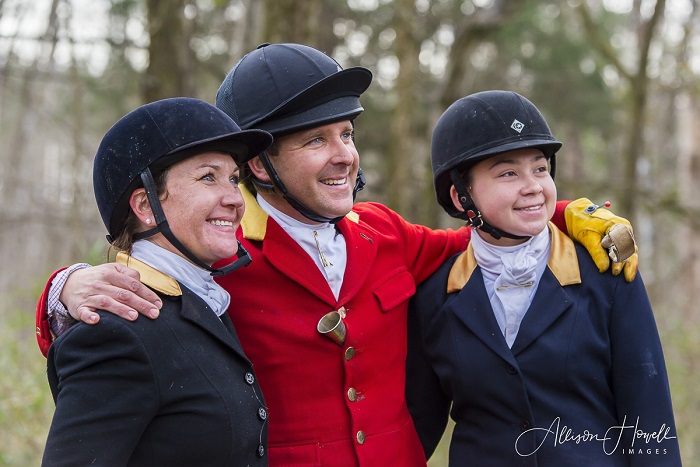 Trial huntsman Chad Wilkes, sister Tara Wilkes Cooper (left), and neice Emalaine Cooper (right) / Allison Howell photo
With regard to the scratches, we verified that at least two people had seen every hound running a deer before we scratched them. There were a couple of others hounds that were reported running deer by only one person. We made notes on them and did not scratch them. We were prepared to scratch them the second day if they were sighted again running deer.
We handled it the same way at Hillsboro two years ago. I kept a list of those numbers on an index card in my pocket—about a half dozen hounds. We scratched some the first day at Hillsboro and suspected others. Several of those hounds on my index card, were caught again running deer the second day at Hillsboro, and we scratched them on the first offense that second day. And the hunting got a lot better.
In total, we scratched ten hounds from five different hunts this day. Shawnee and Belle Meade had no deer runners.
Second Day
Having scratched ten hounds of the thirty-four that started on the first day, the second day—a great day—was with a pack of only twenty-four remaining hounds. Hounds worked well together and trusted each other. Great hound work for a quarter mile. Lots of hunting and trailing scores in the pecan grove. Barbara Lee viewed a good coyote in nearby McCorkle’s hay field going into our best country. We harked the hounds the quarter mile to the view, Chad put them on beautifully, and we ran this coyote all over our best country. The best part was galloping across Stage Coach Road, jumping the coop into Gentleman’s Hill, and galloping across that big, beautiful field with hounds in full cry just ahead of us. “Tally Ho, Coyote!” rang out again and again. I radioed for the mounted whips to keep him out of the airport area. “Make all the noise you can! Road whips blow your horns! Let’s keep him north of Wrightsboro Road!”
They were all in the right place at the right time, making lots of noise, but the coyote crossed the road anyway, as he often does, just east of the Hunt Barn at Harold Sims Coop. With great effort we stopped hounds, as we didn’t want to get any closer to I-20. We had all agreed in the judges meeting about where we would stop them. Nearly every hound was there. We had had twenty-five minutes going “just as hard as you could stick it,” as Hardaway used to say.
Chad and I were off our horses loving on the hounds and horning. Our horses were pretty cooked. We called for second horses as the run was so hard. We were about to catch our breaths when, “Tally Ho Coyote running north at the pipeline and Dead Cow Hill,” came over the radio. This coyote was viewed a quarter mile north of us and going further north into our best country. We double clutched, took a deep breath, swung into our saddles, and harked to the view. Whipper-in Brent Fisher directed us perfectly at the view, hounds hit immediately, and we were off and running again. No chance to switch to second horses even though they were in a horse trailer on the way.
This coyote ran north across Stage Coach Road. Perfect! As he turned toward Maddocks Creek—still swollen from the heavy rains—we thought he might cross the creek and head east toward federal highway US 78—a busy road. We would need to try to stop them pretty quickly if they crossed the creek, as we wanted to keep a mile off US 78 for safety. The last thing we wanted was for any hound, particularly a guest hound, to be hit in the road. Hounds ran beautifully to October Crossing. Barbara Lee was there waiting for them. Hounds swam the creek and tried on the other side. Half the pack was over, looking and searching. Then they swam back and found the line going along the shoulder on the west side of the creek, headed north toward the Boy Scout Cabin. Our quarry continued another half mile, all the way to the Cabin, where Judge Ryan Beer viewed him with the hounds in full cry close behind.
Coyote and hounds swam the creek and turned east up to Marvin’s Hill. We were getting prepared to stop hounds when they stopped on their own. The cry had changed from running cry to marking cry. Had they bayed him up? Had they caught him? Bull Run MFH Rosie Campbell was the first judge there. She got the scores—the hound numbers of the first dozen hounds. I got the numbers of the rest of the hounds as they came running up. It is imperative to get the numbers of the first hounds there. And the numbers of any getting there later. Even a moment later.
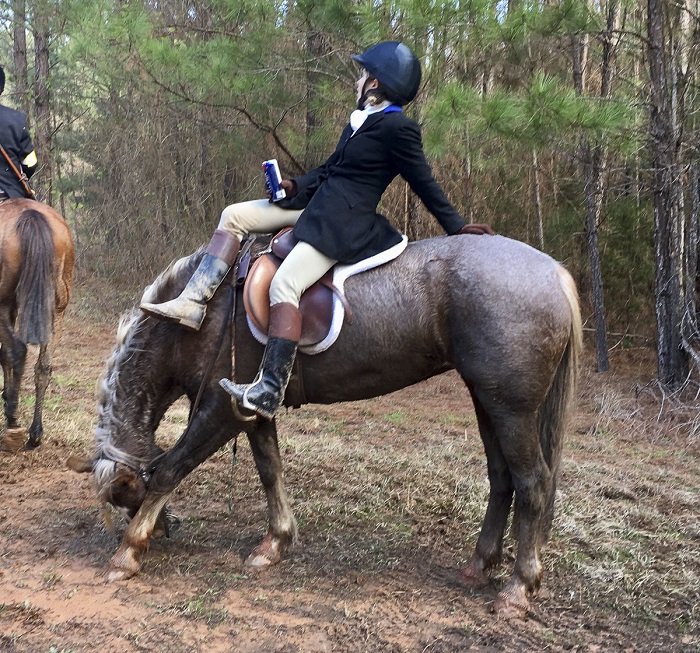 Anne Cobin, Shawnee Hounds, relaxes on Sawyer after the first day’s hunt. She adopted the little mustang mare out west as a feral horse, made her into a field hunter, and hunts first flight. / Allison Howell photo
The Mission
The whole mission of the scoring system is to give every hound all the credit he deserves. The first ones there get a primary marking score. And the others get a lesser score called secondary marking. This is only fair.
We had a great day and a great run and a marking event. It was 9:33 am. We had begun hunting at 8:00 am as planned and would normally have hunted until around 11:00. No need to do that today. We had all the sport and all the scores we needed. Horses were cooked. Chad’s horse had lost three shoes and lost the fourth one on the long ride home.
The multi-phase success of the second day proved that we had done the right thing by scratching the worst deer runners on the first day, if anyone still had doubts.
The judges’ scoring for the second day was quickly digested and combined with those of the first day and soon ready for announcement to the anxious competitors by the time they had finished lunch at Boots Hall. The scoring program, written by Belle Meade field members Jeb Blount and Bud Eichel, is universally used by all the MFHA-Sanctioned Performance Trials across North America.
Click for complete scores for each day and totals. Anyone interested in Foxhound Performance Trials, whether to learn more, attend, or participate with hounds, please email Epp Wilson, MFH, Belle Meade Hunt (GA), Fred Berry, MFH, Sedgefield Hunt (NC), or Cameron Sadler, MFH, Moore Country Hounds (NC).
Posted February 10, 2020