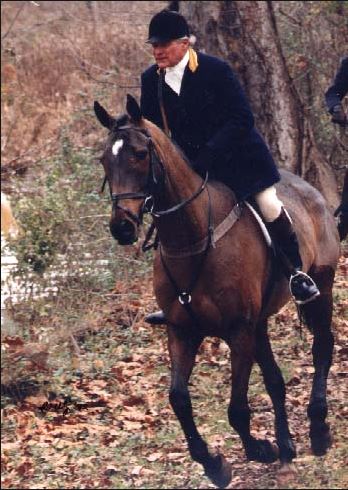
 The late Erskine Bedford led the field brilliantly for the Piedmont Fox Hounds for many years.
A good Field Master is a blessing for any huntsman. The converse is equally true.
Have you ever wondered why your Field Master follows closely upon the huntsman and hounds at times, yet at other times keeps you further back than you, as a keen field member, would like? A good Field Master is always dancing between what he or she knows you want and what he/she knows the huntsman needs.
Good Field Masters ride well, of course, and are confident in their ability to jump whatever comes their way. They also need to be well mounted. I have seen many a good-riding Field Master made to look pretty poor because they were on horses that were simply not cut out to lead across country.
Now, assuming these two requirements—riding well and jumping confidently—are met, we get to the tricky part. The Field Master and the huntsman should actually talk to each other Crazy as it may seem, though, some don’t.
Communication between huntsman and Field Master needs to be regular, and is crucial to the smooth running of a hunting day. The Field Master needs to know how close his huntsman likes the field to be to him when he is drawing for a fox or coyote. Some, like me, don’t mind the field being reasonably close so they can see hounds working. That’s how field members learn and expand their enjoyment of each and every hunting day. Some huntsmen, however, prefer that the field be kept well back. And sometimes, whether the field can be close or further back, depends upon the conditions of the day, the covert being drawn, the time of the season, how scent lays, or a myriad of other factors.
As a huntsman, I want the field to be close enough to see me and the hounds working. However, if they are pressing too close behind me then they could get in the way of the hounds and the draw. We need room to draw the covert in any direction we feel we want to explore, and that sometimes includes behind us where we have just come from. You may ask why would I do that?
Well, If hounds have not drawn a covert particularly well or thoroughly then I will sometimes turn and make them do it again This time with more care and determination to ensure they don’t miss an inch. For those of you blessed with a fox or coyote in every covert … well … lucky you Not every hunt country is the same and not every hunt country has plentiful game in it
Sometimes this can also involve me getting off my horse and walking the hounds through a covert. You will see this occasionally, particularly during cubbing when foxes will sit tight and let hounds draw past them. If it’s a poor scenting day it’s not hard for hounds that are rushing or being pushed by an over-eager Field Master to miss one
So the Field Master not only needs to know his huntsman and his style of hunting, he also needs to know the country well so he can anticipate what is likely to happen at any given point in the day. If you add to these requirements the need to know every landowner whose land we are hunting on that day and if any of them would rather we not come through then you can begin to see that being Field Master is no easy task
One of the best Field Masters I have ever seen in action was William Crosby Dawson at the Tedworth in Wiltshire. He ruled his field not so much with a rod of iron but more a tickle of a feather He was very in tune with what was going on at any given time and rarely, if ever, got left out of a run because he and the field were coffee housing or enjoying the odd flask.
He kept everyone just back enough for the liking of the huntsman and close enough for the field to see the hounds working. We did not have radios then so the old fashioned way was to wait for the ‘gone away’ to be blown before he kicked on after hounds.
He also had that ability to be both firm but fair and he always made everyone feel welcome and part of the ‘team.’ At a check, if he noticed the huntsman walking quietly with his hounds, he would make sure his field were quiet throughout the check and would only start moving again once hounds had recovered the line and were hunting on again. It’s actually a very simple system that works well. Most important of all he made it fun
The huntsman has his part to play of course; he must make sure the hounds are actually gone before blowing gone away Nothing is more frustrating for the field to be stopped after one jump because the fox has turned back into covert and the huntsman is now heading back towards you The huntsman must let it go on its way without too much fuss. Once the huntsman knows the fox has truly gone away, that’s the time to blow it
That should then be the signal for the Field Master to shorten his reins, push his hat down, and kick on The riders behind him will soon see the benefit of this system and can pass that knowledge on down to those who come after us.
It’s also very helpful if the Field Master can make light of any problems that occur during the day; after all it’s meant to be fun If he or she feels they need to correct something a member has done then that should be done quietly, away from prying ears and most certainly not at the tailgate for all to hear.
Some field members occasionally do need telling It’s how the Field Master tells them that makes it a learning process and not a scolding. You may wonder after reading all this why anyone would volunteer to fill this roll. It’s fortunate for us as huntsman and you as members of the field that so many still do. Hopefully this will help you appreciate some of what the Field Master does, and why he does it one way one day and another way the next.
Posted August 21, 2019
Andy Bozdan carries the horn for the Camargo Hunt (OH).