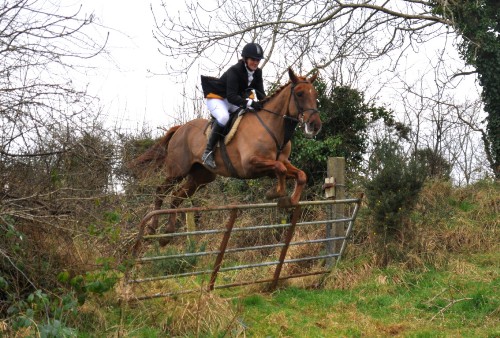
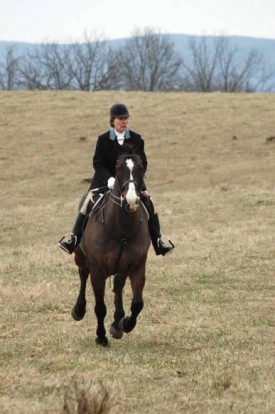
Lillian Doyle, five-times ladies point-to-point champion, out with the Wexford from a meet at her father's pub / Noel Mullins photo
What better place to end the season than with the Wexford Foxhounds at John Jude Doyle’s Cloch Ban Pub in Clonroche, County Wexford? Inside there is a picture on the wall of Bree Foxhounds Joint-Master Jay Bowe having a drink sitting on his horse beside the bar!
Doyle is a director of The Irish Horse Board and Horse Sport Ireland, and one can see why. He has an infectious enthusiasm about the Irish horse as a breeder, producer, and organiser of schools, shows, and gymkhanas. He has campaigned his Irish Draught mare Cloghbawn Cailin and her filly Cloghbawn Liaght on the show circuit. Doyle’s daughter Lillian won the Ladies Point-to-Point Jockey Championship five times. His uncle Jim Joyce bred Parkhill, evented by the late Col. Ronnie MacMahon, and his track greyhound Temple na Dubh won seven nights in succession in Shelbourne Park!
Master and huntsman Mary Kehoe is gifted as a handler of horses and hounds and has hunted the Wexford Foxhounds for nine seasons and the Bree Foxhounds for the last twenty-three seasons, hunting hounds four days a week. Her sister Muriel whips in to her. Their father Owen was Field Master of the Island and hunted the Bree. The other whippers-in are Michael Condon, a formidable rider, and former jockey Padraig English, who won three races on the great steeplechaser Danoli. All of them hunt across country on a simple mathematical principle: the shortest distance between two points is a straight line, and whatever obstacle is on that line is crossed regardless of complexity! But they can because they produce and ride only the very best hunt horses.
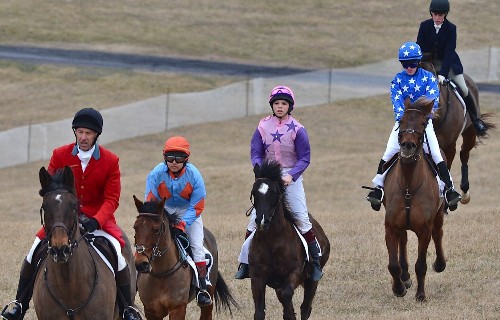
In the Junior Field Masters Chase, Brett Jackson, MFH leads (l-r) Erin Swope on Jordan, Kelly Witte on Missy (small pony winner), and Emme Fullilove on Sparta (large pony winner). / Douglas Lees photo
Thornton Hill Fort Valley Hounds opened the Virginia point-to-point season on Saturday, March 2, 2013 at Thornton Hill Farm in Sperryville. The first race, the Field Masters Chase for horses and small and large ponies, was followed by four races over hurdles, two flat races, and three timber races.
Kelly Witte on Missy, last year’s leading small pony, came to the wire six lengths behind the large ponies and won her division. Last year’s large pony champion Jordan ran just behind the Field Master but lost his rider Erin Swope at the last fence, giving Sparta the win with Emme Fullilove aboard. Emme also won the division for horses on GR’s Prize, holding off Erin Swope's Sweet Talking Guy in the stretch. Bay Cockburn saddled both winners.
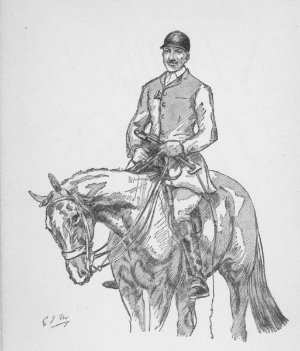
Colonel John Weatherford, MFH / Illustration by Eleanor Iselin MasonThis week's Bonus article, free to all, no subscription necessary. Gordon Grand is one of my favorite sporting authors, and his short story, “The Silver Horn,” is one of my favorite foxhunting stories. The reader is transported, in the early part of the twentieth century, to “that venerable hotel on Albemarle Street” in London, which we may readily assume is Brown’s Hotel. Colonel John Weatherford, MFH is relating Florence’s story as she told it to him upon their chance meeting in the hotel dining room after breakfast. I have extracted just the kernel of the story to reproduce here.
Returning from the theater and supper [Florence] had drifted off into a sound sleep, from which she was gently and fancifully awakened without sensing the cause. Her watch showed three o’clock. The roar and rumble of London had faded to its lowest murmur. A midsummer moon filtered through and illuminated the street below. What was it that had so illusively awakened the sleeper? Again she listened. The faint mellow note of a hunting horn drifted up from Piccadilly.
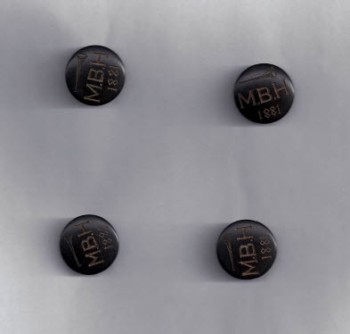
It began with a subscriber’s question. Vicki Reeves wrote, “A friend inherited some hunt buttons which have a hunting horn on them and "M.B.H. 1881." How can I find out what hunt they represent or any additional information about the buttons?”
Foxhunting Life was able to identify the buttons as those of the Meadow Brook Hunt (NY). Once that was established, the owner of the buttons, Connie Rhodes West from Tampa, Florida was able to surmise the likely provenance of the buttons back through family history. Her story was so interesting, and the chronicle of the fabled Meadow Brook Hunt is so extravagant, we thought our readers would enjoy a trip back to those bygone days.
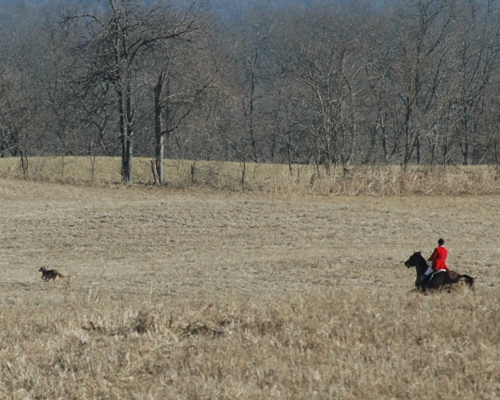
Whipper-in Neil Amatt races to get between hounds and coyote, turns to stop hounds.
Nancy Kleck is a sporting artist who follows the hunt with her camera to record action images of hounds, horses, riders, and foxes for later use in her paintings. She rides with former Blue Ridge huntsman Chris Howells, now a wheel whipper-in, and has discovered that her photos are of use not only to her in her art, and not only to the field members for their enjoyment, but sometimes even to the staff. Nancy writes:
I’ve been following the hunt nearly every meet since huntsman Guy Allman and first whipper-in Neil Ammatt came on board. I've gotten some fun photos as a hilltopper, and it's been a really interesting perspective, listening for the horn, trying to interpret it, and keeping an eye out for anything that moves with a brush!
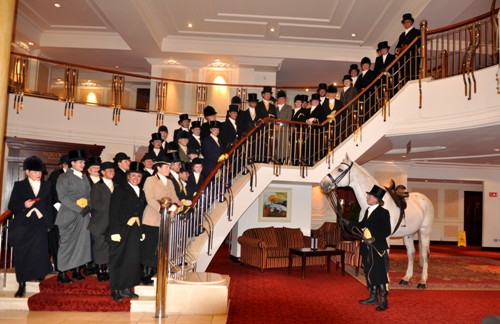
Side saddle meet organizer Susan Oakes with her stallion, SIEC Atlas, at The Knightsbrook Hotel in Trim before the meet
The Ladies Side Saddle Hunt at Boyerstown, County Meath in Ireland was the brainchild of the Meath Foxhounds Masters and side saddle enthusiast Susan Oakes who is the current British side saddle high jump record holder at five-feet-nine-inches. (At Aintree last year Susan just rolled the top pole in her attempt at the world record of six-feet-six-inches.)
The meet, or was it a Ladies Gathering, was a world record turnout of lady side saddle riders seen in any hunt country. Up to fifty ladies from Ireland, USA, England, Scotland, Wales, France, Italy, Sweden, and Belgium descended on County Meath, and what an impact they made. It was like a scene from the last century when ladies still rode side saddle, with high standards of hunting dress, style, and elegance.
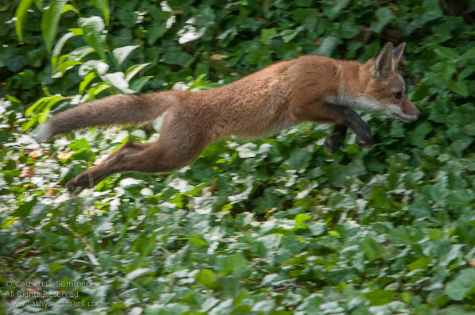
Cathy Summers photo
As a followup to our recent piece on the coyote, here’s that same naturalist’s description of the red fox. As before, I’m unable to provide a reference, book title, author, publisher, or date for this excellent bit of wood lore. If any reader recognizes it and can identify the source, we will publish that information in a future issue.
The red fox (Vulpes fulva) is one of the best-known characters in history and legend, widely spread over the temperate and northern regions of the world. For its combination of beauty and grace and intelligence it has had the attention of artists, poets, and naturalists, and merits the attention of those who would read the signs of the out-of-doors.
The author, leading the field / Nancy Kleck photoMasters, staff, and field of the Blue Ridge Hunt are thankful for the recent Martin Luther King holiday. We always advance the meet from our usual Tuesday to any Monday holiday to give the juniors a chance to hunt. With the Virginia hunting country enveloped in sub-freezing arctic air on Tuesday, Monday’s “storybook” hunt—fifty-five minutes on one fox—was a special gift.
The meet was at Catherine Berger’s Rolling Hills Farm. Hounds found their fox in the first covert where it was viewed across the open fields by a car follower. Before horses were even warmed up, we found ourselves racing to the first fence—a brand-new, raw, double-wide coop standing high on its timbers.