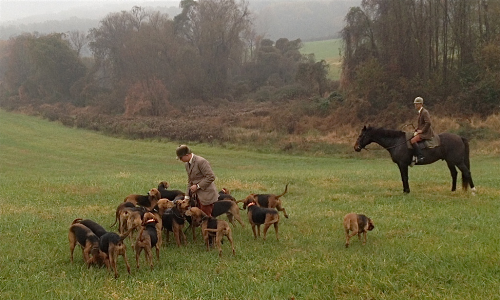
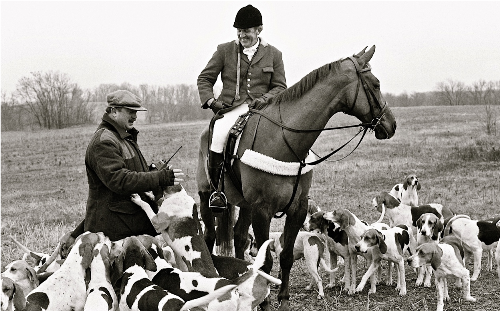
Andrews Bridge first-year huntsman Adam Townsend praises hounds for their work. Mounted rider is whipper-in Charlie Fleischmann.
Adam Townsend joined the Andrews Bridge Foxhounds (PA) this past April as its first professional huntsman in many years. Adam came to us from the Elkridge-Harford Hunt (MD) where he served as first whipper-in for the last three seasons. Since his arrival he has been working diligently with our pack of Black & Tan Penn-Marydels. Each day’s hunting has shown excellent sport but on Monday, October 28, 2013, Adam's efforts were rewarded with a red letter day.
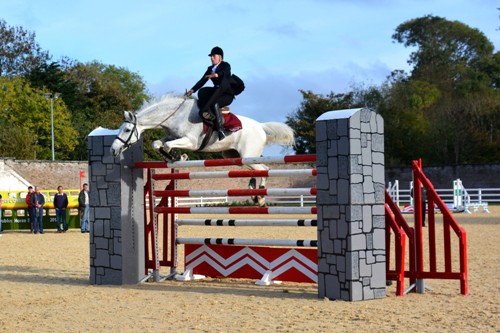
Susan Oakes establishes new side saddle record for jumping triple bar at six feet, four-and-a-half inches from ground level. / Noel Mullins photo
Susan Oakes—Joint-Master of the Grallagh Harriers and the organizer of last year’s international ladies’ side saddle hunt with the Meath Foxhounds—set two side saddle high jump world records at the Irish National Sports Center on October 24, 2013.
Oakes jumped six feet, eight inches over a puissance wall, breaking her own record of five feet which she established just this summer at the RDS Dublin Horse Show. Then she established a world record of six feet, four-and-a-half inches for jumping a triple bar from ground level.
A world record of six feet, six inches for the triple bar set in Australia in 1915 still stands unbroken, but that record was established by jumping off a ramp. Foxhunting Life reported on Oakes’s attempt to break that record last year and also reported on the international ladies’ side saddle hunt that Oakes organized at the Meath last year. Fifty ladies from nine countries including the U.S. participated in that elegant affair.
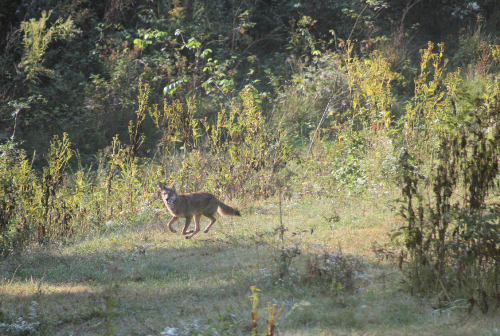
Pony Field meets coyote / Gretchen Pelham photo
I was standing on the line with my helmet off, pointing into the woods after the coyote. The lead hound, Ariat (a black and tan Penn-Marydel), came up the little rise and opened when she hit the line true. The rest of the pack was with her and off they went. Only a few seconds later, huntsman Ryan Johnsey flew past us over the coop next to our gate.
I was leading what I dubbed the Pony Field at our cub hunt at Tennessee Valley Hunt’s Big Valley fixture. I had only two other members in my field, but all three of us were on ponies. One of the girls was a junior, and the other had turned eighteen only a few months earlier.
I decided to stay out of the woods and follow the lake’s edge since the coyote had been circling around the whole day. My junior asked, “Is the coyote circling because this is his home territory? Because if he was just passing through then he would have run straight out of country, right?” Wow. The girls have been listening to me jabber on about hunting!

Tracey Cover receives Championship trophy from (l-r) Catherine Berger and Linda Armbrust, MFH. / Betsy Parker photo
Tracey Cover from the Middleburg Hunt swept the boards at the 2013 Virginia Field Hunter Championship on Sunday, October 20 with her elegant bay, Brandywine. Judged Best Turned Out early in the day, she went on to win the 2013 Virginia Field Hunter Championship against a highly competent field of riders on some brilliant field hunters. The event had been postponed one week due to a three-day rainfall that dumped seven inches of rain on Virginia’s hunting country.
This year’s championships were hosted by the Blue Ridge Hunt at Woodley in recognition of Barbara Batterton’s win on Linda Armbrust’s Nicki in 2012. Woodley, the home of Brooke and Michelle Middleton, is the well-known venue for the Blue Ridge Hunt Point-to-Point Races and the Blue Ridge Fall Races. Spectators are able to view nearly the entire racecourse panorama from a gently rising hillside along the eastern edge of the course.
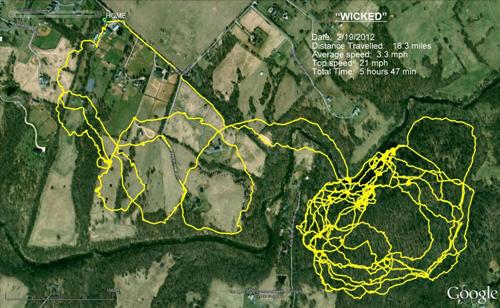
Roger Collins in Middleburg, Virginia owns several retired foxhounds—“some more retired than others,” explains his friend Liz Williams, who sent us this GPS track. Roger fitted Wicked, a Penn-Marydel female (we must use the graceful word here, lest some computer firewalls mark us as Spam!) with a Garmin GPS DC-40 tracking collar and downloaded her track, complete with statistics of her jaunt, to Google Earth with the Garmin Astro 220 base unit.
Wicked started from home (upper left) traveling in a southerly direction, found a fox, made three big loops easterly primarily clockwise, from whence her fox abandoned the open fields and struck out for the woods (bottom right). There he remained, circling countless times, Wicked doggedly on his trail. Finally Wicked broke off the chase in the area where she kept having trouble with the line and struck out for home in the most direct route available, across the creek, along the edge of a field where she broke out onto Miller Road and straight home.
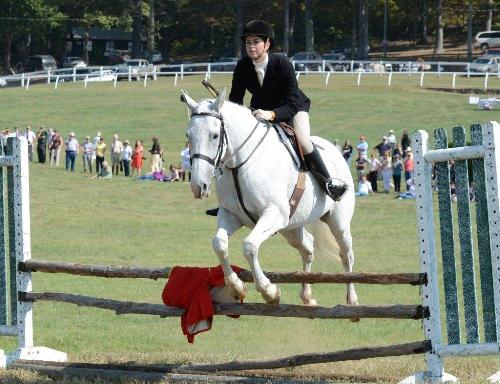
2013 North American Field Hunter Champion Greyland Woods, owned by Karen Mantz and ridden by daughter Teresa Croce, jumps to victory over Judge Jean Derrick's scarlet coat (Belle Meade colors). / Liz Callar photo
Blistering hot weather visited Virginia for the past four weeks. While not unusual this time of year, the length of the hot spell, with temperatures hovering in the high eighties and even reaching into the low nineties, has proved miserable to man and beast alike, but it failed to deter foxhunters who entered this year's North American Field Hunter Championships.
On Monday, September 30, the Championships began at Keswick. Hounds met at Glenwood, a fixture in the neighborhood of James Madison's Montpelier, outside the town of Orange. Contestants from as far away as Florida and Georgia traveled to compete in the event, as well as to enjoy early autumn hunting in Virginia. They were not disappointed. Keswick huntsman Tony Gammell provided a fine day of sport in the lovely rolling countryside as hounds ran across the nearby road, back again, and beyond the fixture into a scenic expanse of woods and cornfields. Afterward, everyone enjoyed a tailgate as five contestants were selected for the finals.
On Tuesday, October 1, hounds met at Owl Run Farm in Warrenton, home of Casanova Hunt Joint-Master Mrs. Joyce Fendley. Previously the home of Donna and Jack Eicher, huntsman at Rombout and later Farmington Hunt, the grounds include a lake and a cluster of graceful weeping willows out front. The residence and barns all exude the charm of old Virginia Hunt Country—weathered stone, stout board and batten, low eaves and metal roofs. A special surprise awaited the field this morning when shortly after casting hounds, an eruption in a cornfield revealed that hounds had encountered a black bear! Fortunately, the pack obeyed their orders to ignore the bear as it beat a hasty retreat. The remainder of the morning proved quieter, and as the field hacked in, Mrs. Fendley positioned herself, as she always does at the end of a hunt, such that she could personally thank everyone in the field as they passed by on their way to their trailer. This small but thoughtful act is just one of many that make hunting in Virginia so special and unique. It was a hot, thirsty, and tired field that gathered under a tent to drink and devour a delicious crab dip while recalling the excitement of having gone on their first bear hunt! This morning, six finalists were announced.
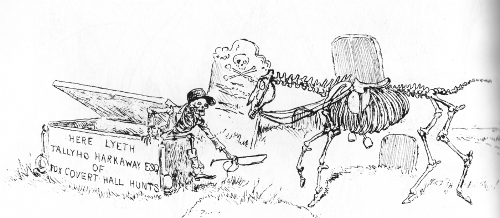
"Peel's view-halloo would waken the dead" / Illustration by Frank Paton from "The Songs of Foxhunting" by Alexander Mackay-Smith, 1974
Like Tom Moody, John Peel owes his celebrity to a song, though I am bound to say that the Cumberland huntsman was far more worthy of such a distinction than the Shropshire whipper-in. And what canny Cumbrian is there, the wide world over, whose heart is not stirred within him by the dear, familiar words and tune of “D'ye ken John Peel,” even as the hearts of his Scottish neighbours across the Border are stirred by “Auld Lang Syne”!
It has been sung in strange places, that famous Cumberland hunting-song. Its chorus rang out hearty and homely from the huts at Balaclava and the dreary trenches before Sebastopol. It cheered the spirits of the band of beleaguered heroes in the Residency at Lucknow. The future King of England, our jolly sport-loving Prince, has been known many a time to join lustily in its spirit-stirring chorus. I myself have heard it sung on the boards of Drury Lane by some seventy comely lasses, whose shapely figures, clad in the hunting costume of the other sex, made one of the prettiest pictures I ever saw upon the stage, and gave an effect to the song which roused the audience to enthusiasm.
And yet, world-famous as the song is, I don't suppose that one person in a thousand knows who wrote it, or has the faintest notion who or what John Peel was beyond the fact that he was fond of hunting. Indeed, I have often heard the question asked, whether John Peel was a real person or merely a mythical hero. Well, that question is easily answered.
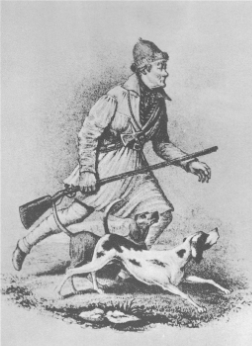
Jonas Cattell from "Memoirs of the Gloucester Foxhunting Club" by William Milnor, Jr., Philadelphia, 1830Jonas Cattell, foxhunter and revolutionary hero, will be honored with a seven-foot bronze statue to be erected in Haddonfield, New Jersey. We foxhunters know about Cattell’s exploits in the hunting field thanks to Alexander Mackay-Smith’s classic book, The American Foxhound: 1747–1967, but I never knew about Cattell’s heroism during the American Revolution. He turned the misfortune of his arrest by Hessian mercenaries into advantage for the Colonial cause.
Cattell whipped-in for the Gloucester Foxhunting Club, the first organized foxhunting club in North America. It was founded in 1766 by a group of Philadelphia gentlemen and named for Gloucester County, New Jersey, directly across the Delaware River. According to Mackay-Smith, quoting Clifton Lisle describing their sport, “When Cupid, the huntsman who succeeded Old Natty, was in the saddle with Jonas Cattell whipping-in to him, amazing runs were made.”
“In 1798, for example, one is recorded that went to Salem, a distance of forty miles by the map from find to kill. Another ended on the ice of the Delaware, a Jersey fox crossing it with fifteen couple of hounds not a hundred yards from his brush—to be rolled over just short of the Jersey shore. Robert Wharton, president of the club at that time, was the first man up, next to Jonas Cattell, the whipper-in, who had crossed the river on foot.”