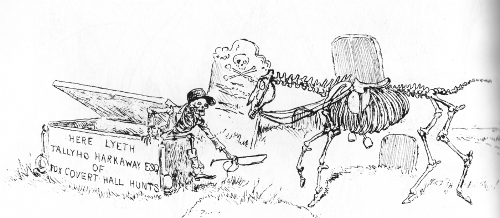
 “Peel’s view-halloo would waken the dead” / Illustration by Frank Paton from “The Songs of Foxhunting” by Alexander Mackay-Smith, 1974
Like Tom Moody, John Peel owes his celebrity to a song, though I am bound to say that the Cumberland huntsman was far more worthy of such a distinction than the Shropshire whipper-in. And what canny Cumbrian is there, the wide world over, whose heart is not stirred within him by the dear, familiar words and tune of “D’ye ken John Peel,” even as the hearts of his Scottish neighbours across the Border are stirred by “Auld Lang Syne”!
It has been sung in strange places, that famous Cumberland hunting-song. Its chorus rang out hearty and homely from the huts at Balaclava and the dreary trenches before Sebastopol. It cheered the spirits of the band of beleaguered heroes in the Residency at Lucknow. The future King of England, our jolly sport-loving Prince, has been known many a time to join lustily in its spirit-stirring chorus. I myself have heard it sung on the boards of Drury Lane by some seventy comely lasses, whose shapely figures, clad in the hunting costume of the other sex, made one of the prettiest pictures I ever saw upon the stage, and gave an effect to the song which roused the audience to enthusiasm.
And yet, world-famous as the song is, I don’t suppose that one person in a thousand knows who wrote it, or has the faintest notion who or what John Peel was beyond the fact that he was fond of hunting. Indeed, I have often heard the question asked, whether John Peel was a real person or merely a mythical hero. Well, that question is easily answered.
John Peel was a real person, and a remarkably fine specimen of the good old sporting Cumberland yeoman, or statesman, as they call the class up there. The ancient race of yeomen, now fast dying out, almost extinct indeed in many parts of England, was the best breed of Englishmen this island ever nurtured—stout of heart, sturdy of limb, wielders of the terrible English long bow, stubborn sticklers for their rights as freemen, and royal good sportsmen all. Was not the Achilles of our English Iliad, bold Robin Hood, a yeoman, and prouder of his descent than any Norman baron of them all? I know that a foolish attempt has been made to show that Robin was an out-lawed nobleman. But in the real, genuine old Robin Hood Ballads, before all the spurious rubbish about Maid Marian was introduced, the hero is always styled yeoman, and it is because he was a type of the true English yeoman that he has retained his popularity as our great national ballad hero.
Of this good stock came John Peel of Caldbeck. He was born on the 13th of November 1776, and he lived for the greater part of his life, after he came to manhood, at Uldale, not far from his birthplace, between Brocklebank Fell and the High Pike. A fine stalwart specimen of a Cumbrian dalesman he was, six feet one inch in his stockings, big-limbed and broad-shouldered. His passion for the Chase was born with him, and showed itself from the time he was able to throw his leg across a pony’s back. That he was of a bold, independent spirit was proved by his romantic marriage. He had set his affections on a young woman named Mary White, the daughter of a farmer at Uldale. He was twenty and she was nineteen, and, without troubling to consult their respective parents, the young couple resolved to get married. There was no secrecy about the affair. John went straight to the parson of Caldbeck, handed in the names of John Peel, bachelor, and Mary White, spinster, both of that parish, and desired that the banns should be read out for the first time the following Sunday.
The announcement that these two persons contemplated being joined together in holy matrimony caused the liveliest astonishment among the congregation. But none were more amazed than the parents of the prospective bride and bridegroom. Up sprang Mary’s mother from her seat and promptly forbade the banns, adding in tones of warm indignation, “They’re far ower young.”
So strong was the parental opposition on both sides that there was no second time of asking, and the young lovers apparently acquiesced in the decision of their elders. But, like Brer Fox, they “lay low,” and, finding that there was no chance of inducing their parents to consent to their early union, they took the law into their own hands.
One night, when the old folks were abed, John went to his father’s stables, selected the stoutest and fleetest horse there, Binsey, saddled him with a pillion, mounted and set off for Uldale. At the appointed signal beneath the window, Mary stole out, was swung by John’s strong arm into the pillion, and away they rode for Gretna Green. So cleverly was the elopement planned that the old folks at Uldale and Caldbeck had only just realised that the pair had levanted, when John Peel’s stentorian view-halloo was heard outside his father’s homestead; and, coolly dismounting, he helped Mary from the pillion and formally introduced her to the astonished parents as his wedded wife. Of course there was a flare-p at both houses. But there was no getting over the fact that the young couple were fast-buckled, and the only thing to be done was to make the best of it. So, the truant lovers were forgiven, and Parson Lynn of Caldbeck was called upon to marry them over again in the parish church, that there might be no mistake about the knot being legally and irrevocably tied.
The saddle and pillion upon which the stout nag Binsey bore the lovers to Gretna Green twain, and brought them back one, are still preserved in the family of John Peel’s eldest son, who lived to the patriarchal age of ninety and died but eleven years ago. Unlike many persons who marry in haste to repent at leisure, John and Mary Peel never had any reason to regret their romantic flight across the Border. Their union was a happy one, and John became the proud father of thirteen children, the eldest of whom, a boy was a thorough chip off the old block and as keen a sportsman as his sire.
I have described John Peel as a huntsman, but he was really far more than that. For, though not what you could call a Master of Hounds, he for fifty-five years kept, solely at his own expense, a pack, usually of twelve couples, which he hunted and whipped-in himself, till his son, young John, was old enough to act as his whipper-in. The pack was a mongrel one of all sorts and sizes, but the hounds were rare good ones for work, though that work would have made the hair of a Master of the Quorn stand on end with horror. For John boasted that they would hunt anything from a rabbit to a sheep. They had some of their best sport with hares. As for the fox, he was regarded by these sporting dalesmen as vermin to be hunted down and slain without mercy. Reynard played too much havoc with the young lambs to be allowed any of the honours and privileges now assigned him. When there was a fox-hunt on, the dalesmen assembled mostly on foot, for their quarry was pretty safe to lead them where horses could not follow, and John Peel’s nondescript pack was reinforced by every kind of dog in the neighbourhood, “mongrel, puppy, whelp and hound, and cur of low degree.”
His own knowledge of the country for miles around was extraordinarily minute and accurate, and when a fox was started he was seldom at fault as to the line it would pursue. Among John Peel’s many sporting friends was one John Woodcock Graves, a native of Wigton, who, as a lad, had hunted with the hounds of Joseph Steel of Cockermouth, a noted sportsman. When he was about in mid-manhood Graves came to Caldbeck and started a woollen mill there. Being still a keen sportsman, he speedily made the acquaintance of John Peel, with whom he had many a good day’s hunting. Graves was an extraordinary walker, and it was said that there was not a horse in the dales that he could not tire out. His admiration for his friend Peel as a sportsman was enthusiastic. He was, amongst his many accomplishments, a bit of an artist, and painted a portrait of John which is still preserved in the family. As a likeness it is said to be excellent, but the execution is faulty and betrays the hand of the crude amateur. But what John Woodcock Graves could not do with his pencil he has done with his pen. He has immortalised the mighty hunter of Cumberland in the famous song which one may safely prophesy will live as long as the English language.
The author of “D’ye ken John Peel” gives the following account of its composition: “Nearly forty years have passed since John Peel and I sat in a snug parlour at Caldbeck among the Cumbrian mountains. We were then both in the heyday of manhood, and hunters of the older fashion, meeting the night before to arrange the earth-stopping, and in the morning to take the best part of the hunt, the drag over the mountains in the mist, while fashionable hunters lay still in their blankets. Large flakes of snow fell that evening. We sat by the fireside, hunting over again many a good run, and recalling the feats of each particular hound, or narrow, break-neck escapes, when a flaxen-haired daughter of mine came in, saying, ‘Father, what do you say to what Grannie sings?’ Grannie was singing to sleep my eldest son—now a leading barrister in Hobart town—with an old rant called ‘Bonnie Annie.’ The pen and ink for hunting appointments being on the table, the idea of writing a song to the old air forced itself upon me, and thus was produced, impromptu, ‘D’ye ken John Peel with his coat so grey’? Immediately after, I sang it to poor Peel, who smiled through a stream of tears that fell down his manly cheeks: and I well remember saying to him in a joking style, ‘By Jove, Peel, you’ll be sung when we’re both run to earth!’”
Seldom has a prophecy been more remarkably fulfilled. The grand rolling rhythm of the words, set, as they have been, to fine swinging music by Metcalfe, has gained the song an extraordinary popularity far beyond its merits as a literary composition. The original manuscript, in the Cumbrian dialect, is now in the possession of Mr. Iredale of Dalston, near Carlisle, and the following is a correct transcript of the song as rendered subsequently by the author into common English:
D’YE KEN JOHN PEEL?
D’ye ken John Peel with his coat so grey?
D’ye ken John Peel at the break of the day?
D’ye ken John Peel when he’s far, far away,
With his hounds and his horn in the morning?
‘Twas the sound of his horn call’d me from my bed,
And the cry of his hounds has me oft-times led;
For Peel’s view-halloo would waken the dead,
Or a fox from his lair in the morning.
D’ye ken that bitch whose tongue is death?
D’ye ken her sons of peerless faith?
D’ye ken that a fox with his last breath
Curs’d them all as he died in the morning?
(Chorus) ‘Twas the sound of his horn, &c.
Yes, I ken John Peel and auld Ruby, too,
Ranter and Royal and Bellman as true,
From the drag to the chase, from the chase to the view,
From the view to the death in the morning.
‘Twas the sound of his horn, &c.
And I’ve followed John Peel both often and far,
O’er the rasper-fence, and the gate and the bar.
From low Denton-holme up to Scratchmere Scar,
When we vied for the brush in the morning.
‘Twas the sound of his horn, Sic.
Then, here’s to John Peel with m’ heart and soul.
Come fill — fill to him another strong bowl:
And we’ll follow John Peel thro’ fair and thro’ foul
When we’re wak’d b’ his horn in the morning.
‘Twas the sound of his horn, &c
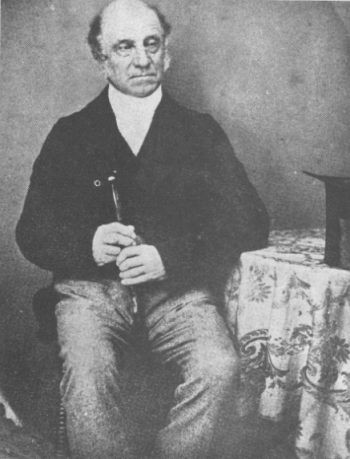 Believed to be a photograph of John Peel taken in Carlisle near the end of his career / From “The Songs of Foxhunting” by Alexander Mackay-Smith, 1974A few further details of the now-forgotten author of the most popular of hunting songs may not be out of place. John Woodstock Graves has published his reminiscences, and, amongst other incidents in his life, tells the story of his marriage, which, though not as romantic as that of his friend John Peel, is certainly redeemed from commonplaceness by its quaintness.
“I thought,” he says, “I would marry a neighbour’s daughter whom I had known from childhood. I was daily in her father’s house. One evening I had stayed late, reading in the parlour. She was sewing, the rest of the family had retired. After asking what o’clock it was, I laid down the paper, and placing my arms on the table, said to her: ‘Miss Porthouse, I’ve been thinking some time of putting aquestion to you.’ ‘And pray,’ asked she, ‘what kind of a question is it? A foolish one, I’ll warrant.’ ‘I’ve been thinking,’ said I, ‘of proposing marriage to you.’ She started, looked me sternly in the face, then, without a single word, snatched up the lighted candle and indignantly stalked away upstairs and slammed the door.
“However, we were married afterwards, and had eight children.” Was ever love story told in more bald, prosaic style, and by a man, too, who was a bit of a poet?
Graves emigrated to Tasmania, settled in Hobart town and died there, on the 17th of August 1886, at the great age of ninety-one, two-and-twenty years after the death of the friend whom he has immortalised. Graves, who was himself a man of some education and culture, has left this estimate of the character of John Peel. “He was a man of very limited education beyond hunting, but no wile of fox or hare could escape his scrutiny; and business of any shape was utterly neglected, often to a cost far beyond the first loss. An excellent rider, I have seen him once on a moor put up a fresh hare, and ride till he caught her with his whip. You may know that he was six feet or more, and of a form and gait quite surprising, but his head and face were somewhat insignificant. A clever sculptor once told me that he once followed him, admiring him, a whole market day before discovering who he was. He was generous and true-hearted, and indeed a better heart never throbbed in a human breast.”
So devoted was John Peel to the sport he loved that he cared not what sacrifices he made to enable him to meet the expenses which his hounds and his couple of first-rate hunters entailed upon him. Whenever he was a little embarrassed for want of money, he would sell a bit of land to tide him over the difficulty, and in this way his modest patrimony gradually shrank to very small proportions. But, fortunately for him, his wife had property at Ruthwaite settled on herself, and there John Peel passed the latter part of his life, when he was compelled to let the house at Caldbeck.
There is a pretty story to the effect that when Peel’s embarrassments reached a crucial point, the leading hunting men of Cumberland called a meeting, to which John Peel was invited; that they presented him with a handsome purse, sufficient to pay his debts; and that, before parting, they gathered round the veteran sportsman and sang, “D’ye ken John Peel,” as it was never sung before or since. The descendants of John Peel, however, indignantly deny that there is any truth in that story, or in another which represents Sir Wilfrid Lawson and Mr George Moore as presenting him with a testimonial in the shape of a large sum of money, subscribed by his neighbours to relieve his necessities. The Peels assert that their grandsire was never in such pecuniary straits as to need assistance of that sort.
The stalwart old Cumberland statesman kept up his hunting to the last. He was in his seventy-ninth year, apparently hale and vigorous, when he had his last day with hounds. But the end came suddenly and unexpectedly. His daughter, Mrs Calvert, has given the following account of the closing scene of his life:
“He had been at a hunt on the Bassenthwaite side and came home late. He was on the dun pony, I remember, when he rode to the door. My mother and I were sitting up. He said he did not feel well; he could take no supper and went to bed. He could not rest, however, and got up again, and was very ill before morning. He grew worse and died in about a week.”
It was on the 13th of November 1854 that the grand old yeoman went to the happy hunting-grounds. His funeral was attended by every sportsman within twenty miles. Such honour had never been paid to any dalesman within living memory. And so, amid unmistakable signs of heartfelt sorrow, they buried John Peel under the shadow of the tall sycamores and yews in the quiet churchyard of Caldbeck. His famous pack of hounds was broken up at his death, and came into possession of “that prince of mountain sportsmen,” Mr John Crozier of the Riddings, master of the celebrated Blencathra Hunt. Young John Peel, who was for many years his father’s whipper-in, being a much lighter weight, was a better horseman than his sire, and must have had a tougher constitution, for he was a hale man to the end of his ninety years’ span. Two finer specimens of the stalwart *statesmen* of the Cumberland dales, or two keener lovers of the Chase than father and son, it would have been hard to find. Long may the sport they loved flourish among the Cumbrian fells, and produce an unending succession of such strong, hardy, fearless, open-air-loving Englishmen as the two John Peels!
Posted September 24, 2013
From “Kings of the hunting field: memoirs and anecdotes of distinguished masters of hounds and other celebrities of the chase with histories of famous packs, and hunting traditions of great houses” by Thormanby, 1889. This lovely story was brought to our attention by Ron Black of Cumbria. Visit Ron’s website for more fell hunting history.