My answer to the question is threefold: first, the very notion of the point-to-point race originated with foxhunters; second, many of our great field hunters have come from the ranks of the timber horses, and conversely many of the best steeplechase horses have their start in the hunting field; and third, most of the steeplechase jockeys are foxhunters as well.
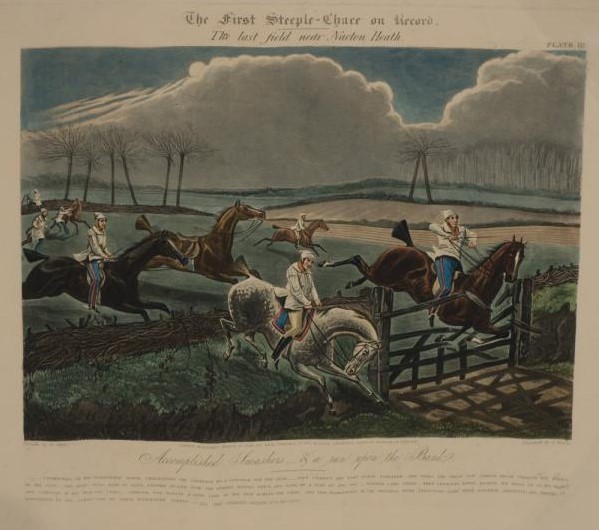
As Catherine Austen reminds us in Thoroughbred Owner & Breeder, “Hunt racing has its roots firmly lodged in the hunting field. Point-to-pointing started when two hunting men, Edmund Blake and Cornelius O’Callaghan, challenged each other to a race in 1752 for four-and-a-half miles across country from Buttevant Church to Donraile Church in County Cork. They jumped everything in their path, and by keeping the steeple of Donraile Church in sight (steeple-chasing), the two men kept to the planned route along the banks of the Awbeg River. The same line can still be taken while hunting with the Duhallow Foxhounds now.
“Amateur jump racing evolved from there....”
The first point-to-point race of the 2022 season is scheduled in Virginia for March 5 (rain date, March 12). The eighth and final hunt point-to-point of the season will be run on May 1. Foxhunting Life reports on most of these jump races as the season progresses. Some readers across North America might wonder why.
My answer is threefold: first, the very notion of a steeplechase race originated with foxhunters; second, many of our great field hunters have come from the ranks of the timber horses and conversely, many of the best steeplechase horses have their start in the hunting field; and third, most of the steeplechase jockeys are foxhunters as well.
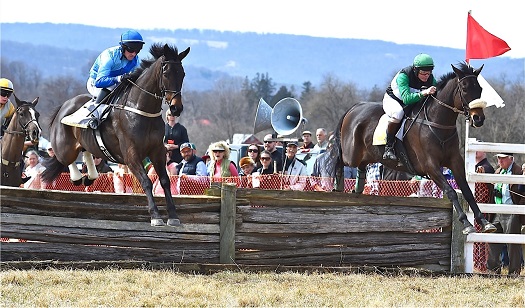
Running for the Rokeby Bowl are (l-r) winner Dakota Slew (Robert Walsh up) and Zulla Road (Woods Winants up). / Douglas Lees photo
Virginia point-to-point fans were treated to a full weekend of racing on March 22 and 23, 2014. The Piedmont Fox Hounds Point-to-Point went off as scheduled on Saturday and the Blue Ridge Hunt races, postponed from their original date, were held on Sunday. In a spirit of cooperation, races over fences were split so that Piedmont ran timber races and Blue Ridge ran just hurdle (brush) races, thus assuring a good field of entries for each specialty.
In the Open Timber Race, Zulla Road (Woods Winants up) set the pace for the first mile, but Dakota Slew ridden by Robert Walsh took control from there to the wire. Skunked ran a strong second, but Dakota Slew in prevailing notched his second consecutive Rokeby Bowl win. Dakota Slew is owned by Magalen Bryant and trained by Richard Valentine. Ms. Bryant shared last season’s Virginia Leading Owner title with Pennsylvanian Irvin Naylor. Although Winants pulled up Zulla Road in that race, the fourth on the card, he had earlier shown his 2013 Virginia Leading Rider form by winning the first two races of the day, Maiden Timber and Amateur Highweight Timber.
David Chapman photo
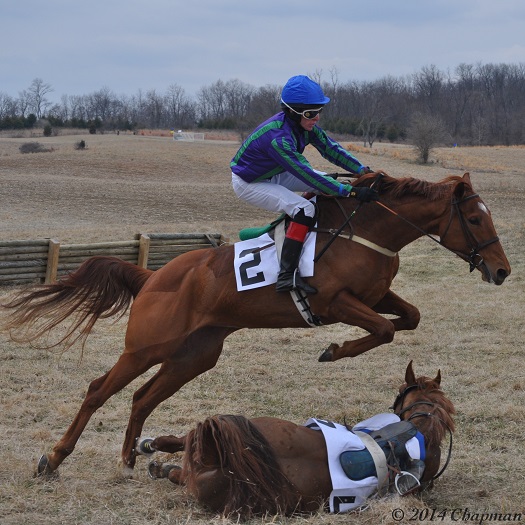
Novice rider Tom Bennett, riding for trainer Jimmy Day, fell at the same fence in the first two races at the Blue Ridge Hunt Point-to-Point on Sunday, March 23, 2014, but came back strongly to notch two wins on the day's card. This spectacular photograph was taken by David Chapman. See the entire sequence by clicking on the photo and starting the slide show. Prints of these photographs are available from the photographer. Contact FHL to be connected.
Bennett's blues started in the first race, the Maiden Hurdle, when his horse, Fall Colors (number 5) owned by Bruce Smart, fell. Bedizen (number 2) jumped Fall Colors cleanly (photo), but unseated his rider, Gerard Galligan, the two going their separate ways as well. (Click on the photo to see the entire sequence.)
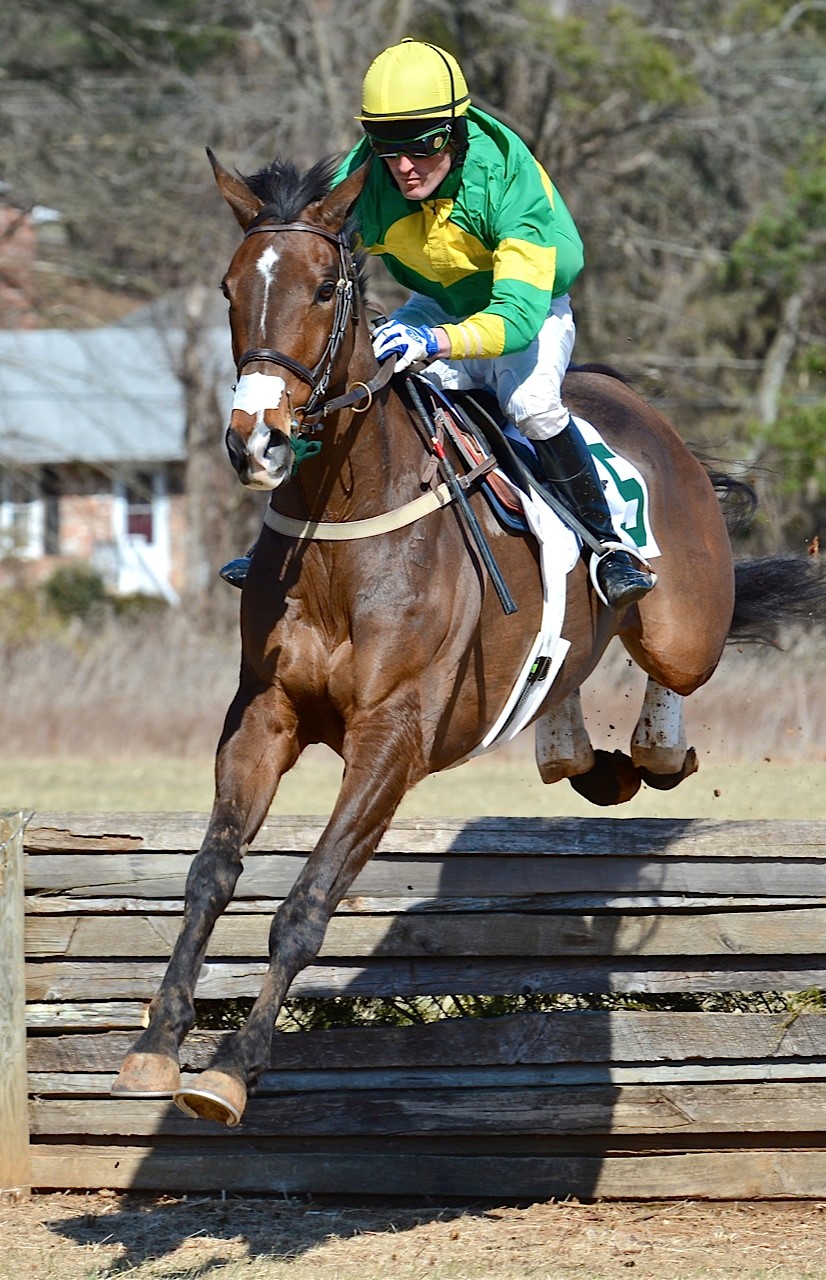
Aero, Kieran Norris up, wins Open Timber at Warrenton. / Doug Lees photoTrainer Doug Fout and jockey Kieran Norris—the latter just out of the Novice Rider ranks this season—accounted for three wins at the Warrenton Hunt Point-to-Point at Airlie Race Course, Warrenton, Virginia on Saturday, March 15, 2014. Warrenton’s was the first hunt race to go off as scheduled this wintry spring season.
Fout’s and Norris’s three winners included Aero in the Open Timber Race. Aero settled into the third position in a three-horse, closely-bunched field. With a half mile to run, Aero drew up to the leader and pulled away in the final quarter mile for the win. Aero is owned by Alfred C. Griffin, Jr.
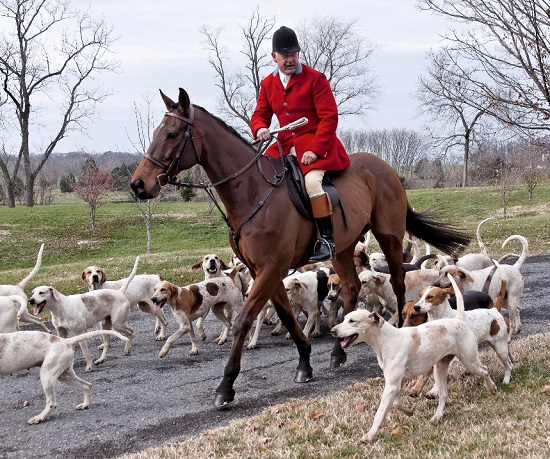
Dennis Downing is the new huntsman at the Bedford Hunt (VA). / Karen L. Myers photo
Huntsman Robert Taylor hasn’t had a good rest in five years. He’s been hunting two separate packs of foxhounds in Maryland—the Goshen Hounds as Master and amateur huntsman and the New Market-Middletown Valley Hounds as professional huntsman. Huntsman Ken George has been driving hounds and horses six hours each way twice a week from Kansas to Iowa to hunt hounds in both states. Huntsmen love what they do, but each season ends with changes in the wind.
As this hunting season draws to a close, we see huntsmen on the move again. Starting in the north and progressing southward then west, here’s what we know so far; please let us know who we’ve left out.
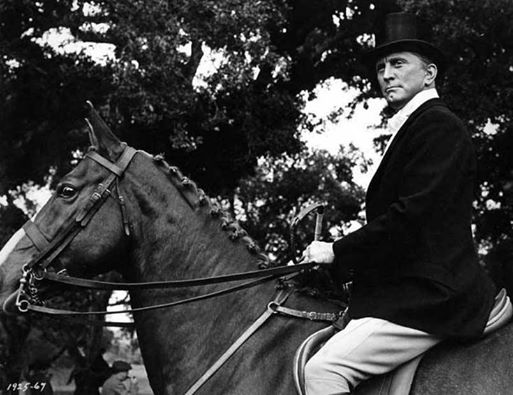
A phrase often ascribed to a proud and majestic horse,“The Look of Eagles” in this photo surely applies to both horse and rider.
This photo of Kirk Douglas in hunting attire is thought to be a publicity still for The List of Adrian Messenger. The film was directed by John Huston, father of Anjelica Huston, whose memoir of growing up at St. Clerans, the family home in Ireland, is reviewed below.
John Huston was a Joint-Master of the Galway Blazers, and he brought many screen stars to St. Clerans, including Kirk Douglas. The foxhunting scenes for The List of Adrian Messenger, in which George C. Scott also appeared, were filmed in Ireland. Scott, along with other Hollywood stars, hunted with the West Hills Hunt in California. John Huston was also a member of West Hills. Whether or not Kirk Douglas hunted with West Hills, we don’t know.
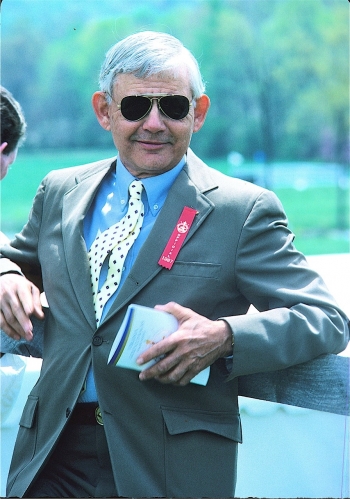
"Dr. Joe" Rogers, MFH / Douglas Lees photoDr. Joseph M. Rogers, who died March 8 at his beloved Hillbrook farm near Hamilton, Virginia, was of a rapidly disappearing breed of Virginians whose financial resources made possible the pursuit of a mission to preserve the countryside before it passed from reality to a lithographic memory.
These Virginians did not keep score with coin. The acquisition of land was not an egotist’s pursuit, and its preservation was not a beauty contest. Land was acquired and cared for because it represented an irreplaceable resource. That it provided the setting for pursuit of agricultural business and field sport was a cherished benefit, not a root rationale. To do otherwise, he believed, was to leave God’s earth to the vagaries of the marketplace.
“Dr. Joe,” as he was known by all, was at heart a man of that earth. He admired a craftsman who could build a proper four-panel fence or shoe a horse as much as he respected a man who made his fortune in business. In many cases, more so. He took pride in being able to train one species of canine to be capable of pursuing another much craftier, quicker, and agile species—a sport called foxhunting, in which the hunted had nearly insurmountable advantage over the hunter. It is a picturesque sport, photographed, illustrated, written about, and otherwise memorialized. But it was also a lot of hard work when you were in charge of bringing the show to the field.