
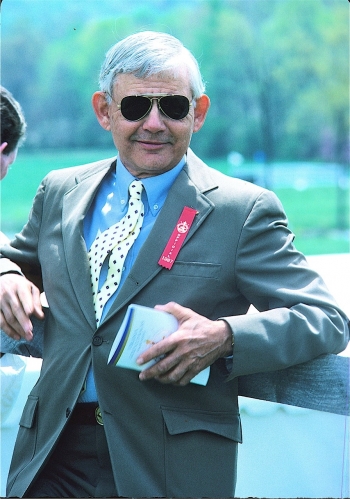
 “Dr. Joe” Rogers, MFH / Douglas Lees photoDr. Joseph M. Rogers, who died March 8 at his beloved Hillbrook farm near Hamilton, Virginia, was of a rapidly disappearing breed of Virginians whose financial resources made possible the pursuit of a mission to preserve the countryside before it passed from reality to a lithographic memory.
These Virginians did not keep score with coin. The acquisition of land was not an egotist’s pursuit, and its preservation was not a beauty contest. Land was acquired and cared for because it represented an irreplaceable resource. That it provided the setting for pursuit of agricultural business and field sport was a cherished benefit, not a root rationale. To do otherwise, he believed, was to leave God’s earth to the vagaries of the marketplace.
“Dr. Joe,” as he was known by all, was at heart a man of that earth. He admired a craftsman who could build a proper four-panel fence or shoe a horse as much as he respected a man who made his fortune in business. In many cases, more so. He took pride in being able to train one species of canine to be capable of pursuing another much craftier, quicker, and agile species—a sport called foxhunting, in which the hunted had nearly insurmountable advantage over the hunter. It is a picturesque sport, photographed, illustrated, written about, and otherwise memorialized. But it was also a lot of hard work when you were in charge of bringing the show to the field.
He owned, trained, and rode some remarkable steeplechase horses that made him—and many of them—household names among devotees of that tough and dangerous sport. But he paid a dear price for that endeavor, suffering countless broken bones, concussions, and the occasional indignation of a mistake in judgment made in front of thousands of spectators. A shy man, it was the latter that irked him the most, and the one for which he was least likely to forgive himself if it resulted in injury to his horse.
All the race day hoopla aside, he took just as much pride in being able to breed a superior Angus, or make a great crop of hay. He could lean on a fence inspecting a yearling and be as happy as any other man admiring his investment portfolio. One was a life about to unfold, and other a life already made.
It was the doing part of life that moved Dr. Joe. He taught his wife, Donna, how to ride over fences, and she went on to become a successful distaff steeplechase rider in her own right. Dr. Joe beamed with greater pride when she was holding the trophy than he did when holding his own. Their Hillbrook life evolved from a mentorship to a partnership. And, that, too, was part of Dr. Joe’s wish to pass his experience along to generations that could carry on, whether it was the United States Pony Club, the United States Combined Training Association, the Morven Park Equestrian Institute or other organizations in which he invested time, energy and money. In fact, “carry on” was one of his favorite phrases in parting company with myriad friends, who came from all walks of life and who each had their own place in his heart.
While Dr. Joe relished the country life Hillbrook afforded him, he also became increasingly alarmed that the Loudoun countryside his generation so thoroughly enjoyed—and generations before had taken for granted—was in grave danger of simply disappearing under the pressure of marginal farming profits and checkbooks of those who had in mind an altogether new crop to be grown on that rich soil—houses. Many large property owners whose names were synonymous with Loudoun’s agricultural history simply could not withstand the pressure, and in the 1970s, “starter castles” began popping up along Loudoun ridgelines.
That re-set Dr. Joe’s compass. He began to explore alternative ways of preserving the countryside, including conservation easements that had a certain attraction to those wealthy enough to be able to take advantage of them. But for middle class working farmers, that wasn’t an option, and Dr. Joe began joining—and even forming—various organizations involved in coming up with economically-based incentives for rural land preservation. That mission, borne of his entire life experience, became the focal point of his energy.
An early morning riser, he’d ring up still-sleepy friends with new strategies that had come to him in the dawn. He was an advocate of incentive-based land preservation on the theory that regulation-based preservation was bound to ultimately fold under the pressure of political winds driven by a rapidly changing demography in the county. Cows, he reasoned, did not require schools. For every discouraging setback experienced in this quest, he found nuggets of success that propelled an eternal optimist to press on. He summoned the strength in this endeavor from the very soil of Hillbrook.
The beating and banging he had taken as a horseman over the years began to catch up with Dr. Joe in his last years. But he still had that impish smile, and he still had Hillbrook to make those years a comfort. He had, many years ago, put to paper words that would later summarize his own passing. It was the last verse of a poem he had written about the experience of having had to put down one of his favorite horses on the farm that was the cornerstone of his life:
So when I am old
Old and feeble
I will come back
To this stone
In this sunny winter pasture.
‘Twould be blessed to meet my end
With quick and quiet mercy
And a loving, grieving friend.
Goodbye, my friend. And “Carry On.”
Posted march 10, 2014
[Dr. Rogers was a lifelong friend and mentor to the author of this article.]