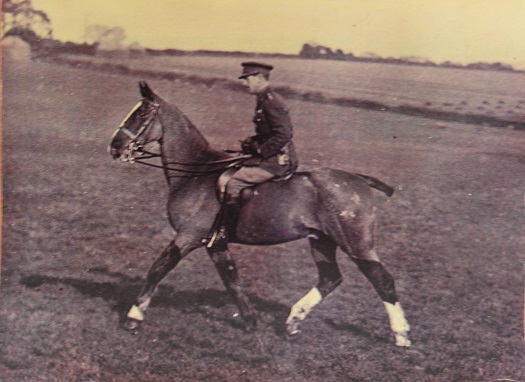
Fascinated by our summer series of articles about the WWI war horses on the occasion of the centennial of that horrific conflict, Noel Mullins, a regular contributor to Foxhunting Life, sent us this story that he wrote for this year’s Souvenir Programme of the Dublin Horse Show. Noel is a Member of the Royal Dublin Society Library & Archives Committee. His story is about Gladeye, a field hunter that went to war, survived, and returned to jump at the Dublin Horse Show in 1926.
War Horse Gladeye and Brigadier Walter Brooke
This year marks the centenary of World War I, and ceremonies around the world remember the nine million human casualties lost in the conflict. But it is often forgotten that eight million War Horses also lost their lives, going through the most terrifying experiences known to any living creature. War was declared on the July 28, 1914 and was expected to end by Christmas 1914, but sadly it lasted another four years until November 11, 1918.
Probably the two most well known Irish War Horses in history were Emperor Napoleon’s white horse Marengo and the Duke of Wellington’s Copenhagen who met at the Battle of Waterloo. Both are said to have been purchased at an Irish horse fair. War Horses in the mounted cavalry units were deployed in many battles in the first years of WWI, amongst them, the battles of Mons, First and Second Battles of Ypres, Festubert, Aubers Ridge, Marne, Vimy Ridge, the Somme Hill, and Cambrai.
 The Port of Baltimore earned a place in American history two hundred years ago this month during the War of 1812. The British, after burning and sacking Washington, D.C. in August of 1814, turned their attention to Baltimore with an assault by naval and ground troops in September. Francis Scott Key, a witness to the naval bombardment of Fort McHenry, jotted down the words to what became our national anthem, “The Star Spangled Banner.”
The Port of Baltimore earned its place in American foxhunting history that very same month—September, 1814. After the British fleet withdrew to make its final assault of the War of 1812 on New Orleans, a merchant ship entered the Port of Baltimore and disembarked two foxhounds from Ireland, Mountain and Muse.
Unusual for their appearance, speed, aggression, hunting style, and pre-potency, Mountain and Muse turned out to be progenitors of our principal American foxhound strains: July, Birdsong, Trigg, Bywaters, and Walker. The Midland Crossbred, developed by Ben Hardaway, MFH, found today in kennels all over North America as well as England, and having its roots in the July strain, also goes back to Mountain and Muse.
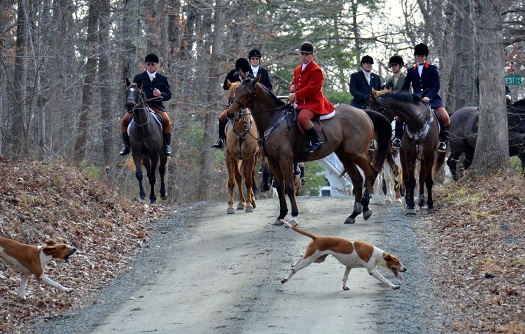
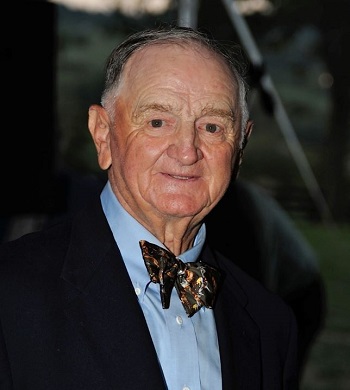
Melvin Poe at his ninetieth birthday celebration / Douglas Lees photoThe world of American foxhunting lost one of its best-loved and most highly respected personalities with the passing of huntsman Melvin Poe, age ninety-four, on Saturday September 13, 2014. That’s the sad news. The good news is that Melvin was able to ride his horse and hunt his hounds to the very last year of his life.
In foxhunting circles he was referred to simply as Melvin. Everyone knew who you were talking about. He’s been a fixture in North American foxhunting for more than sixty years and a celebrated legend for most of that time. He’s immortalized in a dramatic oil painting by Wally Nall; he made the cover of UK’s Horse and Hound in 1991; he starred in Tom Davenport’s 1979 foxhunting video documentary, Thoughts on Foxhunting, narrated by Alexander Mackay-Smith; he was the subject for Peter Winant’s wonderful book, Foxhunting with Melvin Poe, The Derrydale Press, 2002; and in 2011 Melvin was inducted, along with his brother Albert, into the Huntsmen's Room at the Museum of Hounds and Hunting in Leesburg, Virginia.
Melvin grew up in the Virginia countryside. He was the boy to whom his friends turned to identify trees, birds, and animal tracks. His father, uncles, and brothers were all enthusiastic hound breeders and hunters. Melvin and his contemporaries represent a vanishing breed of countryman who knew the woodlands intimately and all that grew and thrived therein. And baseball! Melvin and his brothers loved baseball and participated in organized league play into their adult years.
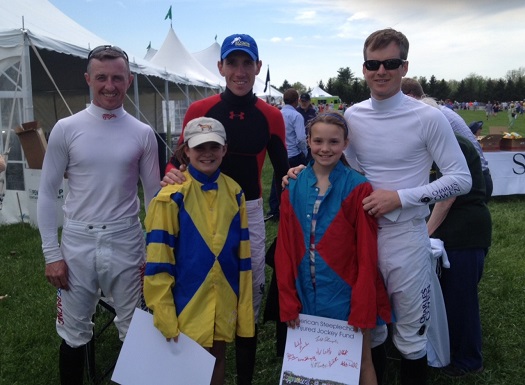
(l-r) Jockeys Robbie Walsh, Willie McCarthy, and Jeff Murphy greet a couple of young racegoers in support of the Injured Jockeys Fund. / Kathy Rubin photo
At the Calcutta party the night before the Blue Ridge Fall Races this year, racegoers will bid on the jockeys instead of the horses. A number of jockeys—among them Robbie Walsh, Willie McCarthy, Jeff Murphy, Kieran Norris, and Zoe Valvo—will attend the affair to mingle with the crowd and help promote their very own cause, the American Steeplechase Injured Jockeys Fund.
The Calcutta will take place on Friday night, September 19, 2014, and the races will go off on Saturday, September 20. The Blue Ridge Fall Races traditionally support local charities, but this year a portion of the race revenues will be donated to the Injured Jockeys Fund, a relatively recent endeavor that is gaining momentum under enthusiastic leadership.
For every jump jockey who rides races it’s not a question of if; it’s a question of how often he or she will fall and whether or not there will be injuries. With thousand pound Thoroughbred racehorses all galloping to the same fences at thirty-five miles an hour, falls and injuries are part and parcel of the game. And some injuries turn out to be life-changers for the jockey.
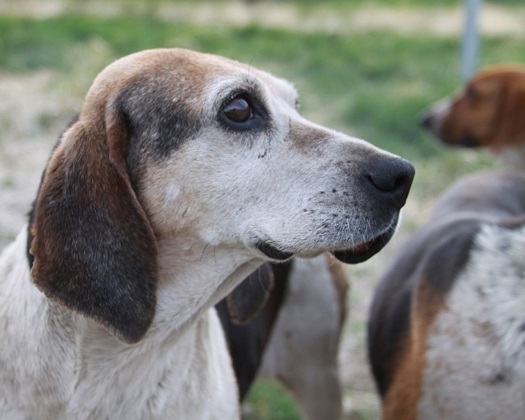
What to do with the old hounds? / Nancy Stevens-Brown photo
Most hunts are beset by similar problems: what to do with old hounds, how to attract more members, how to pay the bills, how to train staff, how to train young hounds. Lynn Lloyd, MFH and huntsman of the Red Rock Hounds (NV), found that the solution to one problem provided the key to solving several others.
What to Do with Old Hounds
The average hunting life of a hound is perhaps six or seven years. That means it is retired from the pack at age seven or eight. Beyond that age, most hounds start falling behind the pack, lacking the foot and endurance to maintain the pace over a full hunting day.
But with several years of life still remaining for the retired hounds, most hunts are hard-put to expend their limited financial resources to keep and maintain them. And here’s where Lynn Lloyd found a way to turn a burden into an asset.

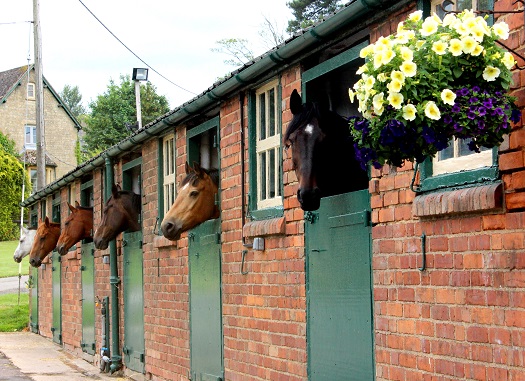
The anniversary of the start of the First World War will be upon us July 28th. Four years ago, in England, on the hundredth anniversary of that terrible conflict, James Barcaly, ex-MFH, tossed and turned through the early morning hours. Thoughts of the war, the carnage that took its toll on James's family members, eighteen million people, eight million horses, and what those years meant to a way of life that was so much a part of the Barclay family ran through his head. He got out of bed, sat down, and wrote this poem. At 6:30 am he finished writing. Twenty minutes later the South Wold Foxhounds came up his drive on summer exercise, making his world right once again.
The stable yard is silent, no equine friends, no ears twitching over the doors.
Where have they gone? They have gone to Europe to fight a war.
Will they be back to graze the summer pastures green?
Will they be back to see the autumn mist and hear hounds running?
Will they be back to enjoy the fifty minutes across the grass?
They and their Masters have gone to defend our freedoms.
In mud and wire they toil, no end in sight,
But the thought of hounds running and their cry deep in their veins,
Make our horse and human friends dream, dream of
A cold winter’s night, hacking homewards with the moon up high.
The hundredth anniversary this summer of the First World War has reminded all of us of that terrible conflict. In England, James Barclay, ex-MFH, tossed and turned through the early morning hours one night this month. Thoughts of the war, the carnage that took its toll on his family members and many horses, and what those years meant to a way of life that was so much a part of the Barclay family ran through his head. He got out of bed, sat down, and wrote this poem. At 6:30 am he finished writing. Twenty minutes later the South Wold Foxhounds came up his drive on summer exercise, making his world right once again.
The stable yard is silent, no equine friends, no ears twitching over the doors.
Where have they gone? They have gone to Europe to fight a war.
Will they be back to graze the summer pastures green?
Will they be back to see the autumn mist and hear hounds running?
Will they be back to enjoy the fifty minutes across the grass?
They and their Masters have gone to defend our freedoms.
In mud and wire they toil, no end in sight,
But the thought of hounds running and their cry deep in their veins,
Make our horse and human friends dream, dream of
A cold winter’s night, hacking homewards with the moon up high.