
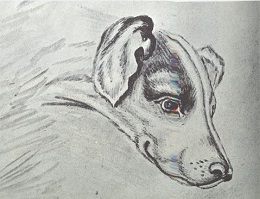
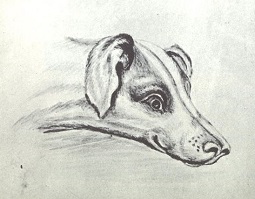
 The Port of Baltimore earned a place in American history two hundred years ago this month during the War of 1812. The British, after burning and sacking Washington, D.C. in August of 1814, turned their attention to Baltimore with an assault by naval and ground troops in September. Francis Scott Key, a witness to the naval bombardment of Fort McHenry, jotted down the words to what became our national anthem, “The Star Spangled Banner.”
The Port of Baltimore earned its place in American foxhunting history that very same month—September, 1814. After the British fleet withdrew to make its final assault of the War of 1812 on New Orleans, a merchant ship entered the Port of Baltimore and disembarked two foxhounds from Ireland, Mountain and Muse.
Unusual for their appearance, speed, aggression, hunting style, and pre-potency, Mountain and Muse turned out to be progenitors of our principal American foxhound strains: July, Birdsong, Trigg, Bywaters, and Walker. The Midland Crossbred, developed by Ben Hardaway, MFH, found today in kennels all over North America as well as England, and having its roots in the July strain, also goes back to Mountain and Muse.
The Odyssey of Mountain and Muse
In 1814, the Duke of Leeds, who had married a daughter of Charles Carroll of Baltimore, gave the two Irish foxhounds, Mountain and Muse, to a visiting guest, Bolton Jackson. After Mr. Jackson returned to Maryland, he presented the Irish hounds to Colonel Sterrett Ridgely of Oakland Manor. Of Mountain and Muse, one admirer said:
“They were remarkable as are their descendants, according to the degree of the original blood, for great speed and perseverance, extreme ardour, and for casting ahead at a loss; and in this, and their shrill chopping unmusical notes, they were distinguished from the old stock of that day; which when they came to a loss, would go back, and dwelling, take it along, inch by inch, until they got fairly off again, whilst these Irish hounds would cast widely, and by making their hit ahead, would keep their game at the top of his speed, and break him down in the first half hour.” (American Turf Register, February, 1832, p. 287)
Although Mountain and Muse were prized for their ability to cope with the fleet, straight-running red fox which had been increasing in number since their importation and release in Maryland in 1730, Colonel Ridgely found them to be a handful to manage, and they came into the hands of Benjamin Ogle, Jr. (grandson of Samuel Ogle, Proprietary Governor of Maryland during Colonial days).
“Mr. Ogle told me [Mountain] was as famous for running dogs as foxes, and frequently he had so annoyed Mr. C.S.R. he (C.S.R.) at last directed his neck to be put under the fence–the common mode of executing a condemned dog. Mr. Ogle, seeing he was determined to kill him, asked not only for his life, but for the dog; and, in that way, preserved a most valuable breed.” (American Turf Register, January, 1933, p. 234)
Benjamin Ogle, Jr. bred a pack of foxhounds from Mountain and Muse, including the famous Sophy whose portrait he hung in his library at Belair, the Ogle family Maryland estate. From Belair, Mountain and Muse went to Charles Carroll, Jr.
“[Mountain] was a very compact dog, of middling size, and what in cattle, in England, is called flecked, not spotted, with large dull blue greyish splotches–such at least was his appearance when I saw him at Homewood, the residence of C. Carroll, Jr. to whom he had been presented by Mr. Ogle.” (American Turf Register, February, 1832, p. 288)
The pair was finally separated when Mountain came into the possession of Dr. James Buchanan who lived near Sharpsburg, Maryland. But Mountain and Muse had already produced foundation progenitors of the premier American hound types to come, the blood of which is still highly prized and carefully nurtured by today’s preeminent foxhound breeders of both mounted packs and field trial foxhounds.
From Dr. Buchanan, Dr. Thomas J. Henry of Virginia (Patrick Henry’s grandson) obtained Captain, said to be the greatest stallion hound of his day. Captain, by Traveler out of Benjamin Ogle, Jr.’s Sophy, was highly inbred according to both van Urk and Hayden Trigg; both his sire and dam were by Mountain out of Muse. (The Story of American Foxhunting, Volume I, J. Blan van Urk, Derrydale Press, 1940, 1941, p. 134 and The American Foxhound, Hayden C. Trigg, 1890, fold-out pedigree between pp. 80 and 81)
“It is said about [Captain] that he had no equal when it came to speed and endurance. When ordered south for his health, Dr. Henry took his pack from Virginia to Florida. [Threatened by alligators in the bayous and lagoons, t]hey were taken to Georgia; and Mr. G.L.F. Birdsong of Thomaston, Georgia, who had come into the Doctor’s life, became the proud owner of the, by then, famous Henry pack.
“The results of this acquaintanceship and acquisition are the Birdsong or July hounds of Georgia (July having been the name of a hound [tracing back to Captain] belonging to Nimrod Gosnell, a Maryland farmer). The well-known Trigg hounds of Kentucky are also descended from the Henry, Irish hounds.” (The Story of American Foxhunting, Volume I, J. Blan van Urk, Derrydale Press, 1940, 1941, p. 134)
Nimrod Gosnell’s farm, where July was bred, actually comprised a portion of the original “Manor Land” granted to Charles Carroll. George Linthicum lived nearby as did John Hardy. Those three men founded the Howard County Hounds and created its first pack from their own Maryland (or Irish) foxhounds.
Charles Carroll is said to have extolled the glories of the chase one evening to several gentlemen, one of whom was General Lighthorse Harry Lee (father of Robert E. Lee), onetime governor of Virginia. General Lee “apparently agreed with everything that was said; but being in a rather negative mood, he innocently contributed the opinion that the sport could be most irritating ‘if your nag is slow and your hounds are poor.’ Quick as a flash Mr. Carroll turned on him and said, ‘I refer, sir, to hunting in Maryland.'” (The Story of American Foxhunting, Volume I, J. Blan van Urk, Derrydale Press, 1940, 1941, p. 39)
The Howard County-Iron Bridge pack today is a mix of American, Penn-Marydel and mostly Crossbred foxhounds. The American blood in the pack has been carefully preserved from what Dr. Roger Scullin, MFH calls the Maryland or Eastern Shore hound, and what his predecessor, past-MFH Oliver Goldsmith, called the Irish hound. The Penn-Marydel was created by crossing that Maryland or Irish blood with the Pennsylvania and Delaware hounds.
Because of the meticulous attention to the preservation of the old blood by Dr. Scullin and his predecessors, a significant portion of the Howard County-Iron Bridge pack still traces directly back in unbroken strains to Mountain and Muse and to other Irish imports. The stamp of those prepotent Irish hounds, Mountain and Muse, after two centuries and countless generations, are still conspicuous in some Howard County-Iron Bridge litters in both appearance and hunting style.
George Garrett, foxhunter and author from Midland, Georgia, recognized the considerable influence of Marylanders on his beloved sport. In Fifty Years With Fox and Hounds (1932), Garrett wrote, “We must graciously concede to Maryland the glamorous distinction of being the royal nursery where the most eminent family of fox hounds in America was cradled and rocked.”
Posted September 20, 2014
The above sketches of the imported Irish foxhounds, Mountain and Muse, were done by Benjamin Ogle, Jr. The sketches became the property of the Tayloe family of Tappahannock County, Virginia through the marriage of Ogle’s sister, Anne, to a member of that family. Mrs. Henry Gwynne Tayloe graciously loaned and later donated the sketches to the Museum of Hounds and Hunting N.A. in Leesburg, Virginia.