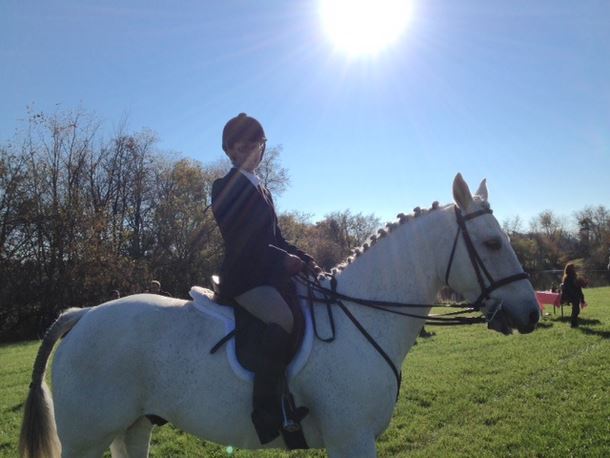
One of the quiet moments in Carla Lake's first Opening Meet
My first Opening Meet has been about a year in the making, and I can hardly believe I’m here. By here, I mean standing on top of a log, cursing my horse, who, instead of standing quietly for me to remount, has decided to leap over the log while I try to stay calm and not burst into tears.
It’s been a trying weekend so far.
My borrowed horse, Seven Up, is completely sick of me after I spent a total of six hours Friday night and Saturday morning grooming the living bejezus out of him. Up to this point, I never had to braid for any kind of equestrian event, so on Friday night I arrive at the barn around 6:30, brush and bathe him, and separate his mane into little sections.
Newly appointed Old Chatham MFH Jef Murdock tells how it feels to hunt hounds for the very first time. / Nancy Kleck photoOn a recent Saturday the Old Chatham Hunt (NY) had a rare hunting day. Hounds ran their first coyote hard for an hour before huntsman and staff had to stop them from going into country where it was difficult to follow. Hounds then found another coyote and ran it through their wooded country in fine voice for another forty-five minutes to finish an excellent day of hunting. What’s remarkable about that? one might ask. Nothing, except that the huntsman had never hunted a pack of hounds before in his life until that day.
At the end of last season, Old Chatham members made some difficult and controversial organizational changes in an effort to improve their sport. A new huntsman—Tommy Hopkins—was named, and a new Master—Jef Murdock—was appointed. Hopkins had been whipping-in for years and was familiar with the hounds, but Murdock, though he’d been following hounds as a field member for years, was better known for his skiing acumen—he owns the popular Butternut ski area in the Berkshire Mountains of Massachusetts—than for his prowess with foxhounds.
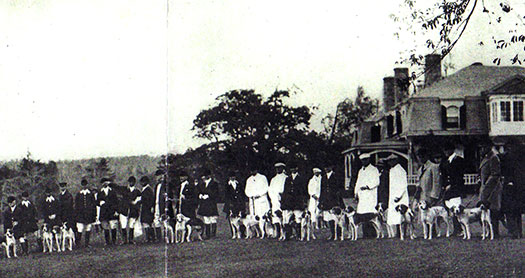
Masters, staff, and hounds at the 1926 New England Hound Trails in front of the Bowditch mansion. John Bowditch was MFH of the Millwood Hunt in Framingham, MA.
Yes, we've got the spelling right. Trails, not Trials. It's a race to prove which hunt can field the fastest and most accurate hounds following a drag scent, and it's been a fixture of the New England foxhunting scene since 1923.
Each hunt may enter up to 2 couple of hounds. Competing hounds may be cheered on and handled by their staff at the starting line, but at no other point in the race. Patrol judges are stationed at strategic places to penalize hounds that skirt or cheat (i.e., take shortcuts off the true line to get closer to the front runner).
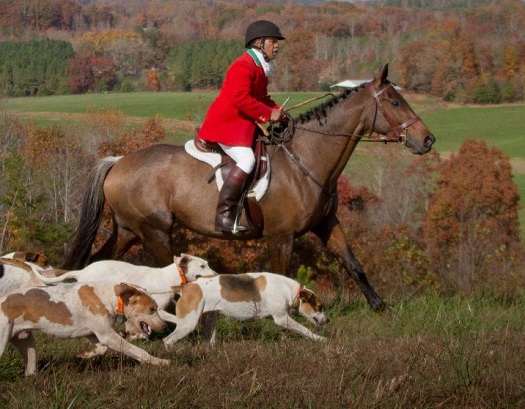
Huntsman Tot Goodwin and the Green Creek Hounds / Erik Olsen photo
It’s always fun to hear a day’s hunting described by different members of the hunt. Years ago I would ask Mrs. A how the day had been, and she would assure me, “They ran and screamed all day.” When Mr. B was queried, he said, “They had a bit of a flurry.” When Mr. C was asked the same question, “They didn’t do a thing.” This past Thursday, however, everyone at Green Creek Hounds (Carolinas) agreed it was a barnburner!
Hounds met at Coxe Road where a few of the young entry thought the deer they saw were worth a go. Puppies were reprimanded, and they hacked obediently through the woods to East Green Creek Road. It was a cool, misty morning with great scenting conditions. This is known as coyote country. Tot sent the pack into covert and allowed them to trail for ten or fifteen minutes, and then they opened. All hounds were on (thirty couple), and the cry was ear-splitting.
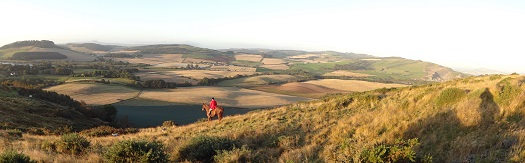
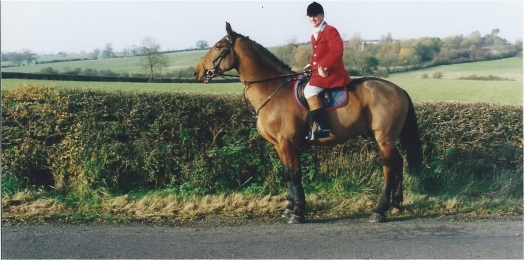
This hunt report—a short but informative excerpt from Chapter 3 of Barclay Rive’s new book, See You at Second Horses—harks back fifteen years to when Barclay accompanied Rosie and Grosvenor Merle-Smith to England. The book recounts their hunting adventures during that trip and is available from Horse Country Saddlery, Warrenton, Virginia.
At the time, Grosvenor was Master and huntsman of the Bull Run Hunt (VA), and Barclay whipped-in to him. Barclay also whipped-in to the Keswick Hunt (VA)—sometimes to both hunts on the same day when Keswick met in the morning and Bull Run in the afternoon!
The author on Bruno at the Fernie meet at Billesdon / Rosie Merle-Smith photo
Julie and Colin brought our horses down the ramp out of the box. We had our first experience of what became a familiar routine: stepping up the ramp and using it as a mounting block for the horse led up beside it. I usually had to shorten my stirrups. Colin had to hold on to the horse’s head until I was done, because they were ready to go as soon as they felt weight in the saddle. Julie gave me instructions as I mounted a big bay.
“This is Bruno. He prefers a longer rein to a shorter one. He hunts with the Fernie every Saturday, so he knows his job.” This was her diplomatic way of telling me to stay off of the horse’s mouth and let him take care of me. I thought Bruno looked like he should be pulling a cart, but I was ignorant. He was a brilliant field hunter. An excellent teacher, Bruno was what American horse dealers call a packer, meaning he could pack me around as if I were a sack of grain. He was calm at checks, but ready to run and jump when the need arose. Sporting author Michael Clayton in Endangered Species reports that English foxhunters say the ideal hunting horse should have “the head of a duchess and the arse of a cook.” Bruno had plenty of muscle behind, and while his head was hardly elegant, he possessed beautiful brains.
Grosvenor, Rosie and I headed down the road where hounds had gone. Julie called to us, “See you at Second Horses.”
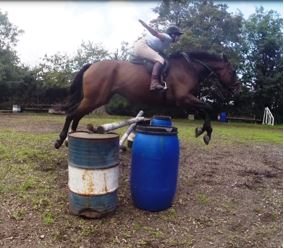
My top moment of any Blackthorn & Brook holiday comes as our guests pull up after a run having encountered their first hedge. They make a fuss of their horse, turn to me and grin.
“I see what you mean about sitting up!” is a recurring comment.
Hedge-hopping is a much discussed feature of our holidays. The subject is met with excitement, trepidation, anticipation, fear, bravado, and everything in between, as it really is an unknown quantity for the majority of our American guests.
With this in mind, we have put together a short video and accompanying blog below, explaining a little of how we prepare ourselves and our horses for popping the hedges in style. What follows is a collection of basic principles that work for us. If anyone has questions or comments—challenges, improvements, ideas—we'd love to hear from you.
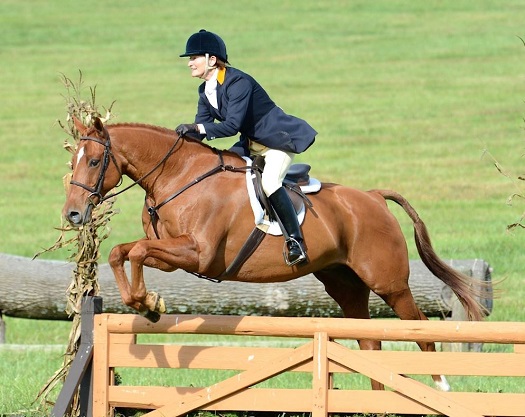
Laurie Ambrose and Stretch from the Piedmont Fox Hounds won the 2014 Mrs. Theodora A. Randolph Field Hunter Championship. / Douglas lees photo
In a hark back to bygone days, the Theodora A. Randolph Field Hunter Championships combine a whirlwind week of foxhunting and socializing against a backdrop of sporting estates, well-bred foxhounds, and passionate foxhunters. Always held the last week of September and ending the first weekend of October, this year's event attracted seventy-four entries with a brilliant card of hosting hunts: Orange County Hounds, Blue Ridge Hunt, Loudoun Fairfax Hunt and the Piedmont Foxhounds. Judges ride alongside the field to observe the competitors in action before selecting several riders each day, based on how well their horses performed, for the finals on Saturday. Every hunt hosted a tailgate, and there were social functions every evening.
Foxhunters from twenty-two hunts and eight states rode in the event: Andrews Bridge, Belle Meade, Blue Ridge, Bull Run, Casanova, Deep Run, Elkridge-Harford , Farmington, Glenmore, Hillsboro, Keswick, Loudoun Fairfax, Lowcountry, Middleburg, Newmarket-Middletown Valley, Old Dominion, Orange County, Palm Beach, Piedmont, Snickersville, Warrenton, and Whiskey Road. Riders came from Florida, Georgia, Maryland, Pennsylvania, South Carolina, Tennessee, and Virginia. The six judges were Helen Brettell, Middleburg; Snowden Clark; Liz McKnight, ex-MFH, Elkridge-Harford; Ginny Perrin, MFH, Deep Run, and the husband-and-wife team of Lincoln Sadler and Cameron Sadler, MFH, Moore County.
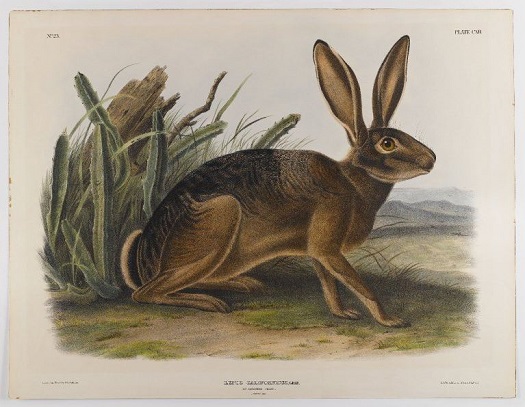
California hare by John J. Audubon
The early part of the last century saw the people of Riverside, California looking towards Great Britain for inspiration for their leisure activities.
This was chiefly because of the many British immigrants who had begun arriving here about 1889, primarily to invest in, among other things, the fast-growing orange industry. English customs were held in the highest esteem, especially among socially ambitious Americans, Tom Patterson wrote in his book, A Colony for California.
Riversiders engaged in such British activities as polo, high tea, and foxhunting. The latter did not usually include a fox, because foxes were not common in the area. Instead they substituted a more common animal, the jackrabbit. These hunts were conducted wherever a large area of open land could accommodate horses, hunters, hounds, and the prey.